Liberty Global (LBTYK) — customer relationships that underpin recurring revenue and strategic services
Liberty Global operates a pan‑European connectivity platform that monetizes primarily through recurring subscription fees for residential and B2B communications services, supplemented by hardware (CPE), technology services sold to affiliates and third parties, and periodic large commercial agreements such as power purchase agreements and platform services. Investors should evaluate LBTYK on the stability of its subscription base, the contractual tenor and criticality of services delivered to joint‑venture partners, and the company’s ability to convert technology and platform offerings into third‑party revenue. For a deeper look at customer-level signals and linkage to enterprise spend, visit https://nullexposure.com/.
How LBTYK sells: a concise operating model for allocators
Liberty Global acts both as a seller of consumer and enterprise communications services and as a service provider to affiliated operators and joint ventures. The company’s revenue mix reflects:
- Monthly subscription economics for broadband, video, fixed-line and mobile services to individuals and business customers.
- Hardware and essential software charges for CPE and managed platforms originating from a centrally managed Technology & Innovation function.
- Intercompany and third‑party technology services, where Liberty Services and related agreements generate built revenue and are being positioned for external growth.
Company-level constraints signal a hybrid contracting posture: subscription‑based billing is the norm, counterparty base spans individuals to large enterprises, agreements are concentrated in EMEA (notably Belgium, Ireland and Slovakia), and there is evidence of material multi‑year service revenue (see the revenue call‑out below).
What the filings and press reveal about customer exposures
Liberty Global’s disclosures and press coverage together paint a clear picture of customer relationships and contractual structure:
- Longer‑dated service agreements exist: Liberty references service terms that run up to five years with an option to renew for two years, indicating multi‑year technology and platform commitments across some affiliate and JV arrangements (company disclosure, 2024 Form 10‑K).
- Subscription economics govern consumer and B2B billing: the company states subscribers pay monthly fees by tier, and B2B subscription revenue includes SOHO through large enterprise services (company disclosure, FY2024).
- Geographic concentration is EMEA: reported segment revenue underscores a material footprint in Belgium, Ireland and Slovakia (company disclosure, FY2024).
- Services revenue with scale is visible: Liberty recorded $24.4 million of revenue in 2024 associated with specified services agreements, which is consistent with the company’s strategy of monetizing platform and managed services (company disclosure, 2024).
These are company-level signals; where an excerpt names a specific partner, that linkage is presented below.
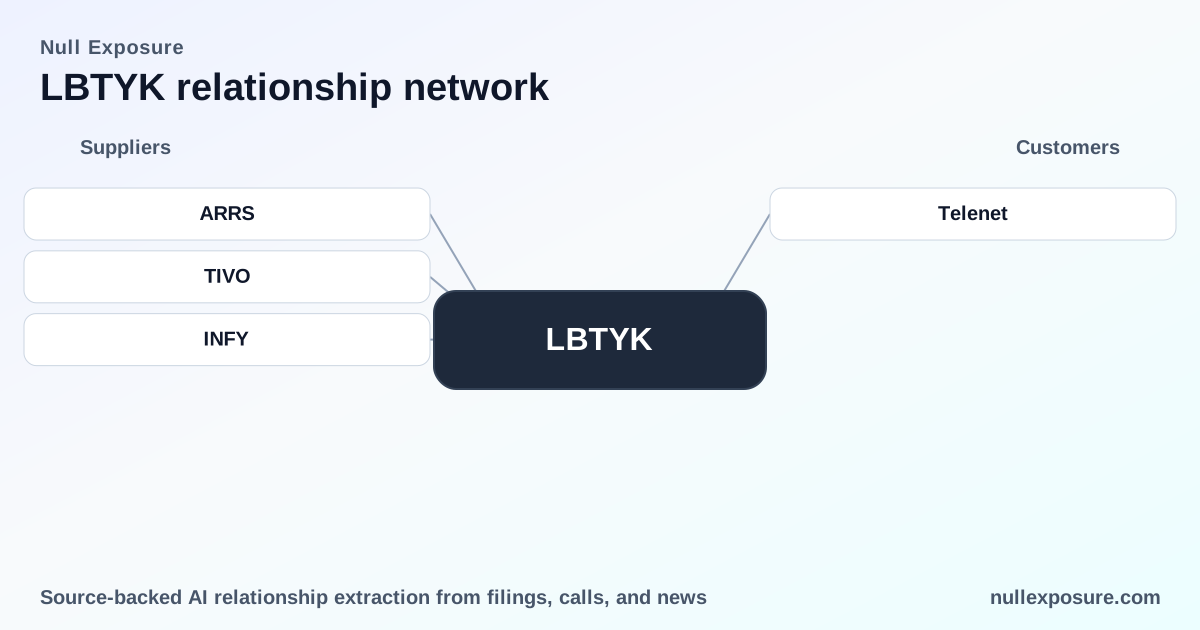
Telenet — a source of subscriber volume and localized market share
Telenet contributes to Liberty Global’s mobile subscriber base: as of December 31, 2024 Telenet accounted for approximately 195,100 prepaid mobile subscribers within Liberty Global’s mobile totals. This confirms Telenet is a material retail channel for Liberty’s mobile footprint in Belgium and supports recurring subscription revenue there. (Source: Liberty Global FY2024 Form 10‑K).
Virgin Media O2 — a strategic JV and a commercial decarbonization customer
Virgin Media O2 (the VMO2 JV) is both a JV partner and a commercial customer in recent announcements: a May 2026 news report notes Virgin Media O2 signed a 10‑year solar PPA with Liberty Global’s egg Power, demonstrating Liberty’s capability to package sustainability and infrastructure services alongside connectivity offerings. The company’s FY2024 disclosures also treat VMO2 JV subscriptions differently under regulatory rule changes, indicating that VMO2 JV subscription contracts are governed by pre‑existing Ofcom regulations and thus are unlikely to fall under proposed DMCCA subscription rules (news and FY2024 Form 10‑K / press, May 2026 and FY2024). (Source: Capital.com report, May 3, 2026; Liberty Global FY2024 filing).
What the constraint signals say about business economics and risk
Translate the constraint excerpts into investor‑relevant characteristics:
- Contracting posture: a mix of subscription billing and multi‑year service agreements. The 5‑year service terms with renewal options and the 10‑year PPA show Liberty balances short recurring cycles with locked‑in service contracts that produce predictable cash flows for specific platform services.
- Counterparty breadth and criticality: Liberty sells to individual residential customers and to business customers across SOHO to large enterprises, and it acts as a provider of mission‑critical connectivity and platform services to affiliated JVs; that mix reduces churn sensitivity of any single cohort but creates reliance on a few regional markets.
- Geographic concentration and market power: operations are EMEA‑centric, with Belgium a notable revenue driver; this concentration makes regulatory and macro exposures in Europe meaningful to revenue and margin trajectories.
- Segment mix and margin implications: revenue derives from services (recurring), hardware (CPE) and software/platforms, implying blended margins and cross‑sell opportunities—platform services can be higher margin if scaled externally.
- Spend scale: the recorded $24.4 million in 2024 tied to specific services agreements indicates Liberty is already monetizing platform services at a non‑trivial mid‑single‑digit millions scale, consistent with a spend band in the $10M–$100M range for aggregated service agreements in FY2024.
Investment implications — where the customer base creates risk and optionality
- Upside: highly recurring subscription revenue and escalator‑protected platform contracts support stable cash generation; the company’s EV/EBITDA of 8.8 and ongoing affiliate service monetization offer multiple paths to margin expansion.
- Risk: regulatory nuance (Ofcom vs proposed DMCCA rules), EMEA concentration, and JV complexities can create earnings volatility; hardware exposure compresses gross margins relative to pure software/service models.
- Operational footprint: Liberty’s role as both service provider and seller to end customers increases cross‑sell potential but requires continued investment in T&I platforms to maintain competitiveness.
Bottom line and recommended read
Liberty Global’s customer relationships are anchored in recurring subscriptions and increasingly in multi‑year platform/service agreements with affiliates and JVs. Telenet contributes discrete subscriber volume in Belgium, while Virgin Media O2 exemplifies Liberty’s ability to sell multi‑year, cross‑functional commercial agreements such as a 10‑year solar PPA. For investors, the relevant levers are subscription stability, the pace of third‑party service monetization, and regulatory developments in core EMEA markets.
If you evaluate telecom customer portfolios or are sizing counterparty exposure in European connectivity, explore more granular customer intelligence at https://nullexposure.com/.