Liberty Global (LBYAV) — customer relationships that reshape a European playbook
Liberty Global monetizes a portfolio of broadband, video and mobile assets through network ownership, wholesale/data center partnerships and selective asset sales, capturing recurring subscriber revenue while extracting incremental value from network capacity and partnerships. Recent moves show the company leaning into asset optimization and strategic cloud relationships to convert infrastructure into cash and platform upside. For deeper signals on counterparty exposures and evolving customer links, visit https://nullexposure.com/.
Slovakia divestiture: trimming the portfolio to sharpen returns
Liberty Global agreed to sell UPC Slovakia for €95 million, a transaction that reduces operating footprint in Central Europe and converts a regional asset into liquidity. According to TradingView reporting on March 10, 2026, the buyer is O2 Slovakia and the announced sale price was €95 million. (TradingView, March 2026)
O2 Slovakia is the direct acquirer of UPC Slovakia, taking on Liberty’s local subscriber base and infrastructure in the country; the deal is part of O2’s expansion under its parent group’s telecom consolidation strategy. A DevelopingTelecoms report noted the buyer is a local unit of e& PPF Telecom Group and placed the consideration at approximately EUR95m. (DevelopingTelecoms, March 2026)
e& PPF Telecom Group is the strategic owner behind O2 Slovakia’s bid and is diversifying its European holdings through the purchase; industry press framed the transaction as portfolio reshaping rather than a core-market exit for Liberty Global. DevelopingTelecoms covered the affiliation and transaction context in March 2026. (DevelopingTelecoms, March 2026)
A broadly syndicated market note summarized the sale as part of Liberty Global’s ongoing portfolio management, reporting the transaction value at roughly €95 million / $110 million and confirming the buyer relationship structure. (Yahoo Finance, March 2026)
Turning network capacity into strategic optionality with Google Cloud
Liberty Global is negotiating a commercial partnership with Google Cloud to explore optimizing network capacity and unlocking data center capacity via its Atlas Edge joint venture, positioning network assets as a revenue-generating platform for hyperscalers. Liberty Global’s corporate announcement outlines collaboration opportunities to optimize capacity across Liberty’s network and identify data center capacity openings for Google Cloud, including work with Atlas Edge. (Liberty Global press release, March 2026)
The market treats this as a commercial relationship with GOOGL (Google’s equity ticker) that could generate non-linear upside from edge infrastructure commercialization and AI workload hosting, effectively converting capital-intensive network assets into higher-margin, platform-level services. Liberty Global’s statement highlighted the potential to unlock data center capacity and deepen cloud/edge integration. (Liberty Global press release, March 2026)
Key takeaway: the Google Cloud tie positions Liberty Global to extract incremental margin from existing capex by selling locality, latency and capacity to hyperscalers — an attractive mix for investors focused on infrastructure monetization.
(If you want regular, structured signals on counterparties and commercial ties like this, explore the coverage available at https://nullexposure.com/.)
Post-spin operations: Sunrise continues to outsource to Liberty Global
Sunrise (ticker SNRS) retains outsourced technology functions to Liberty Global despite being spun out in 2024, demonstrating ongoing operational interdependence that keeps Liberty engaged as a service provider to spun entities. TelecomTV reported that Sunrise still outsources certain functions and technology-related operations to Liberty Global, underlining the continued commercial linkage after the corporate separation. (TelecomTV, March 2026)
References in industry reporting use both the brand name Sunrise and the market ticker SNRS interchangeably; both entries reflect the same outsourcing relationship where Liberty remains the operational back-office for certain services. (TelecomTV, March 2026)
What the relationships collectively reveal about Liberty Global’s operating model
- Contracting posture: Liberty Global is acting as both seller and strategic supplier — divesting non-core assets like UPC Slovakia while offering network capacity and managed services to major cloud partners and spun entities. This reflects an active portfolio management approach rather than passive hold.
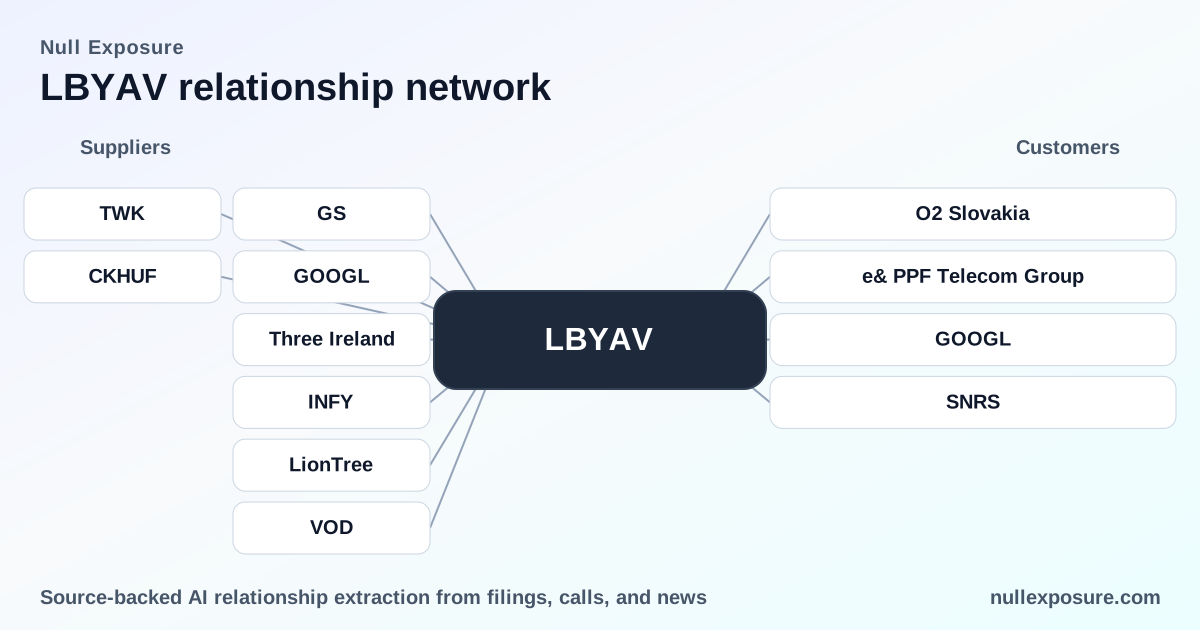
- Counterparty concentration: The company’s counterparties span strategic acquirers (O2 Slovakia / e& PPF), hyperscalers (Google Cloud / GOOGL) and formerly affiliated operators (Sunrise / SNRS), indicating diversified commercial exposures rather than dependence on a single buyer or supplier.
- Criticality: Relationships with cloud providers and spun-out operators are operationally material — Google Cloud access and Atlas Edge commercialization address capacity monetization, while outsourcing links to Sunrise preserve recurring service revenue.
- Maturity and optionality: The mix of asset sales and cloud partnerships signals a mature operator restructuring for platform monetization: Liberty is turning fixed infrastructure into variable, higher-return opportunities (edge, data center hosting, outsourced ops).
No explicit contractual constraints were disclosed in the relationship records provided; the public signals are transactional announcements and partnership press releases rather than detailed contract excerpts. Treat the absence of contract-level constraints as company-level signal that negotiations and service terms remain commercially standard and open to future change.
Relationship-by-relationship précis (plain-English, sourced)
-
O2 Slovakia — Liberty Global sold UPC Slovakia to O2 Slovakia for €95m; the acquirer will integrate local subscribers and infrastructure into its portfolio. (TradingView; DevelopingTelecoms; Yahoo Finance, March 2026)
-
e& PPF Telecom Group — The buyer’s parent group (e& PPF) used its local unit to acquire UPC Slovakia, signaling external consolidation interest in Liberty’s regional assets. (DevelopingTelecoms, March 2026)
-
Liberty Global (LBTYA) — Corporate communications highlight full-year 2025 revenue attribution to operating companies and joint ventures, while leadership and portfolio maneuvers continue to drive monetization choices. (Sahm Capital news release, March 2026)
-
Google Cloud — Liberty Global and Google Cloud agreed to explore optimizing Liberty’s network capacity and unlocking data center capacity through Atlas Edge, creating an avenue to sell edge capacity and host cloud workloads near subscribers. (Liberty Global press release, March 2026)
-
GOOGL — Public references to the deal use Google’s market identity, underlining the potential equity-market relevance of the partnership given Google Cloud’s scale and strategic interest in edge infrastructure. (Liberty Global press release, March 2026)
-
SNRS — Sunrise (SNRS) continues to outsource select functions to Liberty Global after its 2024 spin-out, preserving recurring service revenues and operational interdependence. (TelecomTV, March 2026)
-
Sunrise — Same operational note as SNRS: the spun-out operator still relies on Liberty for technology functions, which stabilizes Liberty’s revenues from legacy relationships. (TelecomTV, March 2026)
Investment implications and next steps for operators and investors
- Upside: Converting network capacity into cloud-hosting and edge services with a partner like Google Cloud creates high-margin optionality beyond subscriber churn and traditional ARPU pressures.
- Risk: Selling localized assets reduces scale in specific markets and can compress long-term subscriber economics; transactions like the UPC Slovakia sale are cash-accretive but shrink local recurring revenue.
- Operational strategy: Maintaining outsourcing agreements with spin-offs (Sunrise) provides steady revenue tails even as Liberty trims its footprint.
For investors and operators tracking counterparty exposure, Liberty Global’s mix of selective divestment and strategic cloud partnering is the defining theme of the current cycle. For continuous, structured visibility into these evolving commercial ties, consider reviewing NullExposure’s coverage at https://nullexposure.com/.
Bold final takeaway: Liberty Global is actively monetizing legacy footprint while repackaging network assets for cloud/edge demand — a capital-efficient pivot that changes both revenue composition and counterparty risk profiles.