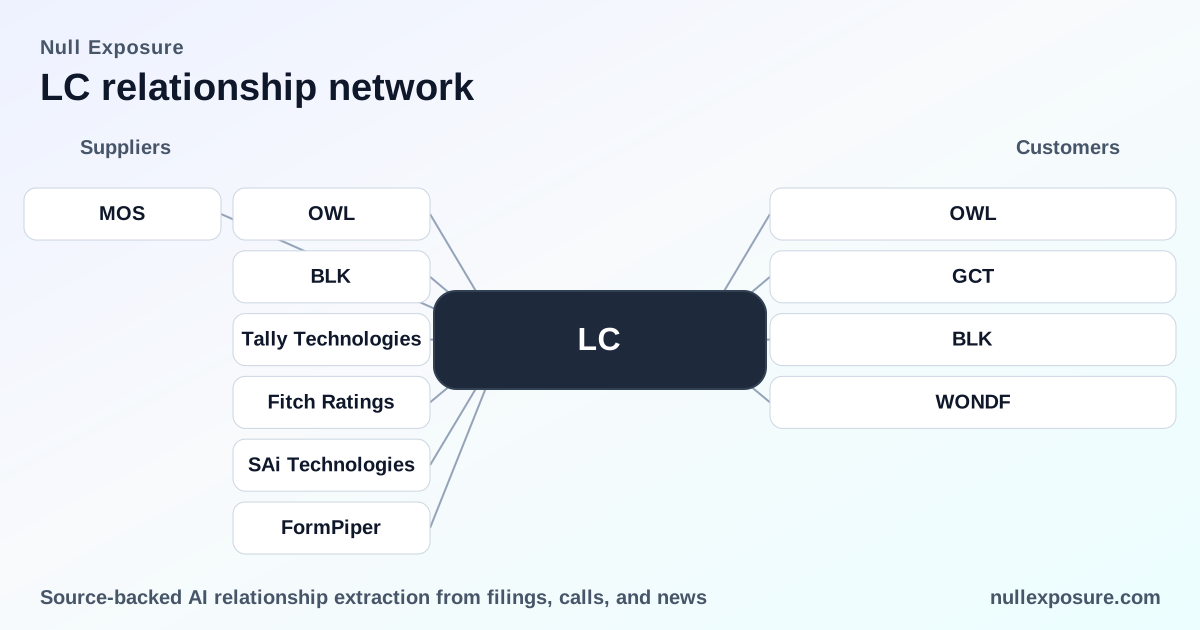
LendingClub’s customer relationships: who funds the loans, who partners on distribution, and what that means for investors
LendingClub operates a technology-driven banking and loan marketplace that originates, services, sells and retains consumer and small-business loans, monetizing through interest spread, origination fees, servicing fees and structured sales to institutional investors. Its model depends on recurring forward‑flow and framework agreements with large marketplace investors and a growing set of embedded partnerships that drive originations and distribution—a hybrid originator-servicer business where third-party capital and partner channels materially shape revenue durability. For a portfolio-level view of relationships and to map exposure across counterparties, see https://nullexposure.com/.
What investors need to know about how LendingClub contracts and gets paid
LendingClub’s commercial posture is not a one-off marketplace; the firm uses framework forward‑flow arrangements and long‑term servicing contracts to convert originations into predictable fee and sale streams. The company’s public disclosures describe long-term leases and recurring agreements with marketplace investors that set the cadence for multiple loan sales over extended periods, while the bank and platform retain servicing roles that produce steady servicing fees. Key operating characteristics: contracts tilt toward recurring frameworks, counterparties span individuals to large asset managers and insurers, the geography is US‑centric, and the firm functions both as seller and ongoing servicer—creating recurring, contract‑driven revenue but concentration risk tied to a few institutional buyers.
Relationship map — counterparties, one‑line takeaways and sources
Below I list every relationship pulled from public reporting and press coverage in the dataset, with concise summaries and source context.
-
GCT — LendingClub is the lending partner in a coalition with Wonder (a GigaCloud Technology subsidiary) and FormPiper to deliver integrated consumer financing to furniture retailers, combining Wonder’s in‑store sales tech with LendingClub’s lending capabilities (GlobeNewswire / FurnInfo, Jan–Mar 2026).
Source: GlobeNewswire press release (Jan 20, 2026) and FurnInfo article (Mar 10, 2026). -
BLK — LendingClub disclosed a forward‑flow memorandum and direct selling relationship with BlackRock investment advisors to purchase loans, including an agreement to buy up to $1.0 billion through 2026 referenced in market coverage (Finviz, FY2025) and in the Q4 2025 earnings commentary (Q4 2025 earnings call).
Source: Finviz coverage (FY2025) and LendingClub Q4 2025 earnings call highlights (Mar 2026). -
BlueOwl — Public reporting identifies Blue Owl as a major marketplace investor that renewed a forward‑flow arrangement, referenced as purchasing billions of loans under an amended agreement (Finviz, FY2025) and reiterated during earnings commentary (Q4 2025).
Source: Finviz coverage citing renewal (FY2025) and LendingClub Q4 2025 earnings call (Mar 2026). -
BlackRock — During investor remarks and press summaries, BlackRock is named among institutional buyers participating in LendingClub’s forward‑flow and structured certification distribution strategy, underscoring the firm’s role as a strategic loan purchaser (Globe and Mail / earnings call, FY2026 / Q4 2025).
Source: Globe and Mail summary of earnings highlights (FY2026) and Q4 2025 earnings call transcript. -
Blue Owl — Multiple publications repeat Blue Owl as an anchor investor in LendingClub’s loan sales program and as a buyer in forward‑flow renewals, supporting sizable purchase commitments across 2025–2026 (Finviz / Globe and Mail, FY2025–FY2026).
Source: Finviz analyst coverage (FY2025) and Globe and Mail earnings coverage (FY2026). -
Blue Owl Capital — Analyst write‑ups explicitly name Blue Owl Capital in connection with a renewed forward‑flow commitment to purchase up to $3.4 billion in loans, indicating material scale in the institutional buy side (Finviz, FY2025).
Source: Finviz coverage (FY2025). -
OWL — Market summaries and earnings call transcripts refer to OWL (Blue Owl) as a continuing forward‑flow partner and an anchor for structured and whole‑loan purchase programs (Finviz and earnings call coverage, FY2025–FY2026).
Source: Finviz and LendingClub Q4 2025 earnings materials. -
Wonder — Wonder, the retail sales acceleration platform, announced a strategic partnership with LendingClub Bank and FormPiper to bring embedded financing into furniture retail channels, with LendingClub described as the “premier lending partner” providing underwriting and product integration (GlobeNewswire / HFBusiness / earnings Q&A, Jan–Mar 2026).
Source: GlobeNewswire press release (Jan 20, 2026), HFBusiness announcement (Mar 2026), and Q4 2025 earnings Q&A. -
WONDF — In analyst Q&A and industry reporting the ticker WONDF (Wonder) is referenced in relation to the Wonder–FormPiper–LendingClub distribution agreement, confirming multiple press outlets covered the same partnership narrative (earnings call and HFBusiness, Mar 2026).
Source: LendingClub Q4 2025 earnings call and HFBusiness (Mar 2026). -
HOMB — Home BancShares (HOMB) is cited in secondary industry filings noting that Home BancShares acquired a marine loan portfolio from LendingClub Bank in 2022, which augmented HOMB’s marine lending capabilities and represents prior whole‑loan transfers from LendingClub Bank (TradingView summary of HOMB filings, FY2026).
Source: TradingView summary of Home BancShares SEC 10‑K or related filings (FY2026). -
Wisetack — LendingClub announced an inaugural partnership with Wisetack to underwrite and originate home‑improvement loans through an embedded contractor platform that reaches over 40,000 contractors, marking LendingClub’s expansion into point‑of‑sale financing in home improvement (PR Newswire / Finviz coverage, Apr–May 2026).
Source: PR Newswire release (Apr 27, 2026) and Finviz aggregation (May 2026). -
NBTB — NBT Bancorp’s earnings commentary referenced a “fairly large unsecured consumer book” tied to LendingClub and Springstone portfolios, indicating secondary exposure to LendingClub-originated assets on regional bank balance sheets (InsiderMonkey coverage of NBTB earnings, FY2026).
Source: InsiderMonkey transcript of NBTB earnings commentary (FY2026).
What the constraints tell investors about the operating model and concentration dynamics
The dataset’s constraint signals read like a profile of a capital‑market intermediation business rather than a pure retail lender. Contracting posture: LendingClub uses frameworks and long‑term arrangements—public disclosures note framework agreements with marketplace investors that govern multiple loan sales over time and long‑term operating leases—so revenue cadence is contractually smoothed rather than entirely transactional. Counterparty mix and concentration: counterparties span individuals, small businesses and large institutional buyers (asset managers and insurers); this gives diversified origination sources but also creates concentration risk when a handful of institutional buyers (as referenced publicly) account for large committed purchases. Role and criticality: LendingClub is both seller and servicer—servicing fees are an ongoing revenue stream and the company retains operational responsibilities (collections, remittance), making these relationships operationally critical beyond the initial sale. Geography and maturity: revenue and operations are US‑centric and relationships are active; the firm sits in a services segment that is maturing into structured products and rated certificates to attract insurance and institutional capital.
- Investor takeaway: the business earns repeatable fee income from servicing and forward‑flow frameworks, but returns and downside are tightly linked to the willingness of a small set of large institutional buyers to maintain purchase commitments and to LendingClub’s ability to embed its products across new distribution partners.
Risks, catalysts and next steps for due diligence
- Risks: reliance on large institutional forward‑flow buyers creates concentration risk; servicing obligations create operational exposure if borrower performance deteriorates.
- Catalysts: expansion of embedded partners (Wisetack, Wonder) diversifies distribution and originations; structured certificates aimed at insurance capital can broaden buyer base.
- Next steps for investors: review LendingClub’s forward‑flow disclosures and servicing revenue breakdown in the FY2026 filings, track renewal schedules for institutional purchase agreements, and monitor originations from newly announced partner channels like Wisetack and Wonder.
If you want a consolidated exposure map or to track renewal timelines for the key forward‑flow partners, visit https://nullexposure.com/ for portfolio‑grade relationship analytics.