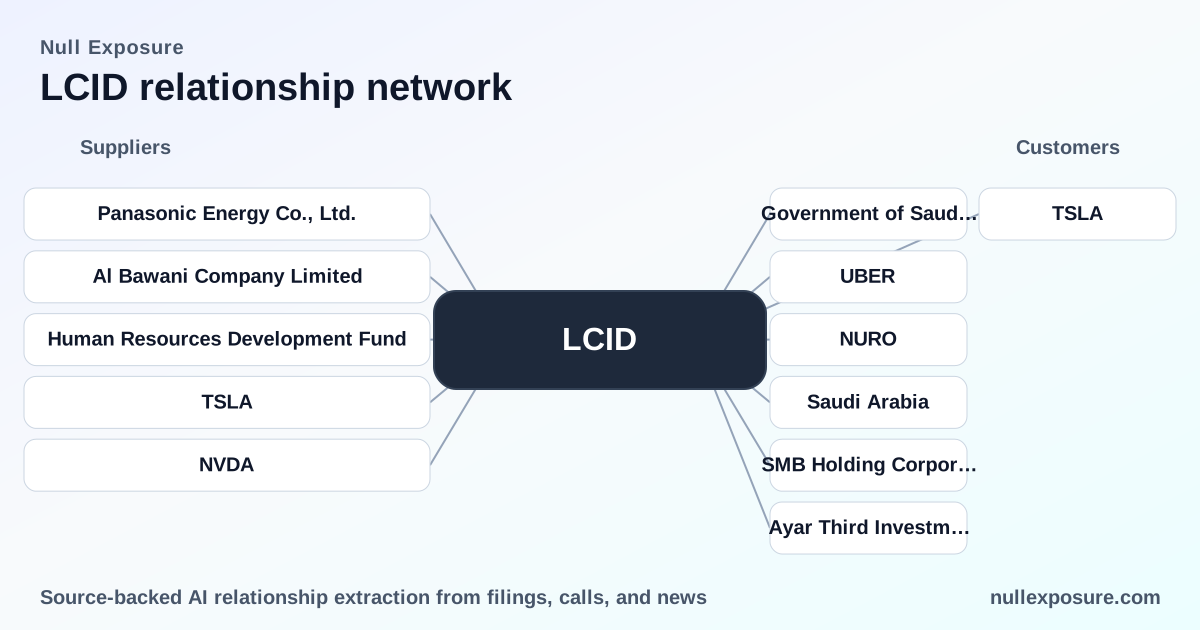
Lucid’s customer map: how Uber, Saudi Arabia and a small group of partners reshape revenue and risk
Lucid Group sells luxury electric vehicles directly to consumers while increasingly monetizing through large fleet agreements and strategic equity relationships that underwrite production scale. Revenue today comes from vehicle sales and direct retail channels; the near-term growth lever is long-term fleet contracts and strategic investments — most prominently with the Government of Saudi Arabia and Uber — that provide volume visibility and working capital support. For detailed customer-level intelligence, visit https://nullexposure.com/.
Why these relationships matter for investors
Lucid is an auto manufacturer that operates as a seller of finished vehicles and a supplier of powertrain technology. Its commercial posture blends consumer retail distribution (studios, online sales, financing through Lucid Financial Services) with signed, high‑volume contracts and strategic equity partners. That hybrid model creates three investment implications: concentration risk, manufacturing criticality, and volume-driven margin leverage.
- Concentration risk: Lucid discloses that the EV purchase agreement with the Government of Saudi Arabia represented a majority share of accounts receivable (51.7% at Dec 31, 2024), signalling material receivable concentration tied to a single government counterparty (10‑K, FY2024).
- Manufacturing criticality: Large institutional purchase commitments (multi‑year, minimum quantities) convert Lucid’s production capacity directly into cash flow; meeting those commitments is an operational priority for its Arizona and Saudi plants.
- Volume leverage: Fleet agreements with Uber and Nuro reframe Lucid from a luxury niche OEM into a supplier for robotaxi and rideshare scale, which amplifies the importance of delivery cadence and supply‑chain execution for margins and investor returns.
Lucid’s geographic footprint is also instructive: North America is the revenue center today, with a presence in Europe and the Middle East (studios and service centers), reflecting a two‑track go‑to‑market strategy: premium retail and institutional fleet sales (10‑K, FY2024).
Contracts and company-level signals that constrain the model
The public record shows several operational constraints that define Lucid’s customer relationships:
- Long-term contracts: The EV Purchase Agreement with the Government of Saudi Arabia is a multi‑year commitment that allows the purchaser to buy up to 100,000 vehicles over ten years with a stated minimum of 50,000 (10‑K, FY2024). This is a high‑confidence signal of long-dated revenue visibility from a single purchaser.
- Government counterparty: The same agreement is explicitly with the Government of Saudi Arabia and its entities; Lucid classifies receivables from that agreement as a concentration of credit risk (10‑K, FY2024).
- Materiality: Receivable exposure from the Saudi agreement represented 51.7% of total accounts receivable at year end 2024, a company‑level materiality flag that amplifies single‑counterparty risk.
- Geographic concentration and expansion: North America accounted for the majority of revenues in 2024, while Lucid has active operations in Europe and the Middle East, implying operational complexity across regions.
- Seller posture and active stage: Lucid’s disclosures describe vehicle sales revenue and direct retail distribution, and the Saudi EV Purchase Agreement is active with recognized revenues in 2023–2024 (10‑K, FY2024).
These constraints describe a company transitioning from low‑volume premium manufacturing to volume‑dependent fleet supply; execution against these constraints is the primary driver of valuation re‑rating.
The customer roll call — what each relationship delivers (and why investors should care)
Government of Saudi Arabia
Lucid has a formal EV Purchase Agreement with the Government of Saudi Arabia that allows purchase of up to 100,000 vehicles over ten years, with a minimum commitment and recorded receivables tied to that agreement; the contract drove significant sales recognized in 2023–2024 and accounted for a majority of accounts receivable at year‑end 2024. According to Lucid’s 2024 Form 10‑K, amounts due under the EV Purchase Agreement represented 51.7% of accounts receivable as of December 31, 2024.
Saudi Arabia
Mainstream press coverage reiterates that Saudi sovereign entities backed by the Public Investment Fund have a purchase commitment supporting Lucid’s ramp, with public commentary describing potential purchases of up to 100,000 vehicles over ten years. A Motley‑style report in The Globe and Mail referenced the Saudi commitment and its strategic role in Lucid’s long‑term volume plan (Mar 2026).
Uber (Uber Technologies, Inc.)
Uber is a strategic customer and investor: Lucid announced multi‑year robotaxi commitments that initially targeted at least 20,000 vehicles and later expanded to at least 35,000 vehicles along with a substantial equity investment from Uber. Lucid’s earnings call and subsequent press coverage summarize the investment and purchase commitments, including a $300M initial strategic investment and later an expanded $500M figure reported in market commentary (Lucid earnings calls, FY2025; PR Newswire and media, Apr–May 2026).
Nuro (NURO)
Lucid has delivered an initial batch of robotaxi engineering vehicles to Nuro as part of a partnership to integrate Level‑4 autonomous capability into Lucid platforms; news outlets and Lucid’s own earnings remarks describe Nuro as a software/AV partner in planned fleet deployments. Management confirmed the delivery milestone on the 2025 Q3 earnings call and media coverage (lcid 2025 Q3 earnings call; SimplyWallSt, Mar 2026).
Aston Martin (ALM)
Lucid will supply electric powertrain technology and technical integration support to Aston Martin for its EV platform, effectively licensing or supplying core components rather than retail vehicles; market commentary highlights the technology‑supply nature of the arrangement (TradingView coverage, May 2026).
SMB Holding Corporation
SMB Holding Corporation, identified in filings as an affiliate of Uber Technologies, received shares in a private placement associated with Lucid’s financing activity, linking Lucid’s capital raises to its Uber relationship and signaling investor alignment between the two companies (resale prospectus supplement reported by InvestingNews, Mar 2026).
Ayar Third Investment Company
Ayar Third Investment Company, an affiliate of the Public Investment Fund, is cited in Lucid’s resale prospectus language relating to convertible note forward transactions and share purchase entitlements, underscoring the PIF’s structured financial involvement beyond the direct EV Purchase Agreement (InvestingNews resale prospectus supplement, Mar 2026).
Tesla (TSLA)
Lucid gained access to Tesla’s Supercharger network and the Combined Charging System infrastructure effective Jan 31, 2025, reducing range‑anxiety friction for customers and improving the EV ownership experience for Lucid buyers; this access was disclosed in the 2024 Form 10‑K filings (lcid 2024 Form 10‑K).
What investors should take away
- Volume visibility exists but is concentrated. Long‑term commitments from Saudi entities and purchase agreements with Uber provide a clear route to scale, but material receivable concentration elevates counterparty and execution risk.
- Partnerships shift Lucid’s business mix. Supply deals (Aston Martin), fleet commitments (Uber), and AV integrations (Nuro) convert Lucid from a pure premium OEM into a multi‑channel supplier where production reliability and supply‑chain maturity determine margin outcomes.
- Near‑term valuation sensitivity is high to delivery cadence. Investors should prioritize metrics tied to production throughput, AR aging on the Saudi agreement, and contractual milestones with Uber/Nuro that trigger cash collections or equity infusions.
For investors and operators who need deeper customer-level intelligence and timely updates on counterparties, visit https://nullexposure.com/ for ongoing coverage and detailed relationship analytics.
Final thought
Lucid’s commercial trajectory is now less about niche luxury halo cars and more about converting signed institutional demand into repeatable factory economics. Execution against long‑term fleet contracts and the management of concentration risk will determine whether Lucid scales into a defensible volume supplier or remains exposed to episodic capital infusions.