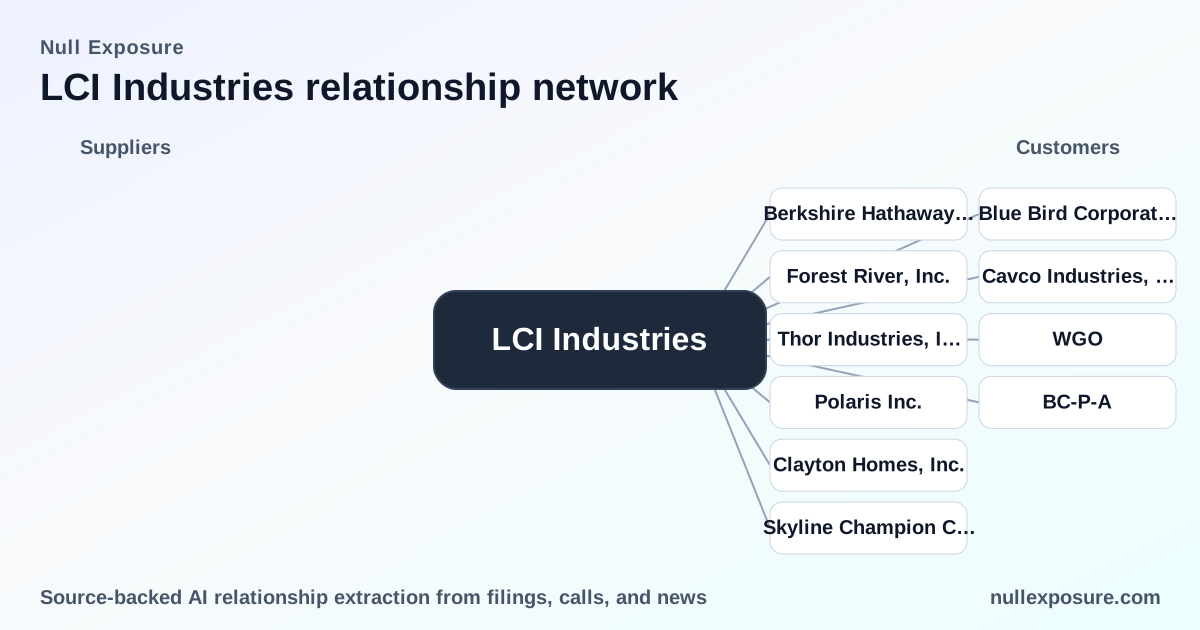
LCI Industries (LCII): A concentrated OEM supplier with durable pricing and measurable customer risk
LCI Industries manufactures and supplies engineered components to recreational vehicle (RV) OEMs and adjacent markets, monetizing through large-scale OEM contracts and a complementary aftermarket distribution channel. The company earns the bulk of revenue by selling high-volume assemblies and components to leading OEMs, while the aftermarket business captures recurring parts and service revenue through dealers and e‑commerce. For investors, the trade-off is scale and margin durability against customer concentration and short-term pricing exposure.
Visit Null Exposure for deeper relationship analytics: https://nullexposure.com/
How LCI runs the business: operating posture and commercial constraints
LCI’s operating model reflects a classic supplier-to-OEM posture. The OEM segment contributes roughly three quarters of sales, manufacturing highly engineered components for RVs and adjacent transportation and housing markets, while the aftermarket segment supplies dealers, distributors and end consumers, adding recurring revenue and channel reach. According to the company’s FY2024 Form 10‑K, the OEM segment accounted for 76% of consolidated net sales in 2024 and the aftermarket 24%.
Key company-level signals that shape the investment thesis:
- Customer concentration is material. LCII reports two customers collectively represented 34% of consolidated net sales in 2024, and no other single customer exceeded 10% (FY2024 10‑K). This concentration drives revenue volatility and negotiation leverage for the largest OEMs.
- Contracts are effectively short-term. Supply agreements frequently fix prices for periods generally not in excess of 18 months, with rights to renegotiate on 60 days’ notice — a commercial structure that pressures pricing during soft demand cycles.
- Large-enterprise counterparty profile. The OEM book is dominated by major manufacturers in recreation, transportation and housing, creating both predictable volumes and bargaining power on the buyer side.
- North America is the revenue engine, with global operations. Billing-address revenue was overwhelmingly U.S.-based in 2024 (roughly $3.35bn U.S. vs $394m international), while operations support customers across North America and Europe.
- Manufacturing + distribution mix. The firm’s combined manufacturing scale and aftermarket distribution/reseller footprint is a competitive advantage in product breadth and aftermarket capture.
These characteristics explain why investors value LCII’s stable cash generation but discount some multiple for concentration and cyclical end markets.
Customer map — every relationship reported (one-line summaries with sources)
Berkshire Hathaway Inc.
Berkshire Hathaway (through Forest River and Clayton Homes) accounted for 18% of LCII’s consolidated net sales in 2024, making it the company’s largest single customer by report — a structural revenue dependency disclosed in the FY2024 Form 10‑K.
Source: LCI Industries Form 10‑K, fiscal year ended December 31, 2024.
Forest River, Inc.
Forest River is named as a major OEM customer and, as a Berkshire Hathaway subsidiary, is part of the combined customer concentration that drove 18% of sales in 2024; Forest River is repeatedly cited among leading OEMs served by LCII (FY2024 10‑K).
Source: LCI Industries Form 10‑K, FY2024.
Thor Industries, Inc.
Thor Industries accounted for 16% of consolidated net sales in 2024, positioning Thor as another top-tier revenue source and part of the two-customer concentration dynamic the company discloses (FY2024 10‑K).
Source: LCI Industries Form 10‑K, FY2024.
Blue Bird Corporation
Blue Bird is listed among LCII’s major customers in FY2024, reflecting LCII’s exposure beyond RVs into buses and commercial vehicle OEMs that diversify end-market exposure.
Source: LCI Industries Form 10‑K, FY2024.
Cavco Industries, Inc.
Cavco is included in LCII’s FY2024 list of major customers, indicating LCII’s participation in manufactured home supply chains in addition to RV OEMs.
Source: LCI Industries Form 10‑K, FY2024.
Clayton Homes, Inc.
Clayton Homes is named as part of the Berkshire Hathaway-related customer grouping; the company’s sales through Clayton contribute to the 18% combined share attributed to Berkshire affiliates in 2024 (FY2024 10‑K).
Source: LCI Industries Form 10‑K, FY2024.
Polaris Inc.
Polaris is listed among major customers in the FY2024 filing, highlighting LCII’s exposure to adjacent powersports and specialty vehicle manufacturers.
Source: LCI Industries Form 10‑K, FY2024.
Skyline Champion Corporation
Skyline Champion appears in LCII’s FY2024 major-customer list, underlining the company’s role in modular and manufactured housing supply chains as well as recreation markets.
Source: LCI Industries Form 10‑K, FY2024.
Winnebago (news: GuruFocus note)
A May 2026 industry note referenced by GuruFocus reiterates that LCII sells to RV manufacturers including Winnebago, underscoring ongoing OEM relationships called out in sell‑side coverage (GuruFocus, May 2026).
Source: GuruFocus coverage of Stifel initiation on LCI Industries, May 2026.
Thor Industries (news: GuruFocus note)
Industry commentary in May 2026 also cited Thor among the primary RV OEM customers for LCII’s products, consistent with Thor’s reported multi‑year share of LCII sales (GuruFocus, May 2026).
Source: GuruFocus coverage, May 2026.
Winnebago Industries (10‑K mention)
Winnebago is explicitly named in LCII’s FY2024 Form 10‑K as a major customer, reinforcing LCII’s placement across the premier RV OEM cohort.
Source: LCI Industries Form 10‑K, FY2024.
WGO (10‑K duplicate entry)
The filing lists Winnebago (ticker WGO) among major customers; the company’s public ticker inclusion is part of the FY2024 customer roster.
Source: LCI Industries Form 10‑K, FY2024.
Winnebago (news: SAHM Capital)
A January 2026 press report noted Winnebago’s adoption of Lippert Components’ Omega Fifth‑Wheel Frame as standard on a product line, a tangible product-level confirmation of LCII’s role as a core supplier (SAHM Capital, Jan 2026).
Source: SAHM Capital news item, January 14, 2026.
PATK (Patrick Industries) — merger commentary
A May 2026 investor note discussed the potential strategic combination of Patrick Industries and LCII, situating Patrick as a peer and potential M&A counterpart relevant to consolidation themes in the supplier space (SimplyWall, May 2026).
Source: SimplyWall investor commentary, May 2026.
Forest River (news: GuruFocus)
A May 2026 industry note again cited Forest River as an end customer for LCII components, consistent with Forest River’s place among the firm’s largest buyers (GuruFocus, May 2026).
Source: GuruFocus coverage, May 2026.
Brunswick Corporation
Brunswick is enumerated in LCII’s FY2024 list of major customers, evidencing LCII’s reach into marine and other adjacent industries beyond RVs.
Source: LCI Industries Form 10‑K, FY2024.
BC‑P‑A (Brunswick preferred symbol)
The FY2024 filing includes Brunswick (listed in the results with the identifier BC‑P‑A), reflecting the same major‑customer designation reported in the 10‑K.
Source: LCI Industries Form 10‑K, FY2024.
Visit Null Exposure for relationship visualizations and contract-level summaries: https://nullexposure.com/
Investment implications: concentrated revenue, short contract tenors, and operational scale
LCII’s strength is scale — roughly $4.12bn revenue trailing twelve months and over $400m EBITDA — backed by deep integration into top OEMs. Key investment positives: diversified product portfolio across OEM and aftermarket channels, durable aftermarket margins, and an experienced manufacturing footprint. Key risks: pronounced customer concentration (two customers = 34% of sales in 2024), short‑term price exposure given <18‑month pricing arrangements, and North America dependence for the large majority of billings.
Valuation context: LCII trades at a mid‑teens P/E with an EV/EBITDA around 9–10x on reported figures, reflecting a market premium for steady cash flow tempered by concentration and cyclicality. Analyst coverage is constructive, with buy/hold mix and a consensus target near the mid‑teens to low‑hundreds on the share price (company consensus data).
Bottom line
LCI Industries is a manufacturing leader whose profitability and cash flow are anchored by deep OEM relationships and an aftermarket channel, but those advantages come with concentrated counterparty exposure and short pricing cycles. For investors and operators evaluating LCII customer relationships, the company offers scale and defensibility, balanced against material customer dependency that directly affects revenue sensitivity to demand swings.