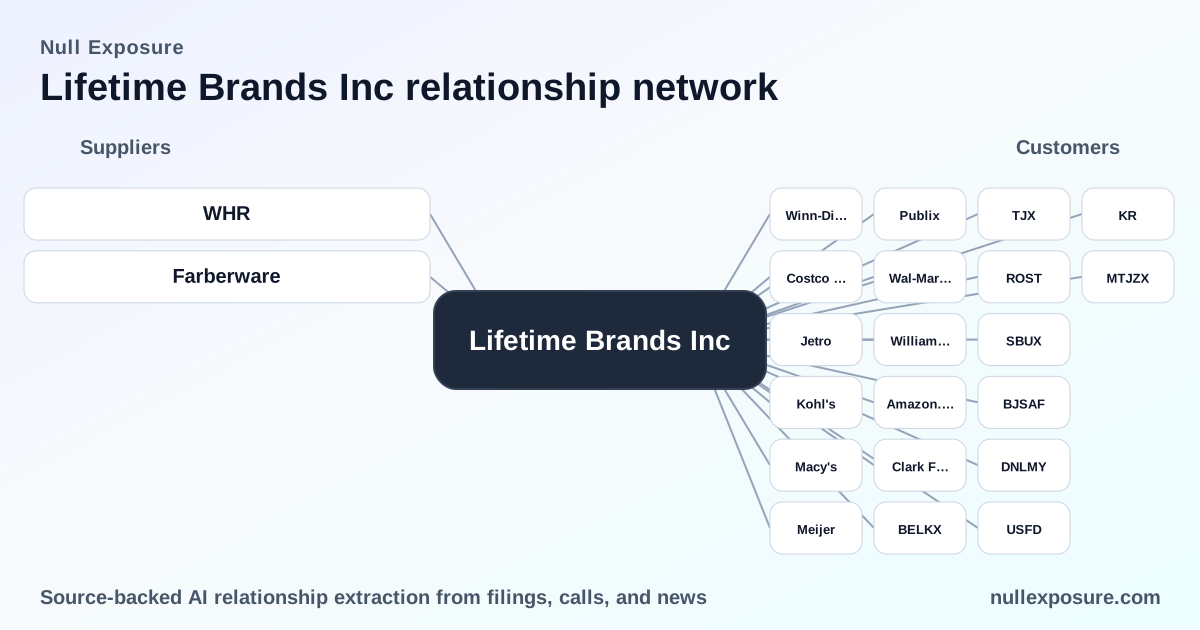
Lifetime Brands (LCUT): Customer Map and Commercial Risks for Investors
Lifetime Brands designs, sources and sells branded kitchenware and tableware and monetizes through wholesale relationships with large retailers, distributors and a smaller direct-to-consumer channel; revenue is recognized on shipment under FOB shipping point and concentrated in a handful of large enterprise customers. This customer footprint drives steady top-line scale but creates pronounced revenue volatility when major accounts shift assortment or inventory. For a concise vendor-risk read and primary-source links, visit NullExposure.
Quick take: how the customer mix drives the thesis
Lifetime Brands’ go-to-market is classic consumer products wholesale: it sells branded products to mass merchandisers, specialty stores, warehouse clubs, grocery and foodservice distributors, and to a limited extent through its own websites. The 2024 Form 10‑K shows material customer concentration — Walmart (19% of consolidated net sales in FY2024), Costco (11%), and Amazon (13%) — which makes LCUT both efficient at scale and vulnerable to single‑customer share shifts. The company books revenue upon shipment (FOB shipping point), signaling spot-style commercial economics and low long-term contractual lock‑ins, while keeping inventory and working capital dynamics sensitive to retailer ordering patterns (Lifetime Brands 2024 Form 10‑K).
Explore the full company profile and primary filings at NullExposure.
What the SEC filing and management commentary imply about operations
- Contracting posture: The company primarily records revenue when products ship (FOB Shipping Point), which is consistent with spot sales and creates exposure to order timing and retailer inventory cycles (10‑K, FY2024).
- Counterparty mix: Lifetime sells to both large enterprises and individual consumers — large retailers and distributors account for the majority of sales, while a limited direct‑to‑consumer web offering complements wholesale channels (10‑K, FY2024).
- Geography and concentration: Sales are heavily U.S.-centric (the U.S. was the dominant region in FY2024 net sales) and a small set of retailers account for meaningful shares of consolidated revenue; concentration is a material balance‑sheet and margin risk (10‑K, FY2024).
- Role and channel: Lifetime acts primarily as a seller to retailers, a supplier to distributors, and a provider of branded products that retailers resell, including through private labels and licensing arrangements (10‑K, FY2024).
- Product positioning: Core revenue derives from branded kitchenware and tableware, not services — the business is product-centric and subject to category-level retail secular trends (10‑K, FY2024).
Every named customer in the public record (concise, primary-source backed)
- Amazon.com Inc. — Amazon accounted for 13% of consolidated net sales in FY2024, underscoring its importance to Lifetime's e‑commerce and third‑party retail exposure; source: Lifetime Brands 2024 Form 10‑K (FY2024).
- Clark Food Service — Listed as a food‑service distributor customer, Clark is part of Lifetime’s commercial channel into institutional and food‑service outlets (Lifetime Brands 2024 Form 10‑K, FY2024).
- Costco Wholesale Corporation — Costco represented 11% of consolidated net sales in FY2024, and management flagged Costco as the largest year‑over‑year decline in a single customer in recent commentary (10‑K, FY2024; earnings call transcript, Q4 2025 — see https://www.insidermonkey.com/blog/lifetime-brands-inc-nasdaqlcut-q4-2025-earnings-call-transcript-1715478/).
- Jetro — Named among food‑service distributors, Jetro contributes to Lifetime’s institutional channel outside mass retail (Lifetime Brands 2024 Form 10‑K, FY2024).
- Kohl’s — Cited as a department store customer; Kohl’s represents the department store channel exposure for Lifetime’s branded and licensed products (Lifetime Brands 2024 Form 10‑K, FY2024).
- Macy’s — Identified alongside other department stores, Macy’s is a traditional wholesale outlet for Lifetime’s brand assortments (Lifetime Brands 2024 Form 10‑K, FY2024).
- Meijer — Called out among grocery clients, Meijer contributes to Lifetime’s grocery-channel penetration (Lifetime Brands 2024 Form 10‑K, FY2024).
- Publix — Another grocery-channel customer included in Lifetime’s FY2024 customer list, supporting supermarket distribution of core products (Lifetime Brands 2024 Form 10‑K, FY2024).
- Wal‑Mart Stores, Inc. (Walmart) — Walmart accounted for 19% of consolidated net sales in FY2024, the single largest retail concentration and a primary driver of volume and promotional cadence (Lifetime Brands 2024 Form 10‑K, FY2024). Management also referenced KitchenAid share loss at Walmart during the Q4 2025 call (earnings call transcript, May 2026 — https://m.investing.com/news/transcripts/earnings-call-transcript-lifetime-brands-q4-2025-beats-eps-forecasts-93CH-4557757?ampMode=1).
- Williams‑Sonoma — Named as a specialty retail partner, Williams‑Sonoma supports Lifetime’s higher‑end specialty channel placements (Lifetime Brands 2024 Form 10‑K, FY2024).
- Winn‑Dixie — Included among grocery stores carrying Lifetime’s products, reflecting supermarket breadth (Lifetime Brands 2024 Form 10‑K, FY2024).
- Costco (earnings call excerpt) — Management singled out Costco as the most visible near‑term decline in a single customer through September, signaling near‑term sales pressure (Q4 2025 call transcript, May 2026 — https://www.insidermonkey.com/blog/lifetime-brands-inc-nasdaqlcut-q4-2025-earnings-call-transcript-1715478/).
- Walmart (earnings call excerpt) — Management commented on lost KitchenAid share at Walmart over the last few years, a revenue mix and brand‑placement concern (Q4 2025 call transcript, May 2026 — https://m.investing.com/news/transcripts/earnings-call-transcript-lifetime-brands-q4-2025-beats-eps-forecasts-93CH-4557757?ampMode=1).
- BELKX / Belk — Listed twice in the filing (Belk/BELKX entries), Belk is a department‑store channel partner in the 10‑K customer list (Lifetime Brands 2024 Form 10‑K, FY2024).
- TJX Companies — Identified as an off‑price retail customer, TJX helps Lifetime reach discount and value buyers (Lifetime Brands 2024 Form 10‑K, FY2024).
- Ross Stores / ROST — Ross is listed among off‑price retailers, broadening Lifetime’s discount channel exposure (Lifetime Brands 2024 Form 10‑K, FY2024).
- Starbucks / SBUX — Starbucks is cited among food and beverage outlets that carry Lifetime products, indicating non‑traditional retail placements (Lifetime Brands 2024 Form 10‑K, FY2024).
- BJs / BJSAF — BJ’s (BJSAF) is included among warehouse clubs that carry Lifetime’s products alongside Costco, giving warehouse‑club exposure (Lifetime Brands 2024 Form 10‑K, FY2024).
- Dunelm / DNLMY — Named as a specialty retail outlet (Dunelm), reflecting Lifetime’s international specialty distribution footprint (Lifetime Brands 2024 Form 10‑K, FY2024).
- US Foods / USFD — US Foods is cited among food‑service distributors, supporting Lifetime’s institutional and foodservice channel (Lifetime Brands 2024 Form 10‑K, FY2024).
- Kroger / KR — Kroger appears among grocery customers, part of the supermarket distribution network in FY2024 (Lifetime Brands 2024 Form 10‑K, FY2024).
- Target / MTJZX — Target is listed as a mass‑market merchant customer, anchoring another large‑format retail node in Lifetime’s mix (Lifetime Brands 2024 Form 10‑K, FY2024).
Commercial implications investors should price in
- Concentration risk is measurable and persistent. Walmart, Amazon and Costco together account for a material portion of revenue — changes in assortment or promotions at any of these retailers will move Lifetime’s top line quickly (10‑K, FY2024; Q4 2025 call commentary).
- Revenue recognition and order volatility: The FOB shipping point policy and spot selling posture mean revenue hits or misses will map tightly to shipment timing and retailer order cadence rather than long multi‑year contracts. That increases quarter‑to‑quarter earnings sensitivity.
- Channel diversity cushions but does not eliminate risk. Presence across mass, specialty, off‑price, warehouse clubs and foodservice diversifies routes to market, but each channel is subject to its own pricing and promotional pressures.
What to watch next
- Quarterly disclosure of customer concentration and any year‑over‑year movement for Walmart, Costco and Amazon.
- Management commentary on share recovery at Walmart and assortment gains at Costco (management flagged both in Q4 2025 remarks). See the Q4 2025 transcripts above for context.
- Inventory and working‑capital trends given the FOB shipping point recognition — rising retailer inventory could presage softer reorder activity.
For a structured vendor‑risk assessment and primary‑source access to the filings cited above, visit NullExposure.