Leidos (LDOS): Revenue driven by government frameworks and mission-critical services
Leidos monetizes by selling engineering, systems-integration, software and managed services into long-term government and regulated commercial programs, typically under multi-year framework and IDIQ-style contracts where the company acts as a principal service provider and integrator. Revenue durability comes from contract scale and repeat award eligibility, while margin leverage stems from mission software, systems integration and specialized hardware deliveries. For deeper relationship intelligence, visit https://nullexposure.com/.
Why the customer map matters to investors
Leidos is a government-first contractor: about 87% of revenues derive from U.S. government work, concentrated in defense, intelligence and federal civil agencies. That concentration creates both predictable backlog and program-level execution risk — awards are often multi-year and issued under framework vehicles, so revenue realization depends on task orders and program phases rather than a single purchase. The company’s posture is that of a service provider and systems seller across software, services and hardware lines; that combination elevates program criticality where successful delivery is material to both customer missions and Leidos’ financials.
Key operating-model signals:
- Framework contracting and IDIQ exposure drives win-rate and backlog dynamics rather than transactional sales.
- Long-term revenue profile: funded backlog and multi-year contract terms underpin forward visibility.
- Government counterparty concentration: revenue and risk are concentrated in the U.S. government; international exposure is limited.
- Mission criticality: a sizable portion of revenue ties to DoD and intelligence programs, making program performance strategically important.
- Segment mix: services-led, supplemented by defense hardware and mission software capabilities.
Relationship map: the customers and engagements investors should track
U.S. Army
Leidos won a five‑year, $869 million MACRO II award to accelerate military decision-making with modular, AI-enabled systems under a competitive contract vehicle, reinforcing DoD program continuity and revenue runway. According to PR Newswire on May 3, 2026, the work covers design, build and integration across multiple domains.
LXU (LSB Industries) — Benzinga transcript
LSB Industries’ public statements indicate ongoing litigation posture: a settlement referenced in Q1 filings did not release claims against Leidos, with LSB preserving fraud and breach claims. Benzinga’s April 2026 earnings/transcript coverage recorded LSB’s reservation of claims against Leidos.
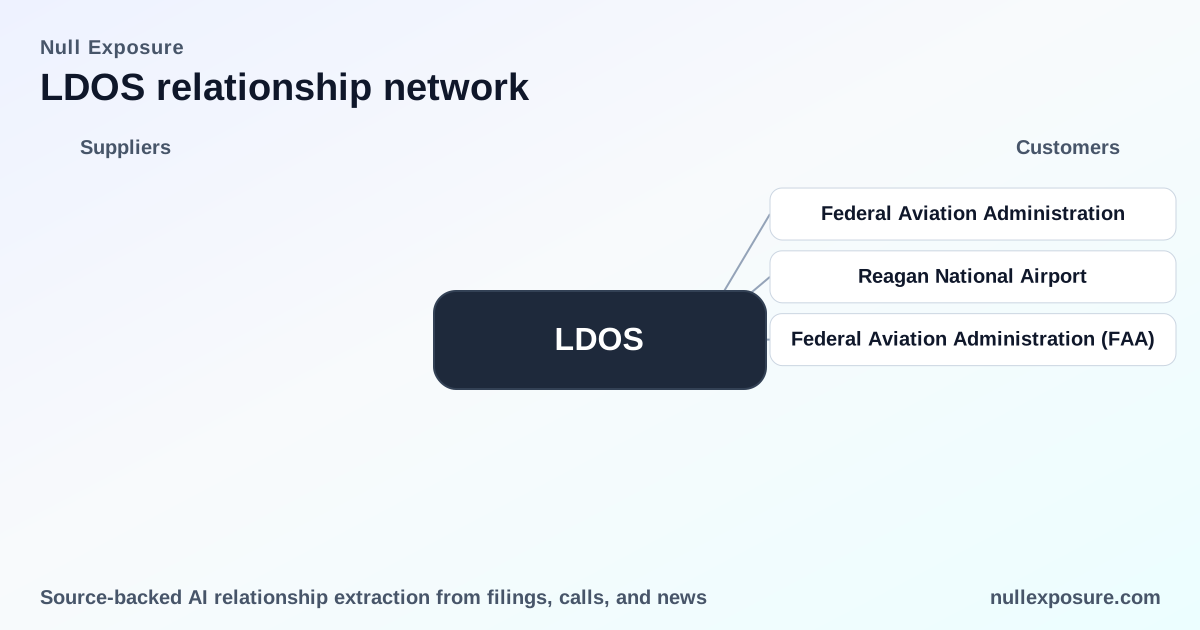
Federal Aviation Administration — Bitget report
Leidos’ Terminal Flight Data Manager capability is described as primarily serving the FAA, reflecting the company’s push into mission-critical air-traffic digitalization and ground-movement optimization. Bitget reported on March 10, 2026, that the program underpins FAA operational modernization.
BBOT (BridgeBio Oncology Therapeutics)
BridgeBio’s filings note maintained and licensed agreements that include Leidos as a collaborator for discovery and development programs with contingent milestone payments, indicating Leidos’ role in lifecycle-stage scientific partnerships. TradingView reported this relationship on March 9, 2026.
LXU (LSB Industries) — SimplyWall.st coverage
LSB continues to pursue separate fraud and contract claims exceeding US$300 million against Leidos entities, with trial scheduling noted for October 2026, underscoring legal and contingent liabilities linked to prior project execution. SimplyWall.st discussed this on May 3, 2026.
SLNH (Soluna) — CityBiz
Leidos provided power market analysis in Soluna’s acquisition advisory package for a wind farm purchase, demonstrating Leidos’ advisory role in energy projects beyond core defense and aviation programs. CityBiz covered the transaction on May 3, 2026.
Federal Aviation Administration — InsiderMonkey operational update
Leidos’ Terminal Flight Data Manager went live at Reagan National Airport as part of progressive FAA deployments, illustrating tangible systems delivery and early operational receipts tied to federal modernization programs. InsiderMonkey reported the deployment on March 10, 2026.
General Services Administration — Military OneSource program
Leidos secured a $456 million, four‑year contract awarded through the GSA to manage Military OneSource services, supporting more than 4.7 million service members and families and translating directly into sizeable recurring program revenue. SahmCapital published this announcement on April 29, 2026.
AMWL (Amwell) — military health partnership
Amwell reported working together with Leidos to advance a staged launch of telehealth solutions across the Military Health System, signaling Leidos’ role as a systems integrator and channel partner in military healthcare digitalization. Finviz captured this mention in March 2026 (FY2025 context).
Reagan National Airport — operational milestone
On February 19, 2026, Leidos’ Terminal Flight Data Manager began operations at Reagan National, providing a concrete example of software/hardware integration into live airport operations and a reference point for FAA rollout progress. InsiderMonkey reported this milestone on March 10, 2026.
FAA — RBC/analyst commentary on TFDM value
Analyst notes linked to Leidos’ TFDM technology emphasize real-time digital substitution for paper flight strips and the FAA program’s value to controller efficiency, reinforcing the strategic importance of TFDM to both FAA modernization and Leidos’ revenue mix. InsiderMonkey captured this discussion on March 10, 2026.
PCT (Ironton Facility certification)
Leidos was cited as the certifying party for PCT’s commercial-scale recycling facility, where successful performance testing and certification by Leidos is a gating item for full commercial operations—highlighting Leidos’ independent-assessment and engineering services role. BR.ADVFN covered the certification dependency on March 10, 2026.
LSB Industries — SimplyWall.st legal follow-up
Separate SimplyWall.st coverage reiterates that LSB is pursuing claims exceeding $300 million against Leidos Inc. and Leidos Engineering, with trial scheduling in October 2026, underlining ongoing litigation risk and potential contingent exposure. SimplyWall.st published this on May 3, 2026.
Pentagon (broader DoD/Joint domain statement)
PR Newswire described Leidos’ tasking to deliver AI, advanced networking and modular open architecture systems for the Pentagon to improve cross-domain decision-making, signaling large-scale defense system responsibilities that span land, sea, air, space and cyber domains. PR Newswire reported this on May 3, 2026.
For a consolidated view of these customer relationships and execution signals, see https://nullexposure.com/ — the homepage hosts the firm-wide relationship intelligence and deeper analytics.
Investment implications and risk checklist
- Revenue durability is high but concentrated. The government-heavy mix provides long contract tails and backlog but increases sensitivity to federal procurement cycles, sequestration risk and program-level performance.
- Contracting posture favors frameworks and multi-year tasking. This improves predictability but ties revenue realization to task-order flow rather than discrete product sales.
- Execution and legal risk are material. High-value DoD programs and active litigation (LSB claims) represent downside scenarios that investors must monitor.
- Diversified capabilities reduce single-program dependency. Services, mission software and hardware offerings collectively mitigate, but do not eliminate, concentration risk.
Bottom line
Leidos operates as a mission-centric integrator selling long-term services and systems into the U.S. federal ecosystem; its financial profile is built on large, framework-style awards, recurring program management fees and periodic hardware/software deliveries. Investors should underwrite growth against task-order cadence and execution performance while monitoring litigation developments and the pace of federal modernization programs.