Lands’ End (LE): Customer relationships that shape revenue and strategic optionality
Lands’ End is a digitally led apparel and home-goods retailer that monetizes through three core channels: direct e‑commerce and company stores, third‑party marketplace and wholesale distribution, and licensing / branded partnerships (including uniform contracts). These channels drive both transactional revenue and recurring royalty streams, giving the business a hybrid retail/licensing profile with diversified outlets but concentrated U.S. revenue. For a concise investor primer and data-centered screening, visit https://nullexposure.com/.
How Lands’ End’s commercial model works in practice
Lands’ End sells product directly on landsend.com and in a small number of company-operated stores while deliberately expanding third‑party distribution—Amazon, Macy’s, Nordstrom, Kohl’s, Next and other marketplaces—to capture customers where they shop. The company also licenses its trademarks and sells uniform programs, creating longer‑term, royalty-bearing agreements that generate cash up front or recurring royalties. This mix produces two structural characteristics important to investors: near-term revenue variability from spot retail sales and higher‑visibility cash flow from longer-term licensing and uniform contracts.
Constraints and what they imply about operating posture
- Contracting posture: Lands’ End runs a mixture of long‑term licensing arrangements that include guaranteed minimum royalties and renewal options alongside spot retail sales recognized at point of delivery; the business combines predictable licensing cash flows with transactional retail volatility.
- Concentration and geography: The company is heavily U.S.‑centric—more than 90% of net revenue ships to the United States—while maintaining a modest international channel that represented roughly 8% of revenue in Fiscal 2024.
- Relationship roles and segment mix: Lands’ End operates as both seller (direct and wholesale) and licensor (trademark licensing) and acts as a buyer in B2B uniform supply. The firm also runs a distribution / Outfitters segment serving institutions and schools.
- Maturity and criticality: Licensing contracts are mature and typically multi‑year with guaranteed minimums; uniform agreements (for example, with Delta) create a higher criticality revenue stream because they replace one‑off product sales with enterprise supply relationships.
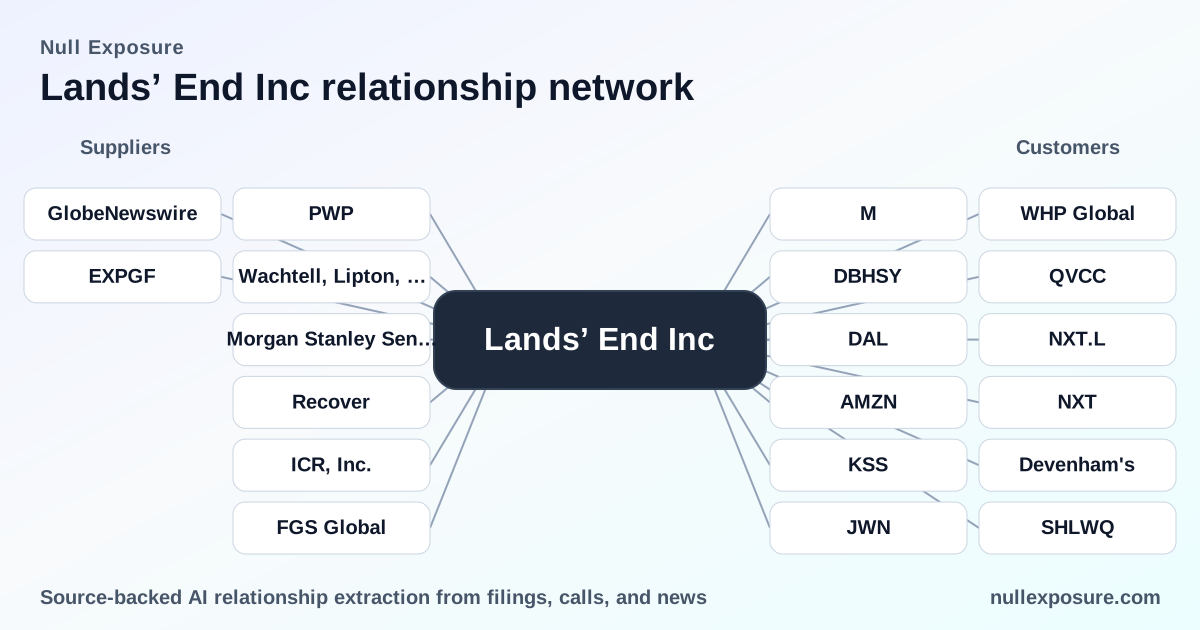
The partner map — every customer relationship in the record
Below is a compact, investor‑oriented review of every relationship mentioned in the collected results, with a short plain‑English summary and source context.
-
Debenhams / DBHSY — Lands’ End expanded its marketplace presence to include Debenhams as part of a push to “meet the customer where they are,” indicating marketplace distribution beyond the U.S. (Q3 2025 earnings call; WWD, SGB Online, March 2026).
Source: Q3 2025 earnings call transcript and press coverage (WWD / SGB Online, March 2026). -
AMZN / Amazon — Amazon is a growth engine for third‑party sales; Lands’ End reported double‑digit performance on Amazon, with Prime‑week and Black Friday promotions driving outsized contributions from a small set of top SKUs. Amazon also acted as a meaningful customer acquisition channel.
Source: Q3 2025 earnings call and subsequent press transcripts (Globe and Mail, InsiderMonkey, Yahoo Finance, March–May 2026). -
DAL / Delta Air Lines / Delta — Lands’ End was selected as the exclusive designer and manufacturer for Delta’s next generation uniform program, supplying more than 60,000 employees worldwide—a material B2B contract that shifts part of revenue into a multi‑year supply role.
Source: Q3 2025 earnings call and SGB Online press (FY2025). -
M / Macy’s / Macy’s — Macy’s is a leading third‑party retail partner and helped lead a 34% year‑over‑year increase in third‑party sales, reflecting successful wholesale assortments and distribution placement.
Source: Q3 2025 earnings call and Globe and Mail transcript (FY2025). -
DBHSY — (duplicate entry in results) See Debenhams entry above; referenced in earnings commentary about marketplace openings.
Source: Q3 2025 earnings call (March 2026). -
Amazon — (duplicate listing) See AMZN/Amazon entry; multiple press items corroborate Amazon as a sustained third‑party growth channel.
Source: Globe and Mail; TradingView / Yahoo Finance (March–May 2026). -
Delta Airlines — (duplicate listing) See DAL/Delta; the uniform agreement is a strategic, recurring B2B relationship.
Source: Globe and Mail / SGB Online (FY2025). -
KSS / Kohl’s / Kohl’s Corp. — Lands’ End expanded wholesale distribution into Kohl’s (including an in‑store presence in ~500 Kohl’s locations historically), contributing to third‑party revenue improvement. Some commentary is critical of the strategic fit, but Kohl’s remains a channel for distribution.
Source: BizTimes (FY2023) and Globe and Mail / TradingView (FY2025). -
Nordstrom / JWN — Nordstrom is positioned as a partner for higher AOV (average order value) sales and premium price points; management highlighted record AOVs and strong outerwear sales through Nordstrom.
Source: SGB Online and WWD press (FY2025). -
WHP Global — Lands’ End agreed to form a joint venture with WHP Global, contributing its intellectual property and licensing agreements in exchange for $300 million in cash for a 50% controlling stake—an explicit monetization of the brand/IP portfolio.
Source: GlobeNewswire press release and SGB Online (January–March 2026). -
QVC / QVCC — Lands’ End has an e‑commerce partnership with QVC, extending reach into home‑shopping audiences and alternative channels beyond core online retail.
Source: BizTimes (FY2023). -
NXT / Next / NXT.L / NeXT — Lands’ End opened on Next (U.K./international marketplace) as part of its marketplace expansion strategy; management cited results ahead of expectations for those channel openings. This supports incremental international reach.
Source: Globe and Mail and WWD / SGB Online (FY2025). -
LEWHP, LLC — WHP Global’s subsidiary LEWHP, LLC launched a tender offer to buy up to 2,222,222 shares of Lands’ End at $45.00 per share, reflecting WHP’s transactional activity tied to the JV and control economics.
Source: Investing.com SEC‑filing coverage (May 2026). -
Devenham’s / Devenham's (spelled in coverage) — Management referenced openings on Devenham’s as another marketplace channel alongside Amazon and Next, part of the company’s physical/digital distribution expansion.
Source: Globe and Mail earnings transcript (FY2025). -
SHLWQ / Sears — Historical dependence on Sears franchise outlets is noted in commentary about Lands’ End’s past distribution strategy and the need to diversify from that legacy channel.
Source: Diginomica analysis (March 2026). -
Sears — (duplicate entry) See SHLWQ / Sears note above regarding legacy franchise dependence and channel evolution.
Source: Diginomica (FY2025 commentary).
What this map means for investors
- Revenue optionality, with two speed regimes: spot retail sales (direct and wholesale) drive near‑term volatility; licensing and uniform contracts create higher‑visibility cash flows and optional liquidity when monetized (see WHP JV).
- Concentration risk is geographic: the business is predominantly U.S.‑driven, so macro U.S. consumer cycles matter more than international trends.
- Channel diversification reduces single‑partner exposure but increases operational complexity and reliance on marketplace discovery algorithms (Amazon, Nordstrom, Macy’s, Next).
- Corporate actions create optionality: the WHP JV and related tender activity materially change the capital structure and unlock IP value.
For investors and operators tracking customer counterparty risk and channel strategy, these relationship signals are actionable inputs for due diligence and scenario modeling. If you want a concise, data‑aligned brief on more tickers and partner maps, visit https://nullexposure.com/ for more coverage and screening tools.
Bold takeaway: Lands’ End balances transactional retail with durable licensing and B2B uniform contracts; the company’s value crystallization is actively underway via the WHP JV, while marketplace expansion (Amazon, Macy’s, Nordstrom, Next, Debenhams) underpins near‑term top‑line recovery.