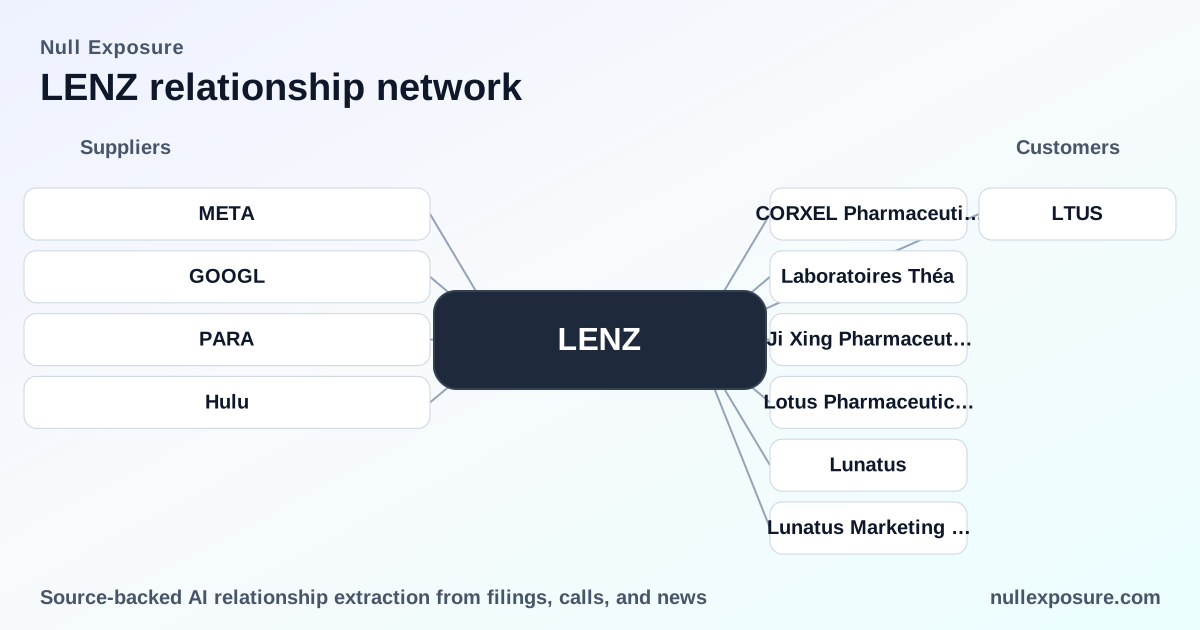
LENZ Therapeutics: Commercial Partnerships Driving Global Rollout of a Presbyopia Asset
LENZ Therapeutics monetizes by out-licensing regional commercialization rights for its lead ophthalmic assets (notably LNZ100 / VIZZ), receiving upfront payments, regulatory and commercial milestones, and ongoing revenue via predetermined supply pricing — a model that transforms capital-intensive late-stage development into recurring, geographically diversified cash flow. For investors and operators, LENZ is executing a partner-led commercialization strategy that de-risks U.S. self-pay launch while scaling market access internationally through exclusive license and distribution agreements. Learn more at the Null Exposure home page: https://nullexposure.com/
How LENZ operates and how that shapes commercial exposure
LENZ advances late-stage CNS/ocular formulations to approval and then outsources registration and commercialization by territory. The company targets the U.S. self-pay market directly while leveraging partners for international regulatory submissions, launch execution, and local distribution. This structure yields a hybrid revenue mix: near-term non-dilutive cash from upfront and milestone payments plus longer-term product revenue tied to minimum supply pricing and revenue-sharing in partner territories. The model concentrates commercial risk with licensees for regional go-to-market execution while preserving upside via structured supply terms.
Operating constraints that matter for valuation and execution
- Contracting posture: LENZ relies heavily on exclusive license and commercialization agreements to scale outside the U.S., indicating a partner-first go-to-market posture rather than building global commercial infrastructure in-house. This reduces fixed SG&A but increases counterparty concentration and execution reliance on partners.
- Concentration and criticality: The business is concentrated around a single late-stage program (LNZ100 / VIZZ) whose regulatory timeline and U.S. self-pay positioning are critical to milestone receipts and partner-triggered payments.
- Customer type and reimbursement posture: Company-level filings state LENZ will commercialize in the U.S. in the self-pay, out-of-pocket market, a deliberate strategy to avoid third-party reimbursement complexity and accelerate patient access.
- Geographic focus: LENZ declares an explicit emphasis on U.S. commercialization internally while using partners for international markets.
- Commercial maturity: Ongoing ECP (eye care provider) education and targeted outreach indicate a ramping commercialization stage in the U.S., focused on early-adopter prescribers to drive uptake.
Full list of relationships disclosed (each entry covered)
Below I summarize every relationship record found in LENZ’s customer-scope results, with a concise description and a direct source.
CORXEL Pharmaceuticals
LENZ licensed Greater China development and commercialization rights for LNZ100 to CORXEL, and subsequently recognized multiple milestone payments including a $10 million series tied to NDA submission and U.S. approval triggers. Source: LENZ press release reporting Q3 2025 financial results — https://ir.lenz-tx.com/news-events/press-releases/detail/43/lenz-therapeutics-reports-third-quarter-2025-financial-results-and-recent-corporate-highlights
CORXEL Pharmaceuticals (press release reference also shown in Q2 release)
The Q2 2025 corporate update also notes the original April 2022 licensing of Greater China rights to CORXEL, formalizing the long-term regional partnership for LNZ100 development and commercialization. Source: LENZ Q2 2025 press release — https://ir.lenz-tx.com/news-events/press-releases/detail/38/lenz-therapeutics-reports-second-quarter-2025-financial-results-and-recent-corporate-highlights
Laboratoires Théa (GlobeNewswire July 2025 announcement)
LENZ granted exclusive Canadian rights to Laboratoires Théa to register and commercialize LNZ100 for presbyopia, transferring local regulatory and commercialization responsibilities in exchange for the structured commercial terms. Source: GlobeNewswire press release, July 7, 2025 — https://www.globenewswire.com/news-release/2025/07/07/3110985/0/en/LENZ-Therapeutics-and-Laboratoires-Th%C3%A9a-Announce-Exclusive-License-and-Commercialization-Agreement-for-LNZ100-in-Canada.html
Laboratoires Théa (LENZ company press release, Q2 2025)
LENZ reiterated the exclusive license to Théa for Canadian commercialization of VIZZ / LNZ100 in its corporate Q2 2025 update, underscoring the strategic use of specialty ophthalmology partners for non-U.S. markets. Source: LENZ Q2 2025 press release — https://ir.lenz-tx.com/news-events/press-releases/detail/38/lenz-therapeutics-reports-second-quarter-2025-financial-results-and-recent-corporate-highlights
Ji Xing Pharmaceuticals (JIXING)
LENZ executed an exclusive Greater China license with Ji Xing for LNZ100 and LNZ101, assigning development and commercialization responsibilities in the region and expanding redundancy in China-market partners. Source: LENZ announcement of exclusive Greater China license (FY2022 release) — https://ir.lenz-tx.com/news-events/press-releases/detail/7/lenz-therapeutics-and-jixing-announce-an-exclusive-greater-china-license-agreement-rtw-to-invest-in-lenz-therapeutics
Lunatus Marketing & Consulting FZCO (GlobeNewswire January 2026)
LENZ announced an exclusive distribution agreement with Lunatus to register and commercialize VIZZ across the Middle East, positioning the company to receive upfront, milestone, and supply-based revenue in that region. Source: GlobeNewswire press release, January 5, 2026 — https://www.globenewswire.com/news-release/2026/01/05/3212729/0/en/LENZ-Therapeutics-and-Lunatus-Announce-Exclusive-Commercialization-Partnership-for-VIZZ-in-the-Middle-East.html
Lunatus Marketing & Consulting FZCO (LENZ press release announcing commercialization partnership)
LENZ’s corporate statements in Q4 2025/early 2026 describe the Lunatus deal terms including upfront payments, regulatory and commercial milestones, and a significant share of regional revenue via a stipulated minimum product supply price. Source: LENZ press release — https://ir.lenz-tx.com/news-events/press-releases/detail/52/lenz-therapeutics-reports-fourth-quarter-and-full-year-2025-financial-results-and-recent-corporate-highlights
Lunatus Marketing & Consulting FZCO (preliminary Q4 2025 filing note)
LENZ reiterated the commercial economics of the Lunatus partnership in its preliminary Q4 2025 results, emphasizing milestone and supply-pricing mechanics that secure downside revenue floors for LENZ. Source: LENZ preliminary Q4 2025 results press release — https://ir.lenz-tx.com/news-events/press-releases/detail/47/lenz-therapeutics-reports-fourth-quarter-2025-preliminary-unaudited-financial-results-and-recent-corporate-updates
Lunatus Marketing & Consulting FZCO (MarketScreener coverage)
MarketScreener and other financial news picked up LENZ’s January 2026 announcement, confirming market interest and the commercial framing of the Lunatus distribution arrangement. Source: MarketScreener report referencing the Lunatus partnership (Jan. 2026 pick-up) — https://www.marketscreener.com/news/lenz-therapeutics-insider-bought-shares-worth-251-411-according-to-a-recent-sec-filing-ce7e51d9db8dff2d
Lotus Pharmaceutical Co., Ltd. (LENZ press release, May 2025 licensing)
LENZ granted Lotus exclusive rights to commercialize LNZ100 in South Korea and specified Southeast Asian countries, forming a broad Asia ex-China regional strategy through a single partner network. Source: LENZ May 2025 press release — https://ir.lenz-tx.com/news-events/press-releases/detail/34/lenz-therapeutics-and-lotus-pharmaceutical-announce-exclusive-license-and-commercialization-agreement-for-lnz100-in-the-republic-of-korea-and-southeast-asia
Lotus Pharmaceutical Co., Ltd. (Yahoo Finance coverage of MFDS filing)
Under the Lotus agreement, Lotus submitted a New Drug Application (NDA) to South Korea’s MFDS for VIZZ, marking the first regulatory filing under that exclusive license and advancing regional commercialization timelines. Source: Yahoo Finance news, reporting the MFDS submission via Lotus (FY2025 coverage) — https://finance.yahoo.com/news/lenz-therapeutics-announces-mfds-submission-133000412.html
LTUS / Lotus Pharmaceutical references in corporate Q2 2025 update
LENZ’s Q2 2025 corporate update references the same Lotus arrangement (listed under ticker LTUS in some disclosures) and enumerates the Southeast Asian countries included in the grant of rights. This confirms consistency across LENZ’s investor communications regarding the Lotus partnership. Source: LENZ Q2 2025 press release — https://ir.lenz-tx.com/news-events/press-releases/detail/38/lenz-therapeutics-reports-second-quarter-2025-financial-results-and-recent-corporate-highlights
Investment implications and final takeaways
- Revenue visibility is front-loaded via upfront and milestone payments from multiple regional partners, reducing near-term cash burn risk and exposing LENZ to execution risk embedded in partner regulatory timelines.
- U.S. self-pay strategy reduces reimbursement risk but concentrates launch success on ECP education and early-adopter adoption dynamics; LENZ is actively ramping targeted ECP outreach to drive uptake.
- Geographic diversification through exclusive licenses (Canada, Middle East, Greater China, South Korea + SE Asia) provides multiple independent value realization paths and reduces single-market concentration risk.
For operators and investors assessing LENZ, the clear thesis is that value crystallization is dependent on partner execution and U.S. commercialization momentum; both dimensions are visible in LENZ’s press releases and regulatory filings. For a compact, relational view of LENZ’s partner network and how those contracts translate to cashflow and clinical commercialization risk, visit Null Exposure: https://nullexposure.com/