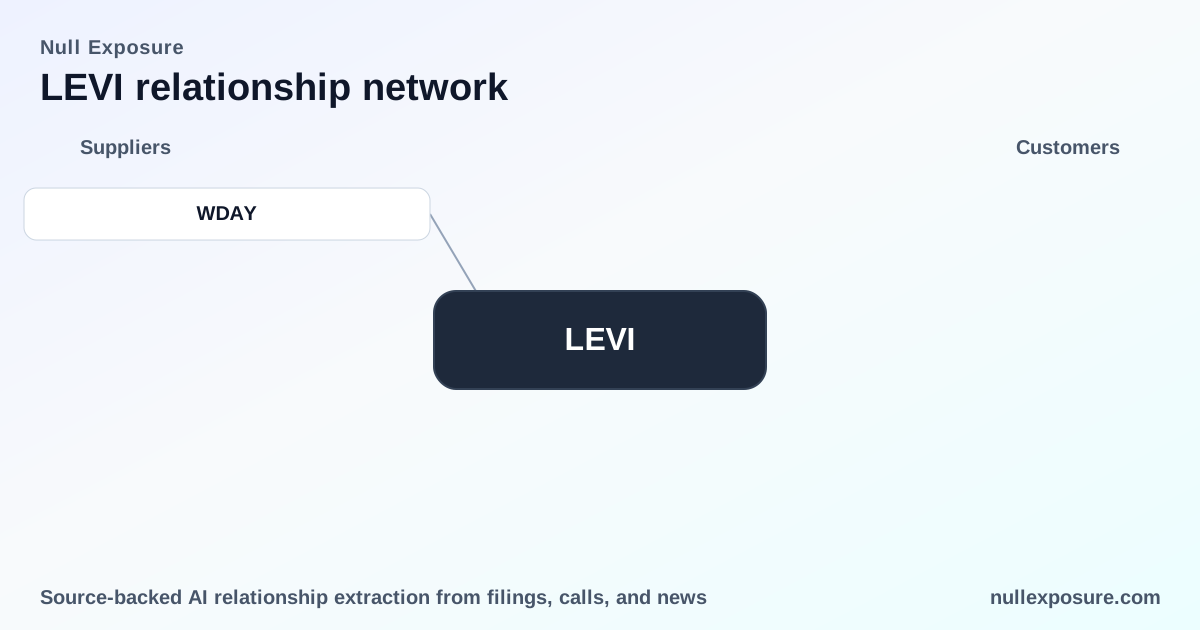
LEVI customer map: how Levi Strauss monetizes relationships and what partner signals tell investors
Levi Strauss & Co. operates as a vertically integrated apparel house that designs, markets and sells denim and related apparel through two distinct channels — direct-to-consumer (company-operated stores and e‑commerce) and wholesale (department stores, specialty retailers, franchisees and licensees). The company monetizes its brand through product sales, selective licensing and international distribution, producing a globally diversified revenue base with no single customer representing 10% or more of net revenues; investors should value Levi as a branded consumer durable with recurring wholesale placements and controllable DTC economics. For a concise data feed and deeper partner-trend monitoring, see Null Exposure: https://nullexposure.com/
How Levi sells and what that implies for partner risk
Levi’s commercial model is a hybrid of retail cash sales and short-term wholesale contracts. Retail and e‑commerce transactions are cash-at-sale, while wholesale arrangements are executed on shipment/receipt terms that vary by country and counterparty. The company reports sales in roughly 120 countries, with FY2025 net revenues split roughly $2.7bn U.S. and $3.6bn international — a clear global footprint that reduces single-market exposure but increases execution complexity (logistics, tariffs, local retail partners). The top ten customers accounted for about 24% of net sales in FY2025, a concentration level that is notable but not client‑critical because no single customer exceeds 10% of revenue.
- Contracting posture: Predominantly spot and short-term commercial terms — retail is immediate; wholesale is post‑shipment credit.
- Concentration: Moderately concentrated at the top-ten level (24% in FY2025) but insufficient to create single-counterparty dependency.
- Geographic exposure: Truly global; the U.S. is a large but not dominant market.
- Revenue role mix: DTC plus wholesale with franchise sales contributing a steady mid-single-digit percent (franchise 6% of net revenues in FY2025).
These are company-level signals drawn from the firm’s FY2025 filing and public commentary.
Relationship roll call: partner-by-partner evidence investors should track
Below are every relationship referenced in the collected results, each with a plain-English takeaway and source note.
-
Authentic Brands Group — Levi completed the sale of the Dockers business to Authentic Brands Group as part of prior portfolio rationalization, a transaction documented in corporate announcements. (Business Wire, transaction noted via Finviz; fiscal period FY2019; first seen May 2026.)
-
Target (TGT) — Target expanded Levi denim distribution into 150 additional stores, reflecting ongoing wholesale shelf placement and mass-retailer partnerships that drive volume growth. (Retail Dive coverage aggregated on Finviz; fiscal period FY2019; first seen May 2026.)
-
Buckle (BKE) — Buckle’s product assortment includes Levi’s, indicating Levi’s placement in specialty denim retailers and the importance of multi-brand wholesale relationships to reach targeted customer segments. (Intellectia.ai reporting on Buckle sales mix; fiscal period FY2026; first seen March 2026.)
-
Genesco (GCO) — Genesco disclosed the wind-down of its licensed Levi’s business, an operational change that signals license transitions and the company’s selective approach to third‑party licensed distribution. (SGB Online reporting; fiscal period FY2026; first seen March 2026.)
-
G‑III Apparel Group (GIII) — G‑III’s licensing portfolio lists Levi’s among prominent global fashion names, underscoring Levi’s role as a licensable brand asset used by retailers and manufacturers. (Bitget news summary quoting G‑III licensing commentary; fiscal period FY2026; first seen May 2026.)
-
Crane Co. (CR‑W) — Historical reporting recounts that denim clippings from Levi production were once used in specialty paper manufacturing for U.S. currency by Crane, a legacy operational linkage rather than a modern commercial partnership. (Coin World feature on historical connections; fiscal period FY2021; first seen March 2026.)
-
G‑III Apparel Group (repeat entry) — G‑III’s FY2026 disclosure reiterated Levi’s inclusion among over 20 licensed names, confirming repeated third‑party licensing references across reporting sources. (GlobeNewswire release by G‑III; fiscal period FY2026; first seen May 2026.)
-
Kohl’s (KSS) — Kohl’s public remarks highlight Levi’s as a key national partner for expanded denim assortments in women’s business, reflecting another major wholesale placement in department stores. (Kohl’s earnings call transcript summarized on InsiderMonkey; fiscal period FY2026; first seen May 2026.)
-
Genesco (repeat entry) — In Genesco’s earnings commentary, management described the tail end of Levi’s license exits and related impacts, reinforcing the company-level observation that Levi reconfigures licensing footprints over time. (Genesco earnings call transcript summarized on InsiderMonkey; fiscal period FY2026; first seen March 2026.)
-
Urban Outfitters (URBN) — Urban Outfitters launched a second iteration of an “On Rotation” collaboration with Levi’s, illustrating how limited-edition retail partnerships and capsule collections support brand relevance and younger consumer reach. (SimplyWall.St coverage; fiscal period FY2026; first seen May 2026.)
-
Genesco (third entry via Marketscreener) — MarketScreener noted that Genesco’s Brands Group historically comprises licensed Dockers, Levi’s and others, a reminder that Levi is often managed via licensing arrangements in footwear and apparel categories. (MarketScreener report; fiscal period FY2026; first seen March 2026.)
-
Lulus (LVLU) — Lulus cited prior collaborations with Levi’s and other brands as part of strategic initiatives to expand brand value and reach, showing Levi’s utility in co-branded and collaborative fast-fashion rollouts. (GlobeNewswire release summarizing Lulus initiatives; fiscal period FY2024; first seen March 2026.)
For ongoing monitoring and to correlate these partner signals with retail sell-through and licensing changes, Null Exposure provides structured coverage: https://nullexposure.com/
Investment implications and risk posture
Investors should focus on a handful of clear, actionable themes:
- Distribution breadth reduces single‑counterparty risk. No single customer accounts for 10%+ of revenues; the top-ten share (~24%) is meaningful but manageable. Company filings for FY2025 confirm this concentration profile.
- Revenue stability depends on DTC economics and wholesale placement. Cash-at-sale retail dampens receivables risk; wholesale terms introduce short-term credit exposure tied to partners’ payment practices. The company continues to balance both channels to optimize margins.
- Licensing is a fungible lever. Several results document license exits, transitions and third‑party licensees using the Levi’s mark — an intentional commercial tool that supports incremental revenue but can create transitional earnings volatility when major license arrangements end or shift. Genesco’s wind‑down is a direct example.
- Global exposure is both an opportunity and an execution risk. Sales in ~120 countries diversify demand but require coordination across retail partners, distribution and tariff regimes (FY2025 geographic revenues: US $2.674bn, foreign $3.608bn).
Bottom line
Levi Strauss combines brand strength with a diversified go‑to‑market structure: a stable DTC base plus a wide set of wholesale and license partners that together produce predictable scale but episodic licensing-driven volatility. Watch partner announcements (store rollouts, license starts/exits, capsule collaborations) as near-term indicators of distribution momentum and wholesale sell-through.
For systematic partner tracking and transaction-level signal aggregation for investors and operators, visit Null Exposure: https://nullexposure.com/