Lexaria Bioscience (LEXX): Licensing relationships anchor a capital-light IP play
Lexaria monetizes a proprietary oral delivery technology, DehydraTECH, primarily by licensing the IP to large consumer and pharmaceutical partners and by providing contract manufacturing for select B2B customers. Revenue is driven by non‑refundable licensing fees and minimum performance payments, with manufacturing a secondary, complementary stream; licensing remains the company’s core commercial lever. For investors, the story is one of intellectual property commercialization through selective partnerships and long‑dated exclusivities against a small revenue base and negative operating margins. Learn more about how we map corporate counterparty risk at Null Exposure: https://nullexposure.com/.
How Lexaria funds its growth: licensing first, services second
Lexaria’s operating model is centered on licensing. Public disclosures state that licensing revenue consists of IP licensing fees for transfer of DehydraTECH and includes non‑refundable minimum performance fees, which creates predictable near‑term receipts from executed deals. The company also executes third‑party contracted manufacturing to produce DehydraTECH‑enhanced products to customer specifications, sold in the US and Canada, giving it a foothold in execution beyond pure IP transfers. According to reported figures, Lexaria recognized approximately $696,000 in licensing revenue in each of the years ended August 31, 2024 and 2025, while trailing twelve‑month revenue sits at $368,000, reflecting a volatile and modest commercial scale.
Company disclosures also reveal structural business characteristics that investors should treat as operating constraints and strategic signals:
- Contracting posture: Licensing is explicit and deliberate; the company positions itself as a seller/licensor rather than a distributor.
- Term and exclusivity: Lexaria holds long‑term exclusivities tied to patent life; one disclosed license grants exclusivity through 25 years after the last Poviva patent—an indication of long‑dated upside if patents remain enforceable.
- Geographic reach: The firm operates on both regional exclusive and global non‑exclusive licensing models—examples include an APAC‑focused exclusive license for Australia and a global non‑exclusive arrangement excluding certain Asian markets.
- Segment split: The company reports a single reportable segment—IP licensing—although manufacturing and support for licensees are material in practice.
- Relationship posture: Contracts are typically license‑centered and active; the company has disclosed multiple active licenses as of FY2025.
These structural choices make Lexaria a capital‑efficient, IP‑first business with concentration and execution risk: a small number of license partners and the occasional expiration of material contracts materially affect short‑term revenue.
Who Lexaria works with — the customer map
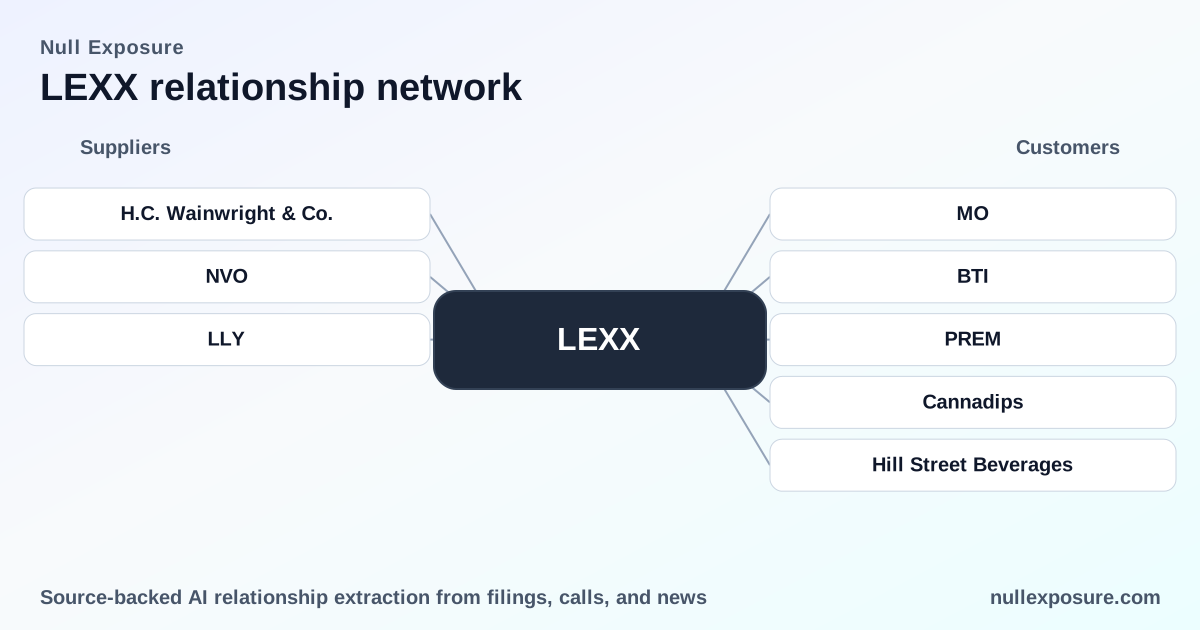
Below are the customer and partner relationships cited in public reporting and news coverage. Each item includes a concise plain‑English description and a source reference.
-
British American Tobacco — Lexaria has licensing or formal R&D agreements in place with British American Tobacco as part of a broader strategy to partner with major tobacco and consumer goods companies to deploy DehydraTECH. According to an InvestingNews company profile (March 2026), BTI is listed among partners with licensing or R&D ties.
Source: InvestingNews company profile (March 2026). -
Altria — Altria is listed by Lexaria as a party with licensing or formal R&D agreements, indicating engagement with one of the largest tobacco conglomerates for potential product development using DehydraTECH. InvestingNews catalogued Altria among named partners in March 2026.
Source: InvestingNews company profile (March 2026). -
MO — The ticker MO appears separately in public mentions reflecting the same Altria engagement; the reporting lists MO as a licensed/R&D counterparty in the company’s partner roster. The duplication in sources reflects both company naming conventions and ticker‑level references in coverage.
Source: InvestingNews company profile (March 2026). -
PREM — A TradingView summary of Lexaria’s SEC 10‑Q indicates that revenue fell to $0 in a reported period following the expiration of the Premier licensing contract, a direct commercial consequence of the company shifting away from B2B clients. The entry labeled PREM reflects this contractual expiration and the revenue impact disclosed in FY2026 filings.
Source: TradingView summary referencing Lexaria SEC 10‑Q (March 2026). -
Premier — The Premier (Premier/PREM) licensing contract expiration is explicitly called out in the SEC 10‑Q coverage; Lexaria reported revenue declining from $183,923 the prior year to zero in the period due to the contract lapse and a strategic move away from certain B2B channels.
Source: TradingView summary referencing Lexaria SEC 10‑Q (March 2026). -
Hill Street Beverages — Hill Street Beverages is named among companies with licensing or formal R&D agreements, representing beverage and CPG engagement where DehydraTECH can be applied to beverage formulations. InvestingNews includes Hill Street in its March 2026 partner roster for Lexaria.
Source: InvestingNews company profile (March 2026). -
Cannadips — Cannadips is also identified as a licensor/R&D partner, aligning Lexaria with smokeless/novel nicotine or cannabinoid product formats where oral delivery enhancement is relevant. This relationship is listed in InvestingNews’ March 2026 partner summary.
Source: InvestingNews company profile (March 2026).
What these relationships imply for investors
- Validation from major consumer firms: Agreements with the largest tobacco companies and beverage partners provide commercial and technical validation of DehydraTECH as a licensed technology platform. That said, validation has not yet translated into large, recurring revenue on the corporate income statement.
- Revenue concentration and volatility: The expiration of a single B2B license (Premier) produced a material near‑term revenue swing; the business has high counterparty concentration and therefore earnings are binary around contract timings. The FY2026 SEC‑reported drop to zero for a period underscores this point.
- Contract maturity and runway: Long‑dated exclusive licenses tied to patent life create multi‑decade optionality for revenue if partners commercialize successfully, supporting a strategy that trades short‑term revenue predictability for long‑term royalty upside.
- Hybrid model: Lexaria’s combination of licensing and contracted manufacturing positions it as a seller of IP with execution capabilities, reducing some go‑to‑market friction but increasing operational scope.
Risk, return, and the investment posture
Investors should weigh IP upside and partner validation against small current revenues, negative EBITDA, and concentration risk. The company’s model is attractive where licensing scales to large CPG or pharmaceutical launches, but current financials show limited commercial traction and notable quarter‑to‑quarter sensitivity tied to single contracts. Patents and long exclusive terms are a core asset, but their value is conditional on partner commercial execution.
If you evaluate counterparties and contract risk for small‑cap IP licensors, Null Exposure provides structured counterparty mappings and risk scoring for investment decisions. Explore our approach at https://nullexposure.com/.
Bottom line
Lexaria is a focused IP licensor that leverages DehydraTECH through selective partnerships with major tobacco and beverage firms and occasional B2B manufacturing. The company’s upside is concentrated in partner commercialization successes and long‑dated patent exclusivities; downside is concentrated in license expirations and limited current revenue scale. Investors should price LEXX as a high‑conviction, high‑binary outcome IP commercialization story rather than a steady cash‑flow business.