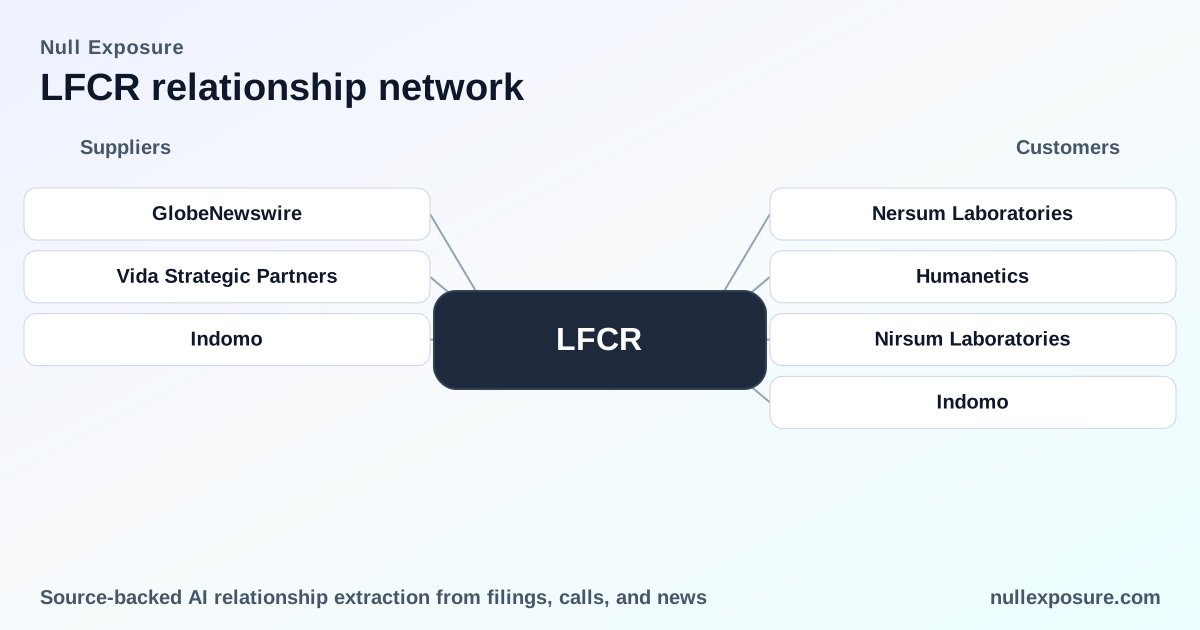
Lifecore Biomedical (LFCR): Customer Relationships, Concentration and Commercial Leverage
Lifecore Biomedical operates as a specialized CDMO that develops, manufactures and aseptically fills high‑viscosity sterile injectables for clinical and commercial customers. The company monetizes through development service agreements, engineering and clinical batch production, and long‑term commercial supply contracts that carry guaranteed purchase commitments and capacity requirements. For investors, the earnings‑call and filing signals below show a business built on service revenue, concentrated counterparty exposure, and long-duration supply relationships. For additional company signal coverage, see https://nullexposure.com/.
How Lifecore actually makes money — a concise commercial portrait
Lifecore sells development services and cGMP manufacturing for complex injectable formulations delivered in syringes, vials and cartridges. Revenue streams are a mix of project fees for clinical development and recurring manufacturing margins from commercial supply; the company also assumes supply‑chain responsibilities and technology transfer obligations for clients. This model creates high operational lock‑in when customers transition from clinical batches to commercial production and leads to predictable revenue from multi‑year commitments when contracts are in place.
What the company signals (constraints) imply about risk and runway
Lifecore’s public filings and disclosures reveal several structural characteristics that shape investor risk.
- Long-term contracting posture. Filings state Lifecore maintains customer relationships spanning decades and that at least one large customer (Alcon) has guaranteed minimum purchases through 2031 and capacity commitments through 2033. This underscores a strategy weighted toward durable supply agreements that underwrite future utilization and capex planning.
- High revenue concentration. The company admits a significant portion of revenue is concentrated in a few large customers; Alcon alone represented 44% of revenue in FY2025. Concentration creates customer‑specific earnings volatility if contract dynamics change.
- Role as critical manufacturer. Lifecore’s work includes technology transfer, aseptic fill/finish and full supply responsibilities, positioning the company as a critical manufacturing partner rather than a commodity supplier.
- Mature customer base and relationship tenure. Multiple relationships extend 20–40 years, indicating stable counterparty ties and embedded operational knowledge but also potential negotiating imbalance when a large incumbent customer exerts leverage.
- Geographic footprint. Revenue is primarily North American (approximately 60% in the U.S.) with meaningful exposure to European markets (notably Belgium and the Netherlands), implying diversified demand but operational concentration in the U.S.
- Commercial spend scale. Related‑party revenue disclosures suggest multi‑tens‑of‑millions in client spend buckets, consistent with typical CDMO engagements in the $10m–$100m range.
These constraints together indicate a CDMO with predictable base revenue when contracts hold, but concentrated counterparty risk that requires monitoring of renewal terms, guarantees and pipeline conversions. For pragmatic deal flow and client risk tracking, visit https://nullexposure.com/ for structured signals.
Named customer relationships and what they mean for revenue exposure
Below are the customer relationships captured in Lifecore’s public mentions; each line is a distilled, plain‑English takeaway with source context.
-
Nersum Laboratories — Lifecore was selected to provide CDMO services to support Nersum’s clinical development of lead candidate NRS‑033, reflecting an early‑stage development services engagement that could convert to larger-scale manufacturing if trials progress. Source: Lifecore earnings call, 2025 Q2.
-
Humanetics — Lifecore signed an agreement focused on Humanetics’ BIO 300 program, representing a program‑specific CDMO engagement where Lifecore supplies development and clinical manufacturing capacity tied to a named development program. Source: Lifecore earnings call, 2025 Q3.
-
Nirsum Laboratories — Lifecore announced a new agreement signed during the third quarter with Nirsum Laboratories, signaling another recent customer addition expanding the company’s clinical services book. Source: Lifecore earnings call, 2025 Q3.
-
Indomo — Lifecore entered a development services agreement to provide a range of CDMO services for Indomo’s corticosteroid candidate DT‑001, including production of engineering and clinical batches to support planned studies and anticipated advancement toward Phase 2 in 2026. This is a developer‑to‑manufacturer relationship that could scale materially if Indomo progresses to commercial supply. Source: GlobeNewswire press release and related media coverage, March 4–5, 2026 (and related December 2025 notices).
-
SCLX (Scleri) — SCLX disclosed plans to engage Lifecore as its contract manufacturer for SP‑102 commercial production if regulatory approval is achieved, identifying Lifecore as the prospective scale commercial supplier for a late‑stage product. Source: SCLX 10‑K (fiscal 2024).
Each of these relationships ranges from clinical‑stage development work to conditional commercial supply agreements; taken together they illustrate Lifecore’s dual role as a development partner and potential long‑term manufacturer.
Investor implications — what to watch next
- Conversion of clinical programs to commercial supply is the primary growth lever. Customer names like Indomo and SCLX are meaningful only to the extent their programs achieve late‑stage success and require commercial manufacturing capacity from Lifecore.
- Concentration risk is real and measurable. The explicit disclosure that Alcon represented 44% of FY2025 revenue means any change in Alcon’s purchasing profile materially affects consolidated results.
- Contract tenor supports capital planning but creates customer dependence. Long‑dated commitments and capacity obligations allow Lifecore to plan utilization and justify specialized assets, but they also lock the company into exposure to a small number of large counterparties.
- Geographic mix cushions but does not remove single‑customer exposure. While the company sells globally (60% U.S., material sales in Belgium and the Netherlands), revenue concentration by customer is the dominant counterparty risk.
Bottom line
Lifecore’s business model is service‑driven, concentrated and contractually anchored, delivering steady base revenue when key customers maintain commitments and producing outsized downside if a major partner reduces spend. For research teams focused on counterparty risk and CDMO pipeline conversion dynamics, Lifecore is a company where client win announcements matter only insofar as they progress to commercial scale and where monitoring contract renewals, purchase guarantees and clinical‑to‑commercial transitions should be part of any valuation or operational diligence.