LifeMD (LFMD) — Customer Relationships That Drive Recurring Revenue and Clinical Integration
LifeMD operates a direct-to-patient telehealth platform that monetizes primarily through subscription access to virtual care and recurring medication delivery, supplemented by one-off product sales and a small software subsidiary. Investors should value LifeMD as a subscription-first healthcare services business with integrated pharmacy and clinical networks that position it as a partner to large biopharma names for specialty indications such as weight management. For a deeper look at relationship signals and deal activity, visit https://nullexposure.com/.
Business model in one line: subscriptions, clinical integration, and embedded pharmacy economics
LifeMD’s core revenue engine is recurring subscription revenue tied to telehealth access, clinical services and ongoing medication fulfillment; management reports roughly 92% of revenue originates from recurring subscriptions, which creates predictable cash flow and high customer lifetime value when retention holds. The company also runs product sales that are point-in-time transactions, and owns a majority stake in WorkSimpli (PDFSimpli), which introduces modest, subscription-style software revenues and diversification beyond healthcare. This blended model makes LifeMD both a healthcare services operator and a subscription business—exposure to consumer acquisition channels and payor/pharma integrations is therefore central to the investment thesis.
What the public signals say about partners and integrations
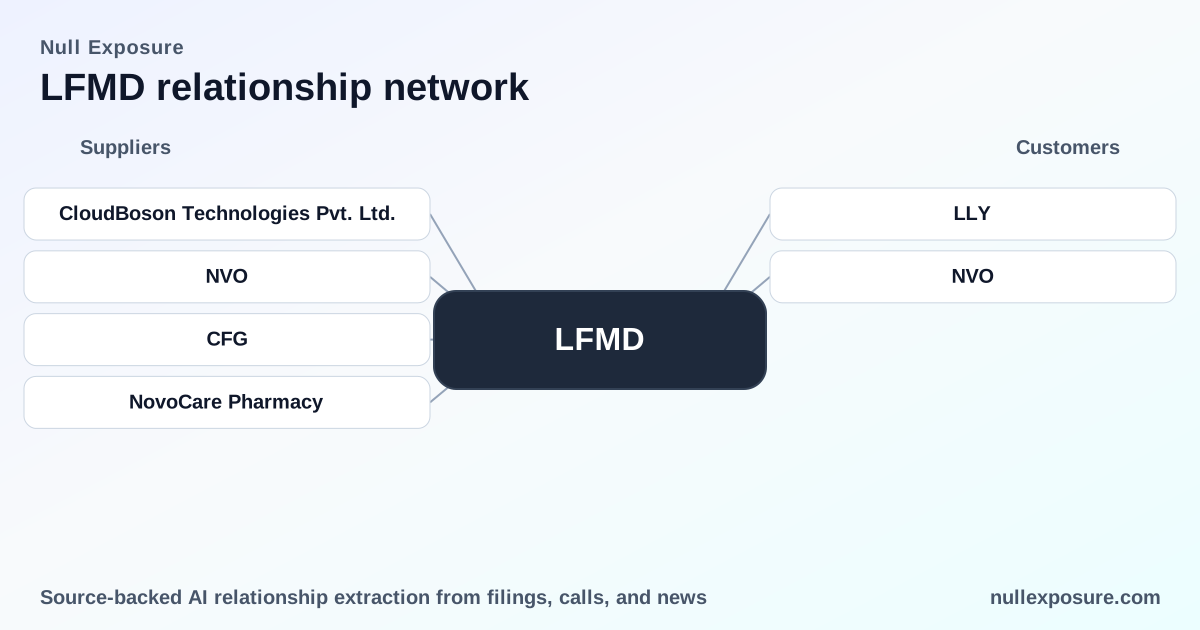
LifeMD has been explicit in its public commentary and filings about strategic integrations and financing activity that support growth and product expansions. Below I cover every partner mention surfaced in recent results and provide a plain-English take on what each relationship means for revenue and positioning.
LFMDP (MarketScreener report)
MarketScreener reported LifeMD announced closing a $50 million revolving credit facility with Citizens Bank and an expansion of its collaboration with Novo Nordisk to act as a recognized telehealth partner offering the newly approved Wegovy pill. This is a clear sign of capital availability for growth initiatives and commercial partnerships supporting weight-management programs. (MarketScreener, March 10, 2026)
Eli Lilly (LLY)
LifeMD stated on its 2025 Q3 earnings call that it is one of the few virtual care providers fully integrated with Eli Lilly, indicating operational connectivity for referral, prescribing, or delivery of Lilly products within LifeMD’s telehealth flow. That integration supports LifeMD’s ability to participate in specialty drug programs and expand clinical offerings tied to high-profile pharma brands. (LifeMD 2025 Q3 earnings call, reported March 2026)
Novo Nordisk (NVO)
Management also confirmed on the 2025 Q3 call that LifeMD is fully integrated with Novo Nordisk, which dovetails with the MarketScreener report about Wegovy access; this places LifeMD on the provider shortlist for telehealth delivery of GLP-1 related weight-management therapies. Integration with Novo Nordisk materially enhances LifeMD’s value proposition in weight management and related subscription services. (LifeMD 2025 Q3 earnings call, reported March 2026)
NVO (duplicate entry recorded)
A second result lists NVO separately but contains the same integration claim from LifeMD’s 2025 Q3 earnings call; the repeated entry reiterates the company’s emphasis on formal, operational ties to Novo Nordisk as a core commercial channel for specialty therapies. Treat this as reinforcing evidence of the same strategic relationship rather than an additional partner. (LifeMD 2025 Q3 earnings call, reported March 2026)
Operating constraints and what they imply for revenue durability and risk
The set of constraints surfaced across filings and disclosures paints a coherent picture of how LifeMD runs its business and what investors should monitor.
- Contracting posture: LifeMD is subscription-first (management states ~92% recurring revenue), with supplementary spot product sales for single shipments and retail transactions. That means most of the company’s revenue is delivered over time and tied to retention metrics, while product sales provide episodic upside.
- Counterparty profile: LifeMD’s customers are predominantly individual consumers acquired through digital channels (Facebook, Google, Amazon), so unit economics and customer acquisition cost volatility directly influence growth and margin sustainability.
- Geographic exposure: The platform operates nationwide across the U.S., including all 50 states, DC and Puerto Rico, which lowers regulatory concentration risk at the state level but keeps the company fully exposed to U.S. healthcare policy and payer dynamics.
- Materiality and criticality: Recurring subscriptions are critical to the company’s revenue base (the 92% figure is a company-level signal), while revenue from contracts with multiple performance obligations is reported as immaterial, indicating a relatively clean revenue recognition profile centered on single ongoing obligations.
- Relationship role and stage: LifeMD functions as a seller of telehealth services and prescription fulfillment, and the business cites approximately 275,000 active patient subscribers, confirming the relationships are operational and active rather than nascent.
- Segment diversification: The company’s operations span services (telehealth, pharmacy, diagnostics) and a software line through WorkSimpli (PDFSimpli), both of which are subscription-oriented but differ in margin profile and competitive dynamics.
Investment implications — the upside and the watch-list risks
- Upside: The combination of high-recurring revenue, embedded pharmacy capabilities, and direct integrations with pharma leaders (Novo Nordisk, Eli Lilly) gives LifeMD a clear path to monetize specialty drug programs and subscription-based weight-management services at scale.
- Risks to monitor: Customer acquisition cost sensitivity, retention rates among its 275k subscribers, regulatory changes in telehealth prescribing, and execution risk in converting large pharma integrations into sustained revenue. Also track the company’s use of the Citizens Bank revolver for growth versus liquidity needs.
For active investors tracking partner momentum and financing posture, LifeMD’s confirmed integrations with large biopharma and recent credit facility are material operational developments that justify monitoring near-term revenue cadence and retention metrics closely.
If you want a concise operational snapshot and ongoing relationship signal updates, visit https://nullexposure.com/ for structured coverage and alerts.
Bottom line
LifeMD is a subscription-centric telehealth operator with a pharmacy backbone and explicit integrations with major pharmaceutical players that enhance its addressable market in specialty therapies. The business profile combines durable recurring revenue with exposure to consumer acquisition cycles and prescription-regulatory dynamics—investors should value the company on retention-driven revenue and the ability to scale pharma partnerships into long-term, high-margin subscription cohorts.