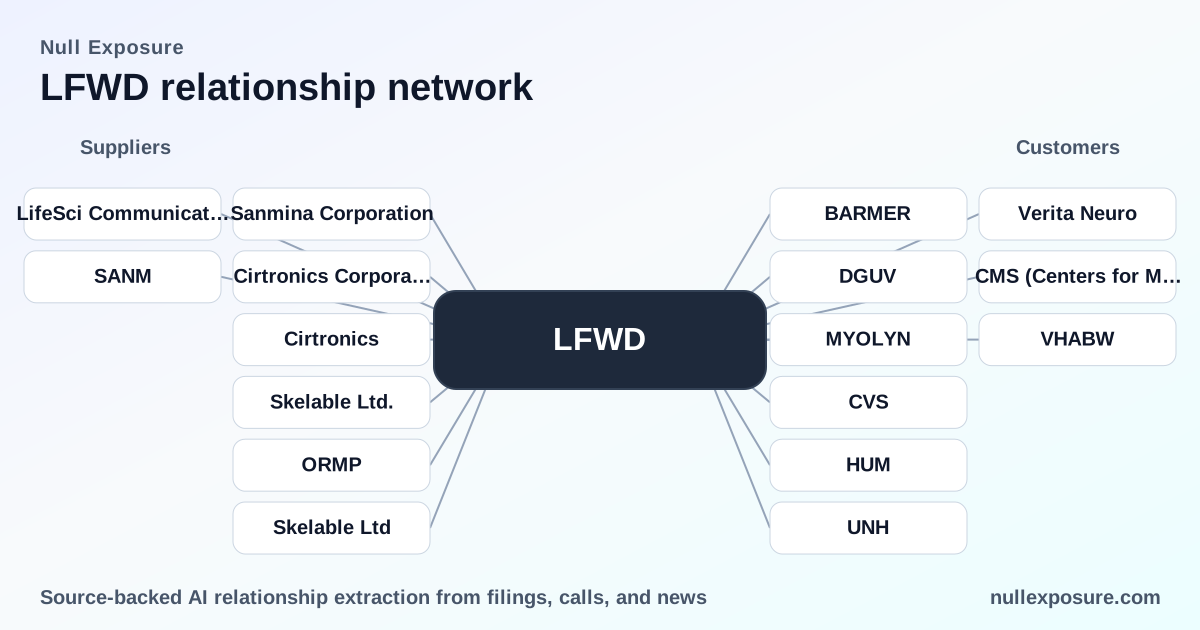
Lifeward / ReWalk (LFWD): Who Pays for the Exoskeletons and Why Investors Should Care
Thesis: Lifeward (ReWalk) designs and commercializes robotic exoskeletons and monetizes through product sales, multi-year rentals, and associated services; its commercial progress is driven by reimbursement wins with major payors and a hybrid direct/distributor go‑to‑market model that exposes the company to concentration and reimbursement risk but also creates scalable leverage if payors add coverage. For an investor oriented view of customer relationships, this note maps the payor, distributor and clinical partnerships disclosed in filings and public releases and highlights the commercial implications. Learn more at https://nullexposure.com/.
How ReWalk makes money and what that implies for customers and investors
ReWalk generates revenue from three channels: product sales, rental arrangements and warranty/services. Company filings state the business is managed as one reportable operating unit and that rental terms are typically fixed monthly fees over multi‑year terms (commonly 2–3 years), which creates recurring revenue visibility but also raises dependency on long payment cycles and reimbursement approvals. The company sells directly in its largest markets (United States, Germany) and leverages a network of third‑party distributors with territorial exclusivity in many markets, creating both reach and counterparty concentration across geographies. Filings and press coverage show an operational footprint spanning North America, EMEA and APAC, with recent distribution agreements expanding reach into Mexico, Thailand and the UAE.
Key operating constraints as reported: the company relies on a mix of direct sales and distributors (including exclusive arrangements), serves both institutional and individual end customers, operates globally with concentration in North America and Europe, and depends materially on third‑party payor reimbursement and government coverage decisions. These characteristics make reimbursement wins the primary commercial lever and insurer relationships the main near‑term value inflection for investors.
The commercial relationships you need on your radar
Aetna — a pivotal Medicare Advantage prior authorization (Feb–Mar 2026)
Aetna issued a prior authorization recognizing the ReWalk Personal Exoskeleton as medically necessary for at least one Medicare Advantage beneficiary, a development disclosed in company press coverage and industry news in February–March 2026. This decision expands access through Medicare Advantage channels and is cited in multiple press outlets (GlobeNewswire, Bitget, The Globe and Mail) during Feb–Mar 2026.
Source: Lifeward press release and subsequent coverage on GlobeNewswire (Feb 17, 2026) and industry news items (Mar 10, 2026).
Humana — Medicare Advantage prior authorizations now included (Feb–Mar 2026)
Humana has issued prior authorizations for qualified beneficiaries to receive the ReWalk Personal Exoskeleton, joining the group of large Medicare Advantage payors that have approved coverage for medically eligible patients. Press coverage in Feb–Mar 2026 highlights Humana as a named insurer providing access under Medicare Advantage plans.
Source: Company announcement and industry coverage (GlobeNewswire press release and related news items, Feb–Mar 2026).
UnitedHealthcare (UNH) — national scale payor acceptance (Feb–Mar 2026)
UnitedHealthcare has likewise issued prior authorizations for qualifying beneficiaries, placing three of the largest Medicare Advantage insurers on record as approving the ReWalk Personal Exoskeleton for medically eligible patients. Multiple press outlets reported this aggregation of payor authorizations in Feb–Mar 2026.
Source: GlobeNewswire press release and syndicated news (Feb–Mar 2026).
CVS-listed mention (CVS entry surfaced with Aetna content — Mar 2026)
A news item surfaced under a CVS feed referenced the Aetna prior authorization for the ReWalk device; while the item’s excerpt specifically documents Aetna’s coverage decision, the coverage was distributed widely via industry news portals on Mar 10, 2026.
Source: Bitget news item syndicated Mar 10, 2026.
BARMER — formalized reimbursement process (agreement finalized Feb 2025)
ReWalk finalized an agreement with Germany’s BARMER in February 2025 to formalize the reimbursement process for providing ReWalk exoskeletons to medically eligible beneficiaries, signaling improved prospects for systematic coverage within a major European health insurer.
Source: FY2024 10‑K disclosure (filed by LFWD, describing the Feb 2025 BARMER agreement).
DGUV — conditional, case‑by‑case coverage from German payor group
DGUV indicated that its member payors will approve exoskeleton systems on a case‑by‑case basis for qualifying beneficiaries, establishing a pathway for coverage but one that requires individualized approvals rather than automatic reimbursement.
Source: FY2024 10‑K (LFWD) referencing DGUV’s case‑by‑case policy.
VHA / VHABW — U.S. veterans’ coverage policy in place since 2015
The Veterans Health Administration issued a national reimbursement policy in December 2015 that covers evaluation, training and procurement of ReWalk systems for qualifying veterans across the U.S., representing a longstanding government channel for device access and procurement.
Source: FY2024 10‑K (LFWD) noting the VHA policy (Dec 2015).
MYOLYN — distribution arrangement and exclusivity signal
The company’s 10‑K flags a distribution arrangement with MYOLYN and cautions that new or future arrangements may not meet expectations; separately, corporate disclosures identify the company as the exclusive U.S. distributor for MYOLYN’s MyoCycle FES products for clinics and for the MyoCycle Home program available to veterans, indicating an important distributor/manufacturer relationship and exposure to partner execution risk.
Source: FY2024 10‑K (LFWD) and related distribution excerpts cited in company filings.
Verita Neuro — exclusive international distributor for three markets (Dec 2025)
Lifeward appointed Verita Neuro as the exclusive distributor for initial launches in Mexico, Thailand and the United Arab Emirates; this expands international reach into specialized neurological centers and establishes a partner with regional clinic access.
Source: SahmCapital news release summarizing the Dec 17, 2025 distribution announcement.
Shirley Ryan AbilityLab — clinical collaboration to accelerate access (Q2 2026)
Lifeward announced a collaboration with Shirley Ryan AbilityLab to launch dedicated clinic days at its Chicago campus starting in Q2 2026, an operational move designed to accelerate patient evaluation and therapy adoption at a leading rehabilitation center.
Source: Lifeward press release / GlobeNewswire (Mar 2, 2026) and related news coverage.
CMS — government reimbursement is a core strategic dependency
Company commentary and investor materials explicitly list reimbursement from third‑party payors including CMS as critical to commercial success, highlighting the strategic necessity of government coverage decisions for scaling revenue.
Source: SahmCapital coverage of company commentary (Dec 2025) and FY2024 filings.
Oramed (ORMP) — financing transaction (securities purchase agreement, Mar 2026)
In a separate commercial/financial interaction, Oramed entered into a securities purchase agreement to acquire senior secured convertible notes from Lifeward (an initial $9 million with an additional $9 million contingent), reflecting financing activity that intersects with corporate partners rather than end‑customer reimbursements.
Source: TradingView report summarizing the March 2026 securities purchase agreement.
What these relationships imply for investors
- Reimbursement is the value driver: insurer prior authorizations from Aetna, Humana and UnitedHealthcare materially expand addressable demand under Medicare Advantage and validate clinical utility in large payor channels.
- Channel mix creates leverage and concentration: a hybrid of direct sales, exclusive distributors and institutional (VHA, major clinics) placements enables scale, but also concentrates execution risk in a handful of partners and payors.
- Multi‑year rentals and services create recurring revenue but rely on stable payor policies: the company’s rental model (reported rental terms commonly 2–3 years) supports revenue visibility but requires sustained reimbursement and clinic adoption to convert installed base into lifetime value.
- Clinical partnerships accelerate adoption: collaborations like Shirley Ryan AbilityLab and distributor expansions (Verita Neuro) are operational accelerants that shorten the path from authorization to patient use.
For investors evaluating LFWD, the immediate monitoring list is simple: track further Medicare Advantage decisions, BARMER implementation details in Germany, VHA procurement activity, and execution by key distributors. For a concise, subscription‑grade view of evolving customer signals and to monitor payer rollouts in real time, visit https://nullexposure.com/.
Bold takeaway: coverage approvals from large Medicare Advantage payors convert a clinical technology story into a commercial growth pathway — execution across distributors and clinic partners determines whether that pathway scales to meaningful revenue.