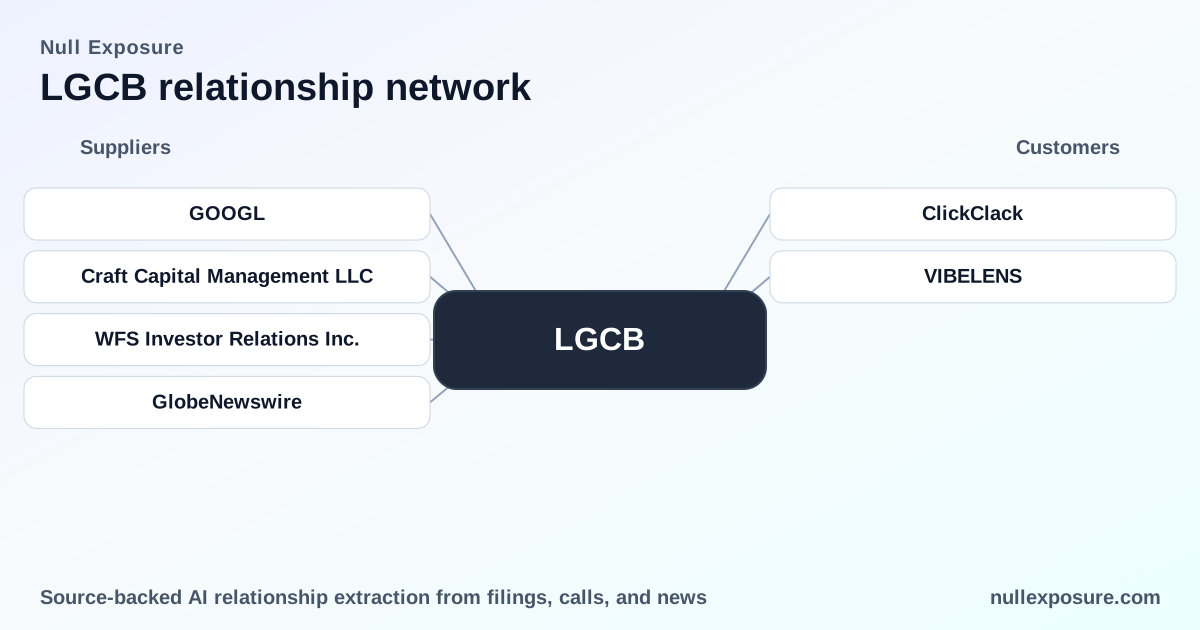
Linkage Global (LGCB): Licensing Deals Drive Revenue Mix Shift — Two Partners to Watch
Linkage Global monetizes intellectual property and embedded technologies by licensing core acoustic algorithms, intangible cultural heritage craftsmanship designs, and smart wearable technology to hardware brands on a per-unit royalty basis. The company charges $10 per unit under recent agreements and recognizes licensing fees when partners ship products; that structure converted a CES showcase into a near-term revenue inflection, while the broader business still carries operating losses. For a concise position read, visit https://nullexposure.com/.
CES as the Commercial Catalyst — what the numbers show
Linkage leveraged CES 2026 to convert IP into product licensing rapidly. Management reported 72,000 licensed units sold in February, generating $720,000 in patent licensing fees under the $10-per-unit structure, a clear demonstration that IP licensing can scale quickly when paired with premium consumer hardware partners. According to a February 10, 2026 company release republished by The Globe and Mail, that month’s licensing revenue is a material tactical win against a trailing revenue base of approximately $5.10 million (TTM). PR Newswire’s January 6, 2026 announcement framed the same agreements as the commercial launch point for two branded headphone products.
Who Linkage is selling to: every reported customer relationship
ClickClack
Linkage has an intellectual property licensing agreement with ClickClack to power the ClickClack S7 All-Scenario Headphones, with Linkage charging a $10 patent licensing fee per unit shipped. The partnership produced an immediate commercial impact: management reported that ClickClack-related licensed sales contributed to February’s 72,000-unit milestone and the $720,000 in licensing revenue. Source: PR Newswire announcement (Jan 6, 2026) and management sales report republished by The Globe and Mail (Feb 10, 2026).
VIBELENS
Linkage licensed the same suite of IP — acoustic algorithms, ICH craftsmanship designs and wearable technologies — to VIBELENS for the A35 bone-conduction camera headphones, under the identical $10-per-unit license structure. PR Newswire and multiple market news outlets summarized this arrangement as part of Linkage’s CES 2026 partnership slate that converts IP into recurring per-unit royalties. Source: PR Newswire release (Jan 6, 2026) and follow-up coverage including Investing.com (May 2026).
How the licensing model shapes operating constraints and strategic posture
Linkage’s commercial engine is not product manufacturing; it is transactional IP monetization. That modality creates a distinct operating profile:
- Contracting posture: Linkage operates as an IP licensor that executes short- to mid-term commercial supply relationships tied to partner SKU shipments, rather than long-term capital-intensive manufacturing contracts. The $10-per-unit royalty is a unit-based contractual anchor that aligns revenue with partner retail execution.
- Concentration and go-to-market: Revenue concentration is an operational signal — a handful of brand partnerships can generate meaningful revenue when product launches succeed, but concentration also amplifies downside if partners underperform. The February figures show how a single launch window can meaningfully move the top line.
- Criticality to customers: The licensing terms and product positioning reflect that partners treat Linkage IP as a differentiator for premium consumer hardware; this elevates Linkage’s bargaining power for per-unit fees while exposing it to product life-cycle and trend risk.
- Commercial maturity: The deals announced at CES and the immediate revenue recognition in February indicate Linkage is in an early commercialization phase where licensing is moving from proof-of-concept to measurable sales, but operating losses indicate the company is still investing to scale distribution and monetization channels.
These are company-level signals derived from the licensing structure and reported sales, not contract-level excerpts from specific partners.
Financial context that investors need to weigh
Linkage reported TTM revenue of approximately $5.10 million and gross profit of $3.70 million, which implies that revenue from licensing carries strong gross economics, while the operating picture remains loss-making—EBITDA is negative roughly $4.56 million and diluted EPS before is -1.30. Key takeaway: licensing is high-margin at the gross level, but the company must scale royalties materially to cover operating costs and convert to positive operating earnings. The February licensing haul—$720,000—is a tangible example of how per-unit royalties translate directly to top-line growth.
Additional balance-sheet and market signals worth noting: shares outstanding are large relative to the free float (shares outstanding ~41.48M vs shares float ~1.93M) and institutional ownership is very low (~0.05%), which creates liquidity and ownership concentration considerations for investors evaluating governance and share-price sensitivity.
Practical implications for investors and operators
- For revenue forecasting, treat per-unit royalties as directly scalable with partner shipment volume; every incremental unit shipped equals $10 in revenue recognized under current contracts.
- For risk modeling, assume partner execution (channel distribution, retail acceptance) is the proximate constraint on revenue growth rather than manufacturing ramp for Linkage itself.
- For diligence, prioritize verification of partner shipment cadence and product lifecycle plans, since a small set of SKUs drives outsized licensing dollars.
Visit https://nullexposure.com/ for more in-depth relationship tracking and real-time headlines.
Risk checklist — what can derail momentum
- Concentration risk: A small number of licensing partners account for meaningful near-term revenue; product or marketing failures at those partners will have an outsized impact.
- Royalty dependence: The $10-per-unit model is effective when volumes scale; below-scale volumes leave operating losses intact.
- Enforcement and IP defensibility: Sustained royalties require active IP protection and licensing administration across geographies.
- Market liquidity and investor base: Low institutional ownership and a narrow public float can create volatility and limit investor support during drawdowns.
Bottom line
Linkage Global has a clear monetization mechanism—unit-based IP licensing—that converted CES visibility into measurable revenue through partnerships with ClickClack and VIBELENS. The $10-per-unit royalty creates direct, high-margin revenue when partner SKUs ship, but the company remains loss-making at the operating level until licensing volume scales further. Investors should treat the recent sales milestone as credible commercial validation while focusing diligence on partner execution and concentration risks. For ongoing coverage of LGCB customer relationships and new licensing announcements, see https://nullexposure.com/.