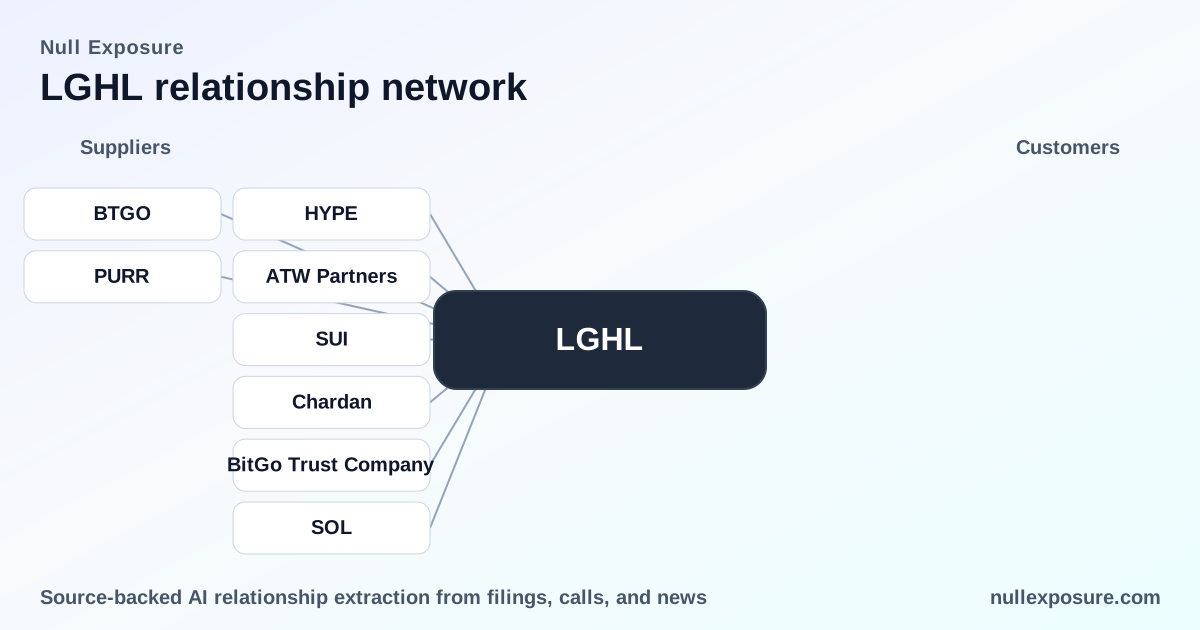
Lion Group Holding Ltd (LGHL): Customer Relationships that Move the Needle
Lion Group Holding operates a Hong Kong trading platform and monetizes through transaction revenue, trading spreads and ancillary capital-markets services offered to retail and institutional clients. The business is small in scale but operationally lean — FY2025 revenue was roughly $7.26 million with gross profit of $5.13 million, while the company remains loss-making on an EPS basis; therefore strategic customer relationships and financing arrangements materially shape liquidity, execution capability and near-term survivability.
If you want a focused digest of LGHL’s external ties and what they imply for investors, read on — or explore deeper analysis at Null Exposure: https://nullexposure.com/.
What to watch: strategy and commercial posture in plain terms
LGHL’s public footprint shows targeted, transactional relationships rather than broad, long-term enterprise contracts. The firm’s operating model points to an opportunistic contracting posture: deals and partnerships are executed to shore up capital or reduce operating cost rather than to lock in diversified recurring revenue streams. Financial signals — a modest market capitalization (~$420k) and concentrated public mentions — indicate overall commercial immaturity and high concentration risk: a handful of counterparties can move access to capital and logistics, which in turn affects execution of the trading platform.
Key corporate characteristics that bear on investor diligence:
- Contracting posture: Tactical and financing-driven, with short-duration commitments visible in public filings and press.
- Customer concentration: Publicly visible relationships are sparse, elevating counterparty importance for cash and operations.
- Criticality: Select counterparties contribute directly to liquidity (capital investors) or cost base (logistics partners), making a small number of relationships disproportionately critical.
- Maturity: Company-level metrics and public mentions position LGHL as early-stage in commercial scale and institutional adoption.
Customer relationships — the ones that matter right now
Below are the customer/partner relationships identified in public reporting. Each is summarized plainly with source context.
Amazon Capital Holding Limited — a structured equity purchase that changed pace
Lion entered a share purchase agreement with Amazon Capital Holding Limited under which the investor was originally committed to buy US$5 million of Class A ordinary shares at a discount tied to LGHL’s 20‑day ADS average price for the first closing on November 8, 2024. According to a TipRanks company announcement (filed / reported May 3, 2026), that tranche and structure represent critical financing capacity for Lion at a time when public float and market capitalization are constrained (https://www.tipranks.com/news/company-announcements/lion-group-holding-cuts-first-tranche-size-in-amazon-capital-share-purchase-deal).
- Takeaway: This is a material capital infusion mechanism and its terms (discounted pricing, tranche structure) directly affect dilution risk, share-price pressure and short-term liquidity.
TKLF / Yoshitsu — an operational partnership to reduce logistics cost
A FY2022 media mention links Lion Group with a warehouse/logistics partnership involving Yoshitsu, reported via a Benzinga story aggregated on Finviz, positioned as a cost-reduction effort for logistics operations (Finviz / Benzinga, FY2022: https://finviz.com/quote.ashx?t=TKLF).
- Takeaway: The relationship is operational rather than revenue-driving: a logistics partnership reduces cost-per-trade or supporting services, helping gross margin recovery in a low-revenue environment.
How these relationships affect valuation and risk
Both ties are typical of companies balancing capital access and cost control while scaling execution capability. The Amazon Capital agreement directly affects liquidity and shareholder dilution, so investors must treat it as a de facto financing line with pricing that compresses upside if executed at steep discounts. The Yoshitsu/TKLF logistics tie reduces operating friction and can improve margins, but it is not a substitute for diversified customer revenue.
Investor implications in a compact list:
- Liquidity dependency: The Amazon Capital structure is a central lever of solvency; successful closings improve runway, but discounted purchases create immediate dilution.
- Operational leverage: Logistics partnerships reduce operating cost but do not materially substitute for trading revenue growth.
- Concentration risk: With only a few publicly reported relationships, LGHL remains exposed to counterparty-specific execution and financing shocks.
- Volatility and governance: Small market cap, negative EPS and high beta (2.667) translate into share-price volatility and governance sensitivity around funding negotiations.
Constraints and what the public record signals about contracting
No explicit contractual constraints are listed in the supplied relationship constraints. At a company level this manifests as:
- Limited disclosed long-term contractual lock-ins. Publicly observable agreements emphasize one-off financings or tactical partnerships rather than multi-year revenue contracts.
- Flexible contracting posture. The absence of firm-level constraint disclosures indicates the company is structured to accept short-duration or contingent relationships to preserve optionality.
- Early commercial maturity. The lack of broad enterprise-grade customer disclosures is a signal that LGHL is still building scalable, recurring revenue channels.
These are company-level signals, not tied to any single relationship unless the related excerpt explicitly names one.
Risk checklist for investors
Investors evaluating LGHL for allocation should weigh the following, with emphasis on the material relationships above:
- Funding execution risk: Track the timing and pricing of tranche closings with Amazon Capital — a missed tranche is an immediate liquidity event.
- Dilution risk: Discounted purchase terms accelerate share issuance and compress per-share value.
- Revenue concentration: Low absolute revenue and sparse customer mentions elevate the importance of each new commercial tie.
- Operational dependency: Partnerships like the Yoshitsu logistics arrangement improve margins but do not eliminate the need for diversified client acquisition.
For a concise, investor-ready dossier and ongoing relationship monitoring, visit Null Exposure for expanded coverage and alerts: https://nullexposure.com/.
Bottom line
LGHL is a small, volatility-prone trading-platform operator whose near-term trajectory hinges on capital access and a few operational partnerships. The Amazon Capital share purchase agreement functions as a crucial financing channel that investors must monitor for execution and dilution effects, while logistics partnerships reduce cost but do not materially diversify revenue. Treat LGHL as a high-risk, event-driven equity where counterparty transactions—not organic scale—drive value over the next 12–24 months.