Legence (LGN): Customer Concentration, Blackstone Ties, and the Data‑Center Revenue Trade
Legence Corp. operates as an engineering and construction firm that monetizes through project contracts and energy-management services for industrial and infrastructure clients, with a growing emphasis on carbon‑reduction and data‑center infrastructure work. Revenue is generated from large, often multi‑year customer engagements—where a small number of anchor accounts drive outsized top‑line contribution—while ownership ties to private‑equity platforms provide preferential access to capital and deployment opportunities.
For a concise overview of our coverage and signals on customer relationships, visit https://nullexposure.com/.
Why customer relationships define LGN’s risk‑reward profile
Legence’s public filings show a company with substantive scale—Revenue TTM of $2.55B and market capitalization near $15.0B—paired with thin profitability (negative reported EPS and marginal operating margin). That financial footprint, combined with reported customer links, implies a project‑driven contracting posture, where revenue swings and margin pressure are highly sensitive to the timing and scale of large client projects.
- Concentration is a feature of the model. Large projects with a handful of institutional clients produce efficiency and scale benefits, and also produce revenue volatility when projects ramp down.
- Contracting posture is counterparty‑centric. Engineering and energy‑management relationships are typically governed by long lead times, staged milestones, and performance obligations that make client continuity critical to cash flow.
- Strategic maturity shows mixed signals. Public metrics show robust revenue growth year‑over‑year but constrained profitability, indicating revenue scale with ongoing operational optimization needed.
No explicit third‑party contractual constraints were present in the reviewed records; that absence is itself a company‑level signal that the primary investor and analyst concerns should focus on customer concentration, contract duration, and delivery execution rather than vendor lock‑ins or regulatory clauses extracted from filings.
QTS: A top customer and a Blackstone pathway
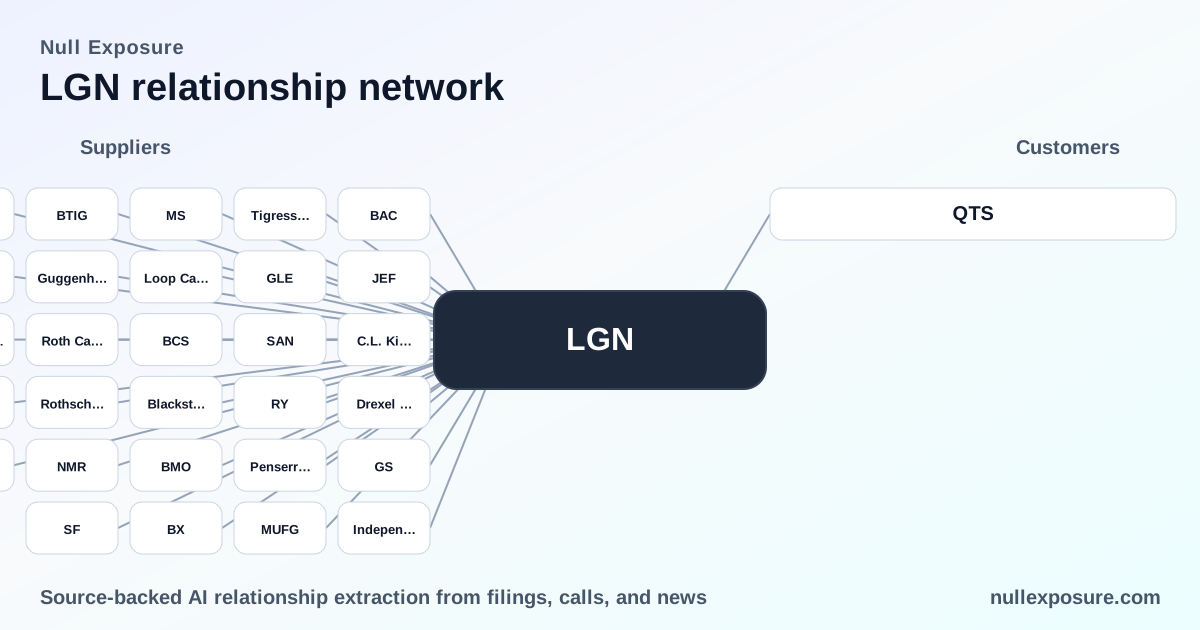
Legence’s largest identified customer is QTS, a major data‑center operator. According to a market note published on March 10, 2026, Blackstone ownership provides Legence preferred access to QTS and supports ongoing expansion of data‑center infrastructure nationwide, which creates a recurring pipeline of large construction and energy‑management contracts for Legence. (Finviz news, March 10, 2026.)
This relationship positions Legence to capture high‑margin services tied to data‑center buildouts, but it also concentrates exposure in a single vertical that is cyclical and capital‑intensive.
BXSL / Blackstone vehicle: ownership and strategic alignment
Legence is identified in Blackstone’s filings as a portfolio company that provides carbon reduction and energy management services, indicating a direct strategic alignment between Legence’s offerings and Blackstone‑owned infrastructure platforms. This description is drawn from Blackstone’s FY2024 disclosure where Legence is referenced in the context of Other Clients. (BXSL 10‑K, FY2024 filing.)
The connection to Blackstone‑owned platforms creates preferential commercial channels and balance‑sheet access that translate into project pipelines and potential repeat business, while concentrating counterparty and reputational exposure to the private‑equity sponsor and its portfolio.
What these relationships mean for valuation and risk
Legence’s customer map and Blackstone nexus produce a clear set of structural implications for investors:
- Revenue growth has a clear catalyst: Ownership and pipeline access tied to Blackstone platforms and QTS data‑center expansion are immediate demand drivers that explain recent top‑line expansion (Quarterly revenue growth YoY reported at ~34.6%).
- Profitability is the watchpoint: Despite revenue scale, trailing metrics show negative EPS and thin operating margin, driving a valuation that trades on growth expectations rather than current cash‑flow generation (EV/Revenue ~3.08; EV/EBITDA ~48.82).
- Concentration risk is elevated: Large client reliance accelerates outperformance in growth cycles and amplifies downside in project slowdowns or contract losses. QTS is explicitly called out as the largest customer, and Blackstone’s role tightens that concentration dynamic.
What to watch in the next two earnings cycles
- Contract secures and renewals with QTS and other Blackstone portfolio platforms; these will be the primary leading indicators of near‑term revenue sustainability.
- Margin progression as Legence scales energy‑management offerings and integrates carbon‑reduction projects; improving operating margin is necessary to justify current forward multiples.
- Disclosure on contract length and backlog composition to quantify concentration and predictability.
Key monitoring points:
- New public confirmations of QTS project awards or expansions.
- Follow‑up filings from Blackstone‑affiliated entities referencing Legence in subsequent fiscal filings.
- Quarterly commentary on backlog, margins, and client mix.
For continued tracking and signal synthesis on LGN customer relationships, see https://nullexposure.com/.
Bottom line: growth centered on a narrow set of powerful relationships
Legence presents a classic growth‑at‑scale investment case: substantial revenue expansion driven by large institutional clients and sponsor relationships, paired with margin normalization as the principal valuation hinge. The Blackstone linkage and the explicit role of QTS as a major customer are both powerful tailwinds for contract flow and meaningful concentration risks that investors must price.
Investors should value Legence on a two‑pronged basis: upside from secured pipelines and sponsor access, and downside from client concentration and execution risk. Monitor contract announcements and margin trends closely—the path to durable upside runs through repeatable project execution and diversification of the customer base.