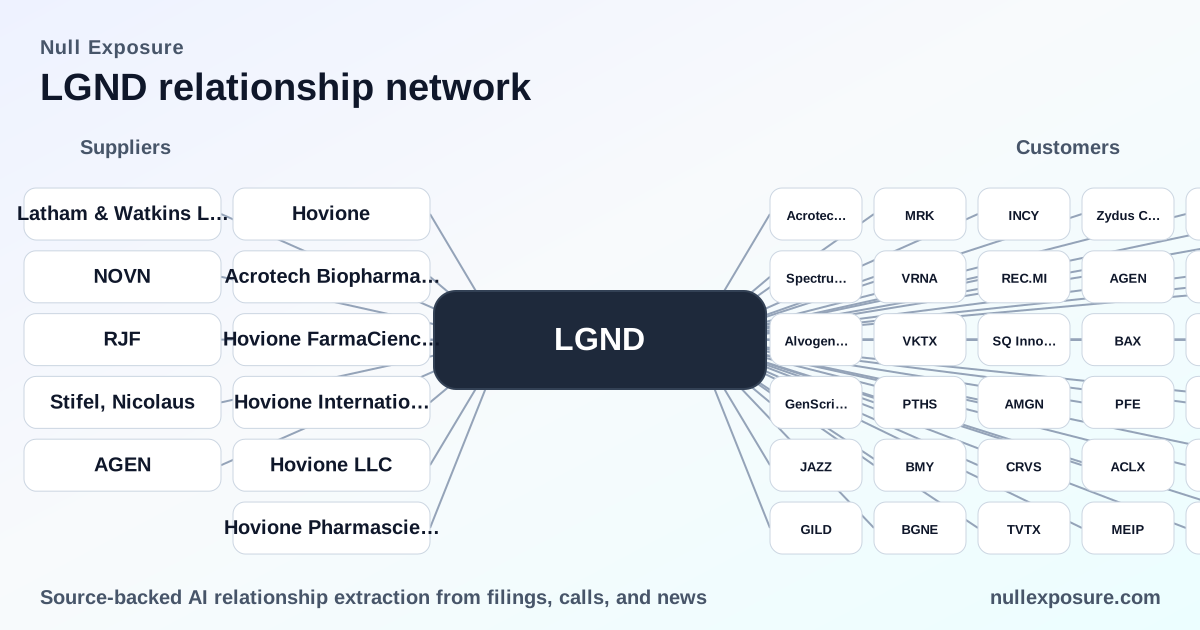
Ligand Pharmaceuticals (LGND): The customer map that drives royalties and Captisol sales
Ligand operates as a commercial financier and licensor to the biopharma sector: it acquires or develops platform technologies (notably Captisol and OmniAb), licenses them to drug makers, supplies formulation material, and finances royalty streams, collecting milestone payments, product royalties and material sales. For investors the company is a royalty-and-license engine whose revenue mix is highly correlated to the commercial performance of a concentrated set of partners and to Captisol demand from large pharma customers. Learn more at https://nullexposure.com/.
How Ligand contracts, sells and collects — the operating constraints that matter
Ligand’s disclosures and public reporting describe a stable seller posture: the company sells Captisol material and licenses platform IP under multi-element commercial arrangements that combine product sales, royalties, milestone payments and financing. According to Ligand’s 2024 Form 10‑K, a 10‑year supply agreement for Captisol with Gilead exists, which signals a long‑term commercial commitment with a major customer (evidence in FY2024). The company reports that its royalty assets are global in scope, with contracts spanning the United States, Europe and other regions, which creates geographically diversified payment streams (company-level signal). Ligand explicitly reports Captisol as a core product line — Captisol sales rose to $30.9 million in 2024 from $28.4 million in 2023, confirming material contribution from direct sales (company-level signal drawn from reported Captisol figures).
- Contracting posture: long‑term supply relationships for Captisol (explicit for Gilead).
- Revenue concentration: royalties tied to a relatively small set of marketed drugs (Amgen, Travere, Recordati, Jazz and others).
- Criticality: royalty receipts are directly linked to commercial success of partners; Captisol sales rely on formulators and large pharma inventory decisions.
- Maturity: the business mixes long‑running marketed royalties with earlier‑stage milestone and financing deals.
If you want a concise dashboard of Ligand’s partner exposures, start with the company filing and the recent press releases summarized below; see full coverage at https://nullexposure.com/.
What the relationship roster implies for investors
Ligand’s partner list reads like a who’s‑who of commercial biopharma. Royalty risk is concentrated around a handful of marketed products (Kyprolis, Filspari, Qarziba, Rylaze, Evomela, Teriparatide), while Captisol provides a steadier, contracted revenue line from material sales. Milestones and royalty financings (e.g., Castle Creek) provide episodic upside but also tie Ligand to clinical and launch execution by partners. The mix creates a hybrid exposure: stable but skewed — predictable cash from Captisol and established royalties, growth optionality from launches and financings.
Detailed relationship log: one‑ to two‑sentence investor summaries (complete coverage)
Below are one‑ to two‑sentence summaries for every partner listed in Ligand’s customer universe extracted from filings and press coverage.
-
Acrotech Biopharma — Ligand reports that a significant portion of its royalty revenue is linked to sales of Evomela, which is sold by Acrotech Biopharma, making Acrotech a direct source of product royalties. Source: Ligand 2024 Form 10‑K (FY2024).
-
Alvogen / Adalvo — Ligand discloses royalties tied to Teriparatide that are paid by Alvogen/Adalvo, positioning Alvogen as a commercial licensee for that product. Source: Ligand 2024 Form 10‑K (FY2024).
-
Spectrum Pharmaceuticals, Inc. — Ligand cites an historic license agreement involving CyDex and Spectrum (dated March 8, 2013), reflecting legacy licensing relationships that underpin some royalty arrangements. Source: Ligand 2024 Form 10‑K (FY2024).
-
GenScript ProBio / GenScript Biotech — A 2021 PR Newswire release announced a global OmniAb license to GenScript ProBio, establishing GenScript as a licensed OmniAb provider for antibody discovery. Source: PR Newswire release (2021).
-
Jazz Pharmaceuticals (JAZZ) — Ligand identifies Rylaze (sold by Jazz) as a royalty‑bearing product and lists Jazz among its partners in filings, making Jazz a recurring royalty counterparty. Source: Ligand 2024 Form 10‑K (FY2024) and company announcements.
-
Gilead Sciences (GILD) — Ligand explicitly reports a long‑term Captisol supply relationship with Gilead, and guidance commentary states increased Captisol demand from Gilead as they rebuild Veklury inventories. Source: Ligand 2024 Form 10‑K (FY2024) and Zacks coverage (news sentiment, FY2024).
-
Pelthos Therapeutics (PTHS) — Ligand owns roughly half of Pelthos, has invested in convertible capital and receives royalties; Ligand recorded a $5 million milestone payment following Pelthos’ commercial launch of ZELSUVMI. Source: Zacks/QuiverQuant coverage (FY2025).
-
Merck (MRK) — Merck is named as a licensee for products that drive Ligand royalties (notably Capvaxive and Ohtuvayre as referenced in guidance), making Merck a material royalty partner. Source: QuiverQuant coverage (FY2025) and news sentiment (FY2024).
-
Verona Pharma (VRNA) — Ligand earned a $5.8 million FDA‑approval milestone from Verona for Ohtuvayre and expects further launch‑linked payments and single‑digit royalties tied to the product. Source: Pharmaphorum reporting (FY2024).
-
Amgen (AMGN / AMGN entries) — Ligand’s royalty revenue is substantially linked to Kyprolis sales by Amgen, making Amgen one of the largest single product exposures in the royalty book. Source: Ligand 2024 Form 10‑K (FY2024) and OncologyPipeline reporting.
-
Incyte (INCY) — Ligand lists programs (e.g., INCAGN2385) in news summaries as part of partnered pipelines that generate royalty prospects; Incyte appears in royalty pipeline reporting. Source: OncologyPipeline (FY2024).
-
Bristol Myers Squibb (BMY) — Ligand references BMS collaborations in oncology program reporting; BMS is included among partners in news summaries relating to pipeline royalties. Source: OncologyPipeline (FY2024).
-
Corvus Pharmaceuticals (CRVS) — Corvus programs are listed in royalty profiling (e.g., ciforadenant) and are counted among Ligand’s partnered oncology assets. Source: OncologyPipeline (FY2024).
-
Travere Therapeutics (TVTX / Travere) — Travere’s Filspari is explicitly cited as one of Ligand’s top revenue generators, with a 9% royalty rate reported and recurring contribution to forecast revenue. Source: Zacks and company guidance (FY2024–FY2025).
-
Viking Therapeutics (VKTX) — News summaries list contract revenue associated with Viking’s NASH program (estimated contract revenue in the $10–20 million range includes $10 million tied to Viking), indicating active program collaborations. Source: Zacks news sentiment (FY2024).
-
Zydus Cadila — Zydus Cadila is referenced in coverage as a commercial partner for biosimilars (Bryxta, Zybev, Vivitra) that generate undisclosed royalties to Ligand. Source: OncologyPipeline reporting (FY2024).
-
Agenus / Agen (AGEN) — Coverage notes that Agenus has mortgaged projects to Ligand to fund late‑stage trials, and Ligand‑linked program economics (e.g., bispecifics) are part of the royalty pipeline. Source: OncologyPipeline (FY2024).
-
Baxter International (BAX) — Corporate releases describe Baxter among a set of leading pharmaceutical companies with which Ligand maintains alliances, licenses and supply relationships. Source: GlobeNewswire (FY2025).
-
BeiGene (BGNE) — Coverage on Qarziba describes BeiGene holding China rights while Recordati handles other markets, with both licensees paying royalties to Ligand. Source: Pharmaphorum (FY2024).
-
Recordati / REC.MI / RCDTF — Recordati is the listed marketer of Qarziba outside China and is a direct source of royalties tied to that product. Source: Ligand 2024 Form 10‑K (FY2024) and Pharmaphorum/OncologyPipeline (FY2024).
-
Sermonix Pharmaceuticals — Sermonix’s lasofoxifene program is included in Ligand’s pipeline lists and projected royalty ranges in oncology coverage. Source: OncologyPipeline (FY2024).
-
UroGen (URGN / UroGen) — UroGen appears in program-level listings with partnered agents (e.g., UGN‑301) that contribute to Ligand’s royalty potential. Source: OncologyPipeline (FY2024).
-
Xi’an Xintong — Xi’an Xintong’s MB07133 cytarabine prodrug appears in partner program listings tied to royalty percentages. Source: OncologyPipeline (FY2024).
-
SQ Innovation AG — Ligand entered exclusive Captisol license and supply agreements with SQ Innovation for a high‑concentration furosemide formulation, with Ligand entitled to material sales, milestones and a low‑single‑digit royalty. Source: PR News (SQ Innovation press release, FY2019) and QuiverQuant reporting (FY2025).
-
Arcellx (ACLX) — Arcellx’s ACLX‑001 BCMA program is listed among Ligand‑tied programs that would generate royalties if commercialized. Source: OncologyPipeline (FY2024).
-
MEI Pharmaceuticals (MEIP) — MEI’s ME‑344 program is listed among Ligand‑partnered oncology programs with potential low single‑digit royalty ranges. Source: OncologyPipeline (FY2024).
-
Acrivon (ACRV / Acrivon) — Acrivon’s ACR‑368 CHK inhibitor is listed among partnered pipeline assets referenced in Ligand coverage. Source: OncologyPipeline (FY2024).
-
Orchestra BioMed (OBIO / Orchestra) — TradingView summary of the 10‑K and news indicates Ligand invested in Orchestra BioMed’s cardiology programs and structured royalty participation in associated programs. Source: TradingView summary of Ligand 10‑K (FY2026).
-
Castle Creek Biosciences — Ligand led a $75 million royalty financing for Castle Creek and entered into royalty financing arrangements tied to D‑Fi Phase 3 activity, reflecting Ligand’s financing role. Source: GlobeNewswire and TradingView (FY2025–FY2026).
-
Apeiron (APNC / Apeiron) — Apeiron/Recordati’s Qarziba is listed as a marketed asset that contributes to Ligand royalties; Apeiron is mentioned in oncology pipeline reporting. Source: OncologyPipeline (FY2024).
Key investment takeaways
- Revenue mix is hybrid and concentrated: Captisol sales are meaningful and contracted, but a small set of licensed drugs generate the majority of royalties (Amgen, Travere, Recordati, Jazz, Verona, Merck).
- Long‑term supply relationships reduce short‑term volatility: the 10‑year Captisol supply to Gilead is a structural revenue support. (Ligand 2024 Form 10‑K, FY2024).
- Growth is driven by partner launches and financings: milestone receipts (Pelthos, Verona) and royalty financings (Castle Creek) create episodic upside.
- Risk is execution‑dependent: upside requires commercial traction by licensees; downside follows partner sales performance.
For a data‑driven investor brief and deeper partner exposure analytics visit https://nullexposure.com/ for the Ligand coverage page and further filings.