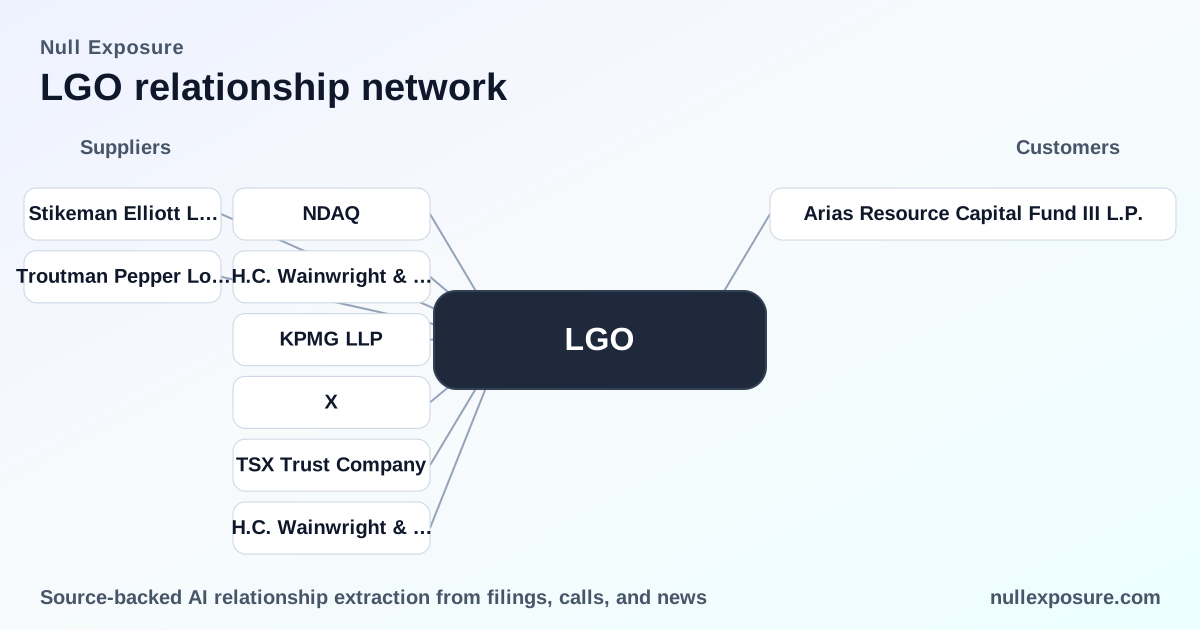
LGO — Customer relationships that matter for capital and optionality
Largo Resources Ltd operates as a natural-resources exploration and development company with operations in Brazil and Canada and monetizes through the development and sale of mined products and associated commercial contracts. Its economics are driven by on-site production scaling, periodic offtake or commercial contracts, and episodic external financing when operating cash flow is negative. Investors should evaluate LGO through a dual lens: operational execution on commodity production and the company’s ability to secure finance from strategic stakeholders. For relationship transparency and provenance, see https://nullexposure.com/.
Quick read for investors: what the relationship map contributes
LGO’s customer-related intelligence returns two items for FY2026. One is a commercial counterparty visible in news flow, the other is a financing commitment from a major shareholder affiliate. Together they signal commercial engagement at the market level and continued reliance on shareholder financing to bridge working capital.
Enel Green Power — a commercial counterparty surfaced in FY2026 media
Quantisnow captured forward-looking language referencing the production, delivery and sale of a VCHARGE+ battery system to Enel Green Power in a press release dated 2026-05-03. The item discusses system design, expected transaction value and the broader long-duration storage market, and is included in LGO’s FY2026 customer relationship sweep. According to the Quantisnow item published May 3, 2026, the press release contained explicit forward-looking statements about delivering a VCHARGE+ system to Enel Green Power: https://quantisnow.com/insight/largo-resources-appoints-ian-robertson-to-co-chair-of-its-board-1456138.
- Interpretation: this mention places Enel Green Power on LGO’s customer radar during FY2026 media coverage, which is relevant for investors tracking potential commercial off-take, ancillary services, or market adjacency. The underlying excerpt focuses on a battery systems sale to Enel Green Power rather than a commodity offtake, so treat this as a media-identified relationship rather than a confirmed mine-to-customer sale.
Arias Resource Capital Fund III L.P. — shareholder-affiliate financing commitment
A BR-ADVFN report dated March 10, 2026 reported that Arias Resource Capital Fund III L.P., an affiliate of LGO’s largest shareholder, agreed to provide the company with financing of US$6.0 million and entered into a securities purchase agreement to acquire 4,918,033 common shares and 4,918,033 warrants. The article frames this as the “ARC Commitment” supporting immediate liquidity needs: https://br.advfn.com/noticias/BW/2025/artigo/97013193.
- Interpretation: this is a direct capital injection from the largest shareholder’s affiliate and constitutes a material financing relationship in FY2026. For investors, the commitment reduces short‑term cash stress but increases equity dilution potential and reinforces shareholder concentration as a structural feature of LGO’s financing strategy.
Operating model and business-model constraints — what the relationship signals imply
There were no explicit contractual constraints surfaced in the relationship-level feed for LGO, which itself is an informative company-level signal: the relationship returns did not include supplier lock-ins, exclusive offtake terms, or formal performance covenants that are visible in public news excerpts.
From these relationship signals and the company fundamentals, derive the following operational and business-model characteristics:
- Contracting posture: opportunistic and transaction-based, not dominated by long-term, publicized offtake contracts in the visible record. The media mentions reflect project- and financing-transaction activity rather than multi-year commodity contracts.
- Concentration: elevated shareholder concentration and financing dependency is evident. The Arias Fund financing confirms reliance on a principal investor to fund near-term cash needs.
- Criticality: capital relationships are strategic and critical; access to affiliated shareholder capital materially affects runway and dilution outcomes.
- Maturity: financial indicators point to a development-stage posture. Revenue TTM of approximately USD 109.9 million sits against negative EBITDA of USD -25.6 million and negative profitability metrics, indicating operations are not yet generating stable, positive operating cash flow that would eliminate reliance on sponsor financing.
- Public-market sensitivity: valuation multiples and trading volatility amplify execution risk. Market cap near USD 112 million, a beta north of 2.2, and crowded small-cap dynamics mean news about single counterparties or financings moves the stock materially.
What investors should watch next
- Follow confirmed offtake announcements or formal supply agreements with industrial or utility counterparties that tie future production to revenue visibility. The Enel Green Power mention is media-visible but not a confirmed mine offtake. A contract filing would change the revenue runway calculus.
- Monitor the terms and execution of the Arias Fund financing because the commitment directly impacts cash runway, dilution, and governance profile. Insider-affiliate financing stabilizes liquidity but concentrates control and can compress minority returns.
- Track operating cash flow and EBITDA trajectory. The company’s negative EBITDA and margins make commercial contracts and equity injections the key levers for survival and growth.
Risk and opportunity, summarized
- Risk — financing dependence: the largest shareholder’s financing role is a double-edged sword that stabilizes capital but increases concentration risk and potential dilution. (Source: BR-ADVFN, March 10, 2026.)
- Risk — limited visible long-term offtakes: the media-cited customer relationship set does not include explicit long-term offtake contracts, keeping revenue exposure to spot and project-based outcomes. (Source: Quantisnow, May 3, 2026.)
- Opportunity — pathway to strategic commercial partnerships: the Enel Green Power mention signals potential adjacency to large utility-scale customers, which would materially increase scale and contract credibility if converted into formal agreements. (Source: Quantisnow, May 3, 2026.)
For a deeper look at relationship provenance and to track how these counterparties evolve in real time, visit the Nillexposure research hub at https://nullexposure.com/.
Bottom line
LGO’s FY2026 customer-relationship topology combines a market-visible commercial mention with a material sponsor-financing commitment. Investors should treat the Arias funding as an immediate liquidity mechanism and the Enel-related media mention as a watchlist item for potential commercial expansion. Both lines of evidence reinforce a thesis where execution on operations plus continued access to sponsor capital determine equity outcomes.