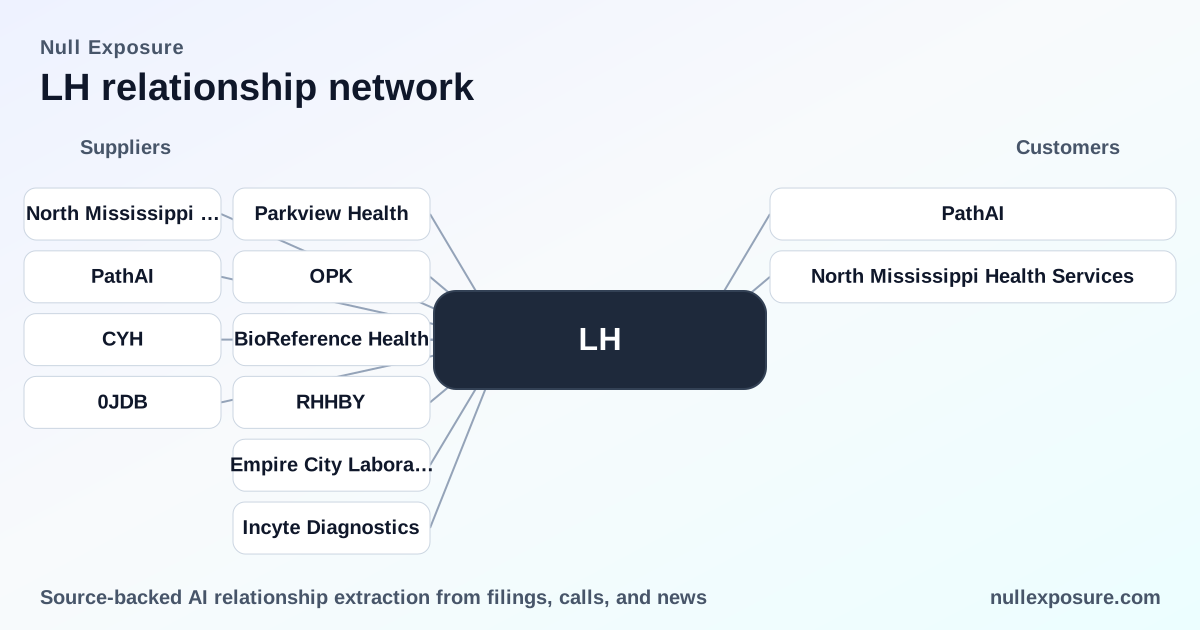
Labcorp (LH) — Customer Relationships: Strategic Collaborations and Operational Signals
Labcorp operates one of the world’s largest clinical laboratory networks and monetizes through a mix of fee-for-service testing, capitated (per-member) contracts, enterprise lab management agreements, and services to pharmaceutical and research clients. That multi-channel revenue model creates a hybrid cash flow profile: high-volume transactional revenue balanced by recurring subscription-like reimbursements and steady enterprise contracts. For investors focused on customer durability and operational risk, the relationships below reveal how Labcorp converts clinical scale into predictable demand and margin leverage. For deeper relationship analytics, visit https://nullexposure.com/.
Why these relationships matter for valuation and risk
Labcorp’s value proposition to customers is scale, regulatory approval breadth, and integrated diagnostic platforms. Strategic partnerships and hospital management agreements expand referral networks and embed Labcorp into clinical workflows, while transition-service arrangements with former spin-offs demonstrate the company’s role as an operational backbone. These dynamics support revenue resilience but also concentrate execution risk in systems integration and reimbursement negotiation.
Customer relationship snapshots — the direct evidence
Below are concise, source-linked summaries for every customer relationship captured in recent filings and press coverage.
-
PathAI — Labcorp expanded a collaboration to deploy an FDA-cleared digital pathology platform, AISight® Dx 1, across Labcorp’s national anatomic pathology network. This is a technology partnership that extends Labcorp’s diagnostic capabilities into digital histopathology and supports nationwide clinical adoption. (Finviz, March 10, 2026: https://finviz.com/news/318329/labcorp-expands-collaboration-with-pathai-to-deploy-fda-cleared-digital-pathology-platform-nationwide)
-
Crouse Health — Labcorp completed the acquisition of select assets from Crouse Health’s Laboratory Alliance of Central New York and executed an agreement to manage Crouse’s inpatient laboratories, formalizing an operational management and asset-transfer arrangement. This represents an embedded long-term services relationship with hospital systems focused on inpatient lab operations. (BioSpace press release, May 3, 2026: https://www.biospace.com/press-releases/labcorp-announces-2026-first-quarter-results-raises-full-year-2026-guidance)
-
Fortrea Holdings Inc. (FTRE) — Labcorp disclosed transition services fees charged to Fortrea for administrative and IT support after a corporate separation, with the fees recorded in other income while the underlying costs remain in operating income. This is a supplier/customer-style transitional contract that monetizes Labcorp’s shared-services capability. (BioSpace press release, May 3, 2026: https://www.biospace.com/press-releases/labcorp-announces-2026-first-quarter-results-raises-full-year-2026-guidance)
-
North Mississippi Health Services — Labcorp acquired the ambulatory outreach laboratory business and became the referral lab for seven hospitals and clinics, consolidating regional referral flows into Labcorp’s network. This transaction expands Labcorp’s footprint in community health systems and strengthens referral volume. (Bitget News, March 10, 2026: https://www.bitget.com/amp/news/detail/12560605237903)
-
Children’s Hospital of Philadelphia (CHOP) — Labcorp announced a nationwide strategic collaboration to expand access to advanced diagnostics for pediatric patients, positioning Labcorp as a national partner for specialized pediatric testing and diagnostic innovation. (Earnings call transcript reported by The Globe and Mail / Motley Fool, May 3, 2026: https://www.theglobeandmail.com/investing/markets/markets-news/Motley%20Fool/1636257/labcorp-lh-q1-2026-earnings-call-transcript/)
What the contract and counterparty signals reveal about the operating model
Labcorp’s customer-facing posture is dual-natured: it sells both variable, transaction-driven services and negotiated recurring contracts.
-
Contracting posture: Labcorp operates significant usage-based (fee-for-service) relationships where revenue scales with test volume, alongside subscription-like capitation and managed-care agreements that generate per-member recurring payments. This mix creates revenue flexibility: volume drives upside while capitation smooths downside.
-
Counterparty breadth and concentration: The company serves individuals, health plans, government payers, mid-market and very large enterprises, and pharmaceutical and research firms. Customer concentration is intentionally low; the breadth reduces single-counterparty exposure but increases billing complexity and reimbursement risk.
-
Criticality to customers: Labcorp’s services are operationally critical to hospitals, clinics, and biopharma trial workflows; agreements to manage inpatient labs and provide transition services demonstrate embedded operational dependence.
-
Geographic and maturity signals: Revenue is heavily North American, with global service lines supporting pharma and research clients in ~100 countries; Labcorp’s operational model is mature and scale-driven, emphasizing national lab networks, regulatory-compliant platforms, and enterprise integrations.
These company-level signals indicate a business that leverages scale to maintain bargaining power while accepting complexity from diverse payers and contract types.
Investment implications — risk and upside in the customer base
-
Upside drivers: Strategic partnerships (PathAI, CHOP) and hospital management deals (Crouse, North Mississippi) expand referral pipelines and admissions into higher-margin specialty testing. Transition services with corporate spin-offs like Fortrea convert legacy infrastructure into short-term revenue and reduce stranded cost risk.
-
Key risks: Reimbursement pressure on fee-for-service volumes, execution risk in integrating acquisitions and managing inpatient labs, and complexity from a multi-payer billing environment. Regulatory changes or adverse reimbursement decisions would disproportionately affect transactional revenue flows.
-
Operational levers: Margin improvement will come from scaling high-value diagnostics, digital pathology deployment, and migrating volume into integrated contracts that carry higher predictability.
Tactical read and next steps for investors
Labcorp’s customer relationships show deliberate expansion across hospital systems, pediatric centers, and digital pathology partners, supporting a thesis of durable revenue backed by scale. Monitor rollout progress for PathAI deployments and the operational performance of newly acquired or managed labs (Crouse, North Mississippi) for early signs of margin contribution or integration strain.
For a concise tracker of partner and customer developments and how they affect revenue durability, visit https://nullexposure.com/. Bold customer wins and transition-service fees are tangible evidence that Labcorp is converting platform scale into recurring income and one-off monetization events — a constructive signal for investors focused on cash-flow predictability and operational optionality.