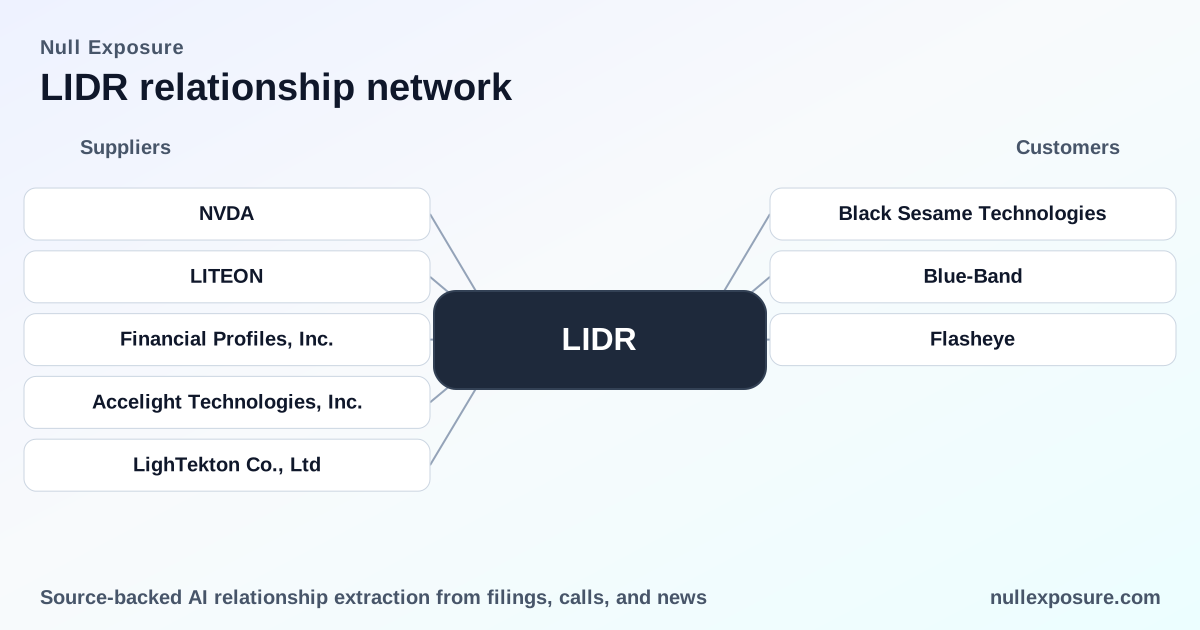
AEye (LIDR) customer map: who pays for Apollo and why it matters to investors
AEye builds adaptive, AI-driven LiDAR sensors and sells them across automotive, smart-infrastructure and defense channels. The company monetizes through prototype and hardware sales, development arrangements with OEMs and systems integrators, and strategic commercial partnerships that embed the Apollo sensor into larger perception stacks. Investors should read relationships as evidence of commercial validation across traffic management, logistics/airports, automotive compute platforms and defense systems — each relationship signals a different revenue vector and go-to-market path. Learn more about our coverage at https://nullexposure.com/.
How AEye packages technology into revenue
AEye’s core offering is the Apollo family of LiDAR sensors combined with perception software and integration services. Revenue flows in two distinct ways: point-in-time hardware sales for prototypes and production units, and multi-stage commercial integration deals that include development milestones, software licensing and system-level bundling with partners. The company discloses prototype sales recognized at a point in time and performance-based revenue from development arrangements, which positions AEye as both a component vendor and a systems collaborator.
This mixed monetization strategy creates a profile where near-term cash comes from discrete hardware shipments while longer-term value is tied to successful integrations with large OEMs, infrastructure projects and defense contractors.
Customer relationships: the practical partners validating Apollo
Below I summarize every relationship pulled from public materials, with one- to two-sentence plain-English takeaways and the source for each.
Blue-Band (earnings call mention)
AEye highlighted a partnership with Blue-Band using Apollo’s long-range sensing to enable AI-driven traffic management and urban mobility solutions. This is a commercial validation of AEye’s positioning in smart-city traffic systems (discussed on the 2025 Q3 earnings call, March 2026).
Blue-Band LLC (news release)
A public announcement quotes Blue-Band saying that integrating AEye’s long-range LiDAR improves its platform’s ability to deliver intelligent, scalable traffic management solutions, signaling expected commercial deployment for urban projects (Yahoo Finance release, May 2026).
Flasheye (earnings call mention)
Flasheye is described as a partner whose 3D perception software enhances safety and logistics in complex environments such as airports and transportation hubs, indicating AEye’s penetration into logistics and stationary-perception markets (2025 Q3 earnings call, March 2026).
Black Sesame Technologies (earnings call mention)
AEye named Black Sesame Technologies as a China-based partner that combines Apollo’s 1550-nanometer sensor with an automotive-grade compute platform to deliver a full-stack obstacle detection capability—an explicit route into ADAS/autonomous vehicle OEM ecosystems in APAC (2025 Q3 earnings call, March 2026).
SynTech (MarketScreener FY2025 & SahmCapital FY2026)
AEye entered a strategic commercial relationship with SynTech to integrate Apollo LiDAR into defense applications, combining perception systems with SynTech’s defense hardware and systems expertise; follow-up coverage reiterated the defense focus in early 2026 (MarketScreener release, FY2025; SahmCapital commentary, April 2026).
New Circle Principal Investments LLC (news sentiment)
AEye disclosed the voluntary termination of a $50 million share purchase agreement with New Circle Principal Investments LLC, removing an anticipated capital source and forcing management to pursue alternative liquidity strategies (TipRanks coverage of the December 10, 2025 announcement).
What these relationships collectively tell investors
- Revenue diversification across end markets. Partnerships span smart cities (Blue-Band), logistics/airports (Flasheye), automotive compute partners (Black Sesame Technologies) and defense (SynTech), demonstrating that Apollo is not confined to a single buyer class.
- Validation at system-integration level. Several partners explicitly combine AEye sensors with third-party compute or perception software, signaling that Apollo is being positioned as a component in broader stacks rather than a standalone product.
- Commercial-stage mix. Public signals include both prototype sales and announced commercial integrations, consistent with a company generating point-in-time hardware revenue while pursuing multi-phase commercial deals.
Operational and business-model constraints that matter
Null Exposure signals describe AEye’s operating model characteristics that will drive risk and return outcomes for investors:
- Contracting posture — spot and development contracts. The company recognizes revenue from prototype sales at a point in time (spot), while also recording revenue tied to performance obligations under development arrangements; this creates lumpy near-term revenue and milestone-dependent longer-term upside.
- Counterparty profile — leaning toward large enterprises. Evidence indicates primary customers include OEMs and major suppliers, pointing to high buyer sophistication but also concentrated procurement processes that lengthen sales cycles.
- Geographic footprint — global but APAC/EMEA material. Revenue disclosures show meaningful figures attributable to North America, Europe and Asia-Pacific, with APAC represented strongly in disclosures; this suggests exposure to global auto and infrastructure programs and associated geopolitical/regulatory dynamics.
- Role and stage — seller and active engagements. The company operates as a hardware seller and active integrator, with reported prototype and performance revenue in recent years reflecting ongoing commercial activity, albeit at modest absolute scale.
- Segment maturity — hardware-led, consolidation risk. AEye reports a single reportable segment focused on high-performance active LiDAR, which concentrates execution risk on hardware maturation and margin expansion.
(Confidence notes are reported with each constraint in underlying signals and should be interpreted as probabilistic indicators rather than binary facts.)
Key takeaways for investors
- Growth optionality across four verticals: urban traffic, logistics/airports, automotive ADAS and defense each offer distinct monetization paths and time horizons.
- Execution risk remains high: prototype-recognition and milestone-based revenue underline revenue volatility and dependency on multi-stage integrations with large enterprise customers.
- Geographic diversification is both strength and complexity: APAC and EMEA exposure increases addressable markets but adds regulatory and partner-management complexity.
- Capital pathway changed in late 2025: the terminated New Circle agreement removed an expected capital infusion, elevating the importance of operational cash flow and alternative financing.
If you want a concise investor-ready summary of these customer relationships and operating signals, visit https://nullexposure.com/ for our structured outputs and further context.
Where to watch next
Focus on three near-term indicators: (1) cadence of production orders or multi-year supply commitments with named OEMs or system integrators, (2) milestone payments and recognized revenue tied to announced integrations, and (3) capital actions that restore balance-sheet flexibility following the New Circle termination. Together these will determine whether AEye’s current partnerships convert into durable revenue and margin improvement.
Bold relationships like Blue-Band, Black Sesame and SynTech are the immediate commercial levers; investors should treat announced partnerships as directional validation but require subsequent contract-level evidence (order volumes, recurring revenue schedules) before assuming material top-line lift.