Life360 (LIF): Customer Relationships That Anchor Recurring Revenue and Platform Scale
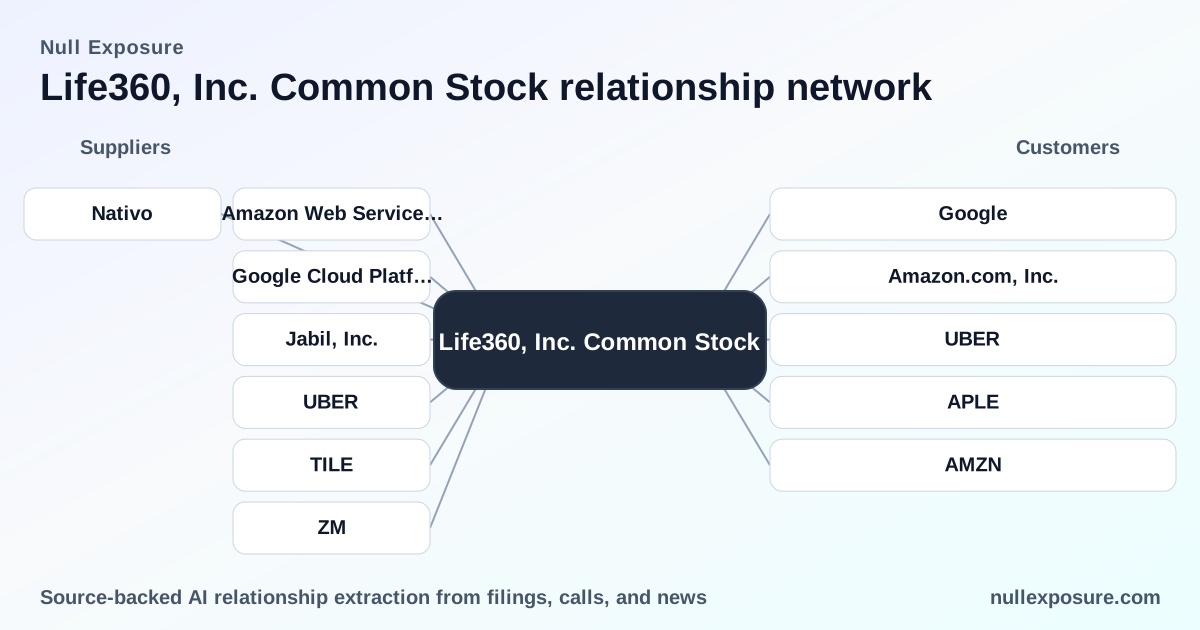
Thesis: Life360 operates a consumer-first location and safety platform that monetizes primarily through recurring subscriptions and complementary hardware sales (Tile, Jiobit), while channel partners process a large share of transacted revenue; investors should value LIF as a subscription-led consumer software business with significant channel concentration and embedded monetization via ad and data partnerships. For a focused view of customer counterparty exposure and partner criticality, review the relationship map below and the operational constraints that govern Life360’s revenue durability. Explore further company relationship intelligence at https://nullexposure.com/.
How Life360 makes money — the core economics you need to track
Life360’s stated business model is freemium subscription software plus hardware. According to the company’s FY2024 Form 10‑K, the core mobile app is offered at no charge with three paid membership tiers, and the company recognizes subscription revenue ratably over monthly or annual contractual terms. Hardware revenue is generated by sales of Jiobit and Tile devices, which integrate with the Life360 platform and are sold through retailers and distributors.
- Subscriptions are billed in advance and recognized over the contract term, creating a predictable, recurring revenue base that supports margin expansion as membership penetration increases (FY2024 10‑K).
- Channel partners process the majority of revenue transactions, meaning payment-platform and app-store relationships are operationally critical to cash flow and receivables (FY2024 10‑K).
- U.S. concentration is material: the company reported that U.S. revenue was $318.6 million, or 86% of total revenue for 2024, implying seasonal and regulatory sensitivity tied to the U.S. market (FY2024 10‑K).
These characteristics combine into a contracting posture that is subscription-dominant, consumer-facing, and channel-dependent, with an ancillary hardware business that increases per-customer monetization but introduces reseller risk.
What the constraints say about operating risk and commercial posture
Company-level signals from Life360’s filings and public disclosures highlight several actionable operating constraints:
- Contract type: subscription — high confidence: subscriptions are the principal revenue source and are billed monthly or annually in advance (FY2024 10‑K).
- Customer base: individual consumers — Life360 primarily sells to individuals through channel partners and retail resellers rather than enterprise contracts.
- Geographic concentration: North America — the U.S. represented the majority of revenue in 2024, creating single-market exposure.
- Reseller dependence — the company explicitly depends on retailers and distributors to sell hardware, which raises distribution concentration risk if major partners change terms.
- Segment mix: hardware and software — hardware (Tile, Jiobit) contributes tangible device revenue that bolsters ARPU, while software subscriptions deliver recurring margin.
Together these constraints depict a mature consumer subscription business with channel concentration and hardware diversification — attractive for recurring revenue investors but requiring vigilance on partner terms and platform distribution dynamics.
If you want a snapshot of partner-level exposure and third‑party risk for investment or operational diligence, see more on https://nullexposure.com/.
Line-by-line: every customer relationship mentioned in the record
Below are the individual relationship records pulled from Life360’s customer-focused disclosures and relevant press coverage. Each entry is a concise, plain‑English summary with a source reference.
-
Google (Form 10‑K, FY2024) — Google is listed as a channel partner that processed a significant portion of Life360’s revenue transactions, with reported channel partner percentages in the mid‑teens to high‑teens across periods presented. According to Life360’s FY2024 Form 10‑K, Google processed roughly 18%/16%/15% in the tabulated channel partner figures in the periods shown.
-
Amazon.com, Inc. (Form 10‑K, FY2024) — Amazon is mentioned in the context of a putative class action filed August 14, 2023, in which plaintiffs named Tile, Life360, and Amazon.com, Inc. as defendants; the filing is disclosed in Life360’s FY2024 10‑K.
-
Uber (GlobeNewswire press release, Feb 17, 2026) — Life360 announced a new integration with Uber to help families stay connected on trips; the collaboration was positioned as evidence of Uber’s investment in Life360 Ad Solutions and broader commercial ties (GlobeNewswire, Feb 17, 2026).
-
Uber Technologies, Inc. (GlobeNewswire press release, Feb 17, 2026) — The same GlobeNewswire release frames Uber Technologies as a strategic partner for integration with Life360’s platform and ad solutions, reinforcing that the Uber relationship spans product integration and monetization channels (GlobeNewswire, Feb 17, 2026).
-
Uber (Finviz coverage, March 2026) — Independent market coverage highlighted the Life360–Uber integration as a recent corporate development in March 2026, underscoring investor interest in transportation partnerships that expand Life360’s use cases and ad inventory (Finviz news, March 2026).
-
Apple (Form 10‑K, FY2024) — Apple is reported as the single largest channel partner, processing a substantial majority of transactions: the Form 10‑K shows Apple at roughly 53%/53%/49% in the channel partner tables for the periods presented, establishing platform dependence on Apple’s app ecosystem.
-
APLE (Form 10‑K, FY2024) — The same 10‑K table appears under the APLE identifier in the record; the company reiterates that Apple is the dominant channel partner in transaction processing across the cited years.
-
Uber (Finviz coverage, March 2026 — alternate entry) — A separate Finviz news item captured the Uber integration announcement in the run‑up to Life360’s Q4 reporting, reflecting multiple media outlets amplifying the partnership narrative (Finviz news, March 2026).
-
Amazon (Form 10‑K, FY2024 — revenue share note) — Life360’s FY2024 10‑K clarifies that Amazon accounted for less than 10% of total revenue for both 2024 and 2023, signaling that Amazon is a non‑core revenue processor relative to Apple and Google (FY2024 10‑K).
-
AMZN (Form 10‑K, FY2024 — duplicate entry) — A second 10‑K reference reiterates the same conclusion: Amazon’s share of total revenue remained below the 10% threshold in the fiscal years presented.
-
ALL‑P‑I / Arity‑related reporting (New York Post, June 10, 2024) — Media reporting indicated that Life360’s subscription apps provided driving and telematics data to Arity, an Allstate-owned company, which uses that data to compute driving scores for insurers; the report links Life360’s data flow to insurance analytics (New York Post, June 10, 2024).
-
Uber (Finviz coverage tied to Q4 expectations, March 2026 — another duplicate) — Additional Finviz coverage referenced the Uber integration in the context of Life360’s Q4 results and Wall Street expectations, again signaling market focus on partnerships as a growth vector (Finviz news, March 2026).
-
Uber (Finviz, March 2026 — duplicate mention) — A final news item in the record reiterates the same Life360–Uber integration story, showing multiple mentions across news outlets during the March 2026 reporting cycle (Finviz news, March 2026).
Investment implications — concentration, control, and catalysts
- Concentration risk is real and quantifiable: Apple’s processing share in FY2024 dominates channel flows and creates leverage over app‑store economics and fee structures; Google is the second major channel processor. Life360’s subscription economics are robust, but the company’s ability to collect, bill, and distribute subscriptions is tightly coupled to these platform partners (FY2024 10‑K).
- Partnerships are upside catalysts: The Uber integration broadens Life360’s platform reach into transportation, increases ad inventory, and validates the company’s ad‑solutions strategy (GlobeNewswire, March 2026 / Finviz coverage).
- Regulatory and reputational risk from data resale: Media reporting on data provision to Arity (Allstate) raises oversight and privacy considerations that can affect user trust and retention if not managed defensibly (New York Post, June 2024).
For investors and operators assessing LIF, the balance to watch is recurring subscription growth and ARPU expansion through hardware and ad products, offset by channel concentration exposure and third‑party data governance. For a deeper commercial counterparty profile, visit https://nullexposure.com/.