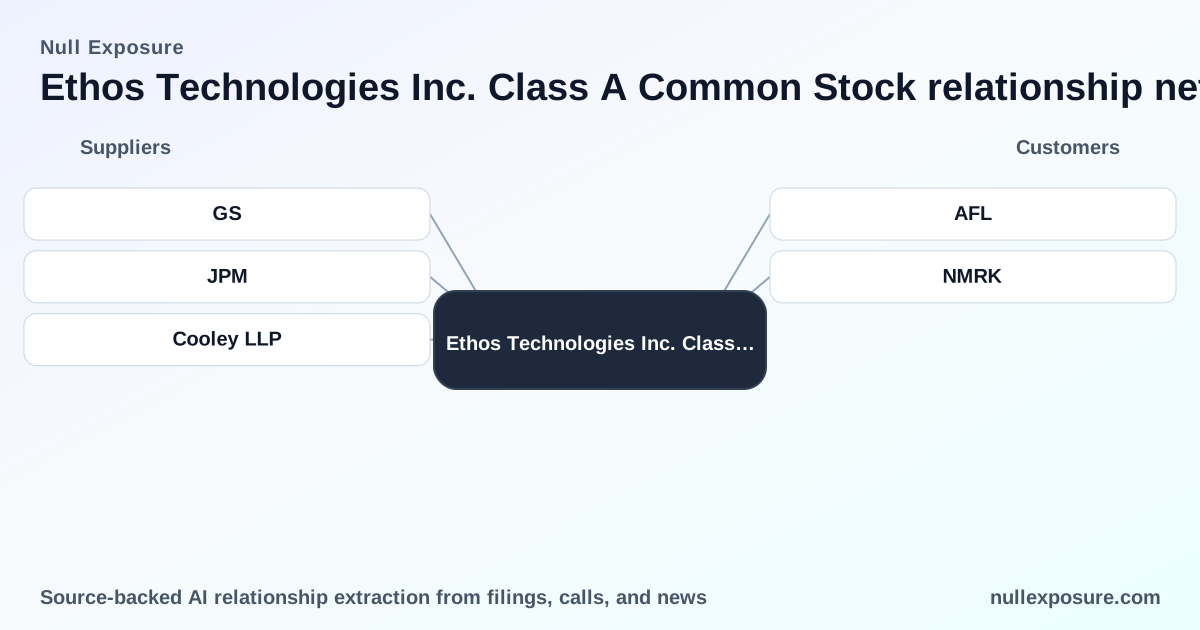
Ethos (LIFE): Platform partnerships are the product — monetization through white‑labeling and underwriting licensing
Ethos Technologies (LIFE) operates as a B2B life-insurance technology and underwriting platform that monetizes by licensing its distribution and underwriting stack to traditional carriers and by co-developing white‑labeled products for those carriers. The company’s commercial strategy centers on embedding Ethos’ tech behind established insurance brands, creating recurring revenue streams from platform fees, underwriting services, and product launches with partners. For a direct view of Ethos’ partner traction, see https://nullexposure.com/.
Market position and the operating signal Ethos’ disclosed customer relationships show a deliberate go-to-market: sell the stack to incumbents rather than compete head-on with carriers. That gives Ethos a commercial posture focused on enterprise contracts, integration work, and product partnerships rather than retail policy sales alone. The partner roster in recent disclosures signals three structural business-model characteristics investors should weigh:
- Contracting posture: Ethos contracts with large insurers on white‑label and co‑development terms, implying longer sales cycles and revenue recognition tied to implementation and product performance rather than one-time consumer acquisition.
- Concentration and counterparty importance: Partnerships with major carriers are high‑value and strategically significant; a small number of large partners can represent meaningful revenue and distribution reach.
- Operational criticality and maturity: The relationships indicate Ethos’ technology is sufficiently mature for carrier-grade use, acting as a critical underwriting and distribution layer for partners’ life and supplemental products.
If you want an ongoing feed and deeper partner profiling, visit https://nullexposure.com/.
Customer relationships — the proofs and sources Below are the individual relationship mentions found in Ethos’ recent public record. Each entry is presented exactly as reported with a one- to two‑sentence plain-English summary and a short source citation.
AFL (earnings call)
Ethos launched a supplementary health product with Aflac to expand offerings into niche coverage such as cancer insurance, showing Ethos’ willingness to extend beyond pure life insurance into adjacent supplemental product lines with carriers.
Source: Ethos 2025 Q4 earnings call transcript (mentioned March 7, 2026).
Aflac (earnings call)
The company reiterated the same initiative with Aflac, confirming a supplemental health product partnership that leverages Ethos’ platform to deliver additional coverage options under the carrier’s distribution.
Source: Ethos 2025 Q4 earnings call transcript (mentioned March 7, 2026).
Liberty Mutual Insurance (news sentiment)
Liberty Mutual will leverage Ethos’ technology platform and proprietary underwriting engine to deliver a fully white‑labeled, end‑to‑end digital life insurance experience, positioning Ethos as the behind‑the‑scenes engine for an incumbent’s digital offering.
Source: The Globe and Mail coverage of market news referencing the Liberty Mutual relationship (May 3, 2026).
NMRK (earnings call)
Ethos is working with North American Sammons on an accumulation indexed universal life product, targeting customers who want both protection and investment features — a product type that necessitates coordinated underwriting and policy servicing capabilities.
Source: Ethos 2025 Q4 earnings call transcript (mentioned March 7, 2026).
North American Sammons (earnings call)
The same transaction with North American Sammons was described as an accumulation indexed universal life product, underscoring Ethos’ capability to deliver more sophisticated life products beyond term life.
Source: Ethos 2025 Q4 earnings call transcript (mentioned March 7, 2026).
What investors should read into the partner set Ethos is executing a platform-as-a-service strategy for life carriers. The partner list—Aflac, Liberty Mutual, and North American Sammons—reads like a targeted effort to embed Ethos into established distribution channels rather than build direct-to-consumer scale solely on its own brand. Each relationship represents a different commercial vector:
- Aflac shows expansion into supplemental health products, broadening the addressable market and product complexity Ethos can support.
- Liberty Mutual signals the highest strategic validation: a major carrier is willing to white-label Ethos’ tech, which implies both reliability and regulatory/compliance readiness.
- North American Sammons demonstrates capability for investment-linked life products, which require sophisticated actuarial and product-engineering support.
Business-model implications and risk framework Ethos’ monetization is driven by carrier adoption and breadth of product partnerships. That pattern produces the following investor-relevant implications:
- Upside: Scaling white‑label agreements with large carriers can drive recurring revenue growth and gross-margin expansion as implementation costs are amortized and platform fees compound across products. Liberty Mutual’s commitment is a salient commercial milestone in this path.
- Execution risk: Reliance on a small number of major partners creates counterparty concentration risk; if one large program underperforms or the carrier pauses roll‑out, revenue volatility can follow. Ethos’ revenue profile will depend on contract cadence and launch timing.
- Product and regulatory complexity: Delivering accumulation indexed universal life and supplemental cancer coverage increases product complexity and regulatory touchpoints, elevating operations and compliance costs during scale-up.
- Contracting and integration risk: The company’s contracting posture—enterprise integrations and co‑development—creates longer sales and implementation cycles, which compress near-term visibility but increase switching costs once live.
Constraints signal No customer‑scope constraints were returned in the available constraints feed; this is a company‑level signal that no explicit contractual constraints were disclosed in the dataset provided. Investors should therefore treat partner disclosures and carrier announcements as the primary public evidentiary basis for evaluating customer risk and runway.
Final read and where to look next Ethos is a technology-first vendor to traditional insurers, monetizing via white‑label platform licensing and product co‑development with major carriers. The Liberty Mutual item is the clearest validation of the business model, while Aflac and North American Sammons illustrate product breadth from supplemental health to investment-linked life. Track upcoming quarterly disclosures for revenue recognition detail on these programs and any new carrier additions.
For ongoing partner tracking and to monitor how these carrier programs translate to revenue, visit https://nullexposure.com/.