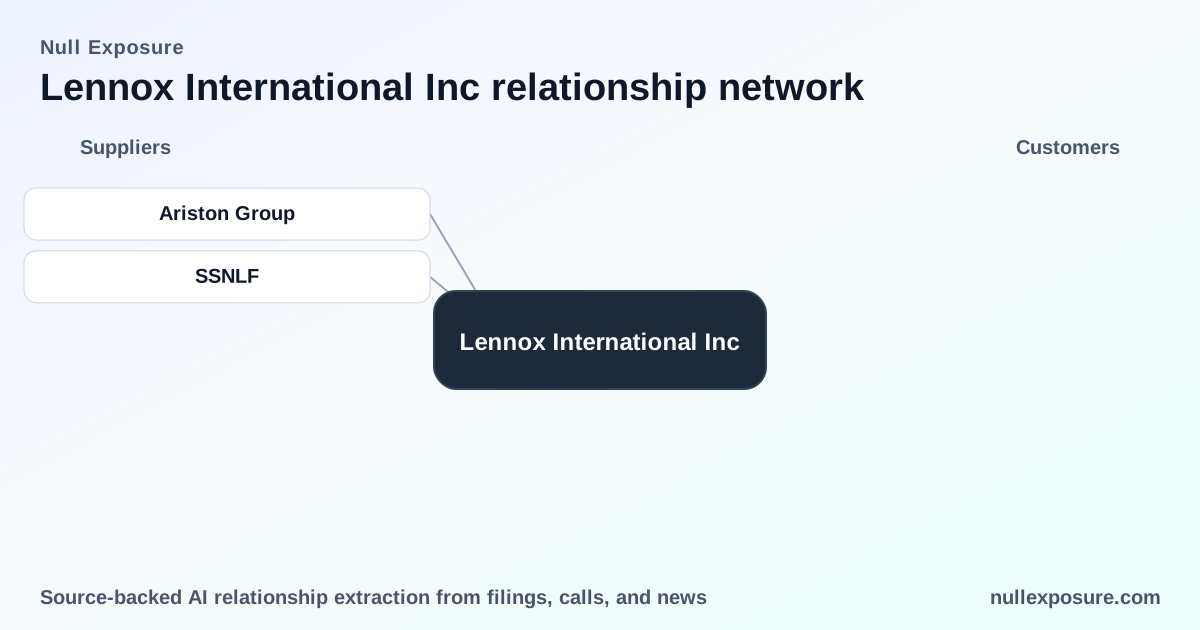
Lennox International (LII): Customer Map and Commercial Posture
Lennox International designs, manufactures and distributes HVAC and refrigeration equipment and captures recurring revenue through installation, maintenance and national account services; the firm monetizes primarily by selling capital equipment and aftermarket service contracts, with reported TTM revenue of about $5.26 billion and an operating margin near 14%. Investors should evaluate Lennox as a North America–centric hardware manufacturer that offsets product cyclicality with service offerings and a broad dealer/distributor footprint that keeps customer concentration low.
How Lennox gets paid: channels, contracts and pricing power
Lennox sells under a multi-channel go-to-market model that balances direct and indirect routes to end customers. Products flow through independent installing dealers, company-owned Lennox stores and independent distributors, while National Account Service (NAS) delivers installation and maintenance for commercial accounts. This configuration supports a mix of upfront equipment revenue and higher-margin, recurring service revenue. According to Lennox’s filings for the year ended December 31, 2024, the company distributes products both to independent dealers and to national account customers, and it operates a dedicated NAS function across the U.S. and Canada.
This contracting posture implies moderate stickiness: equipment buyers can switch vendors over time, but service and maintenance contracts provide a durable revenue base and create ongoing touchpoints with national accounts.
Geography and concentration: North America dominates
Lennox is a predominantly North American company. For the year ended December 31, 2024, U.S. sales made up the majority of revenue (roughly $5.02 billion combined Home Comfort and Building Climate), while net sales from outside the U.S. represented only 6.0% of total net sales in 2024. That places the firm squarely exposed to U.S. building and construction cycles and regional HVAC demand drivers.
At the same time, customer concentration is not a financing risk: no single customer accounted for 10% or more of consolidated net sales in the periods presented, per the company’s disclosure. That dispersion reduces counterparty risk, but magnifies sensitivity to macro demand and dealer-channel health rather than to dependency on a handful of large buyers.
Channel roles and commercial implications
The company-level signals in Lennox’s disclosures indicate several role archetypes that matter for partners and investors:
- Distributor / Reseller / Seller: Lennox sells through distributors and independent dealers as core go-to-market partners, which means inventory financing, trade promotions and dealer economics are key operational levers.
- Service provider: NAS provides installation and preventive maintenance for commercial national accounts in the U.S. and Canada, creating recurring revenue and service-led margins.
- Hardware manufacturer: Lennox is fundamentally a producer of HVACR equipment, with product innovation and manufacturing scale driving gross margins.
These roles suggest Lennox’s cash conversion and working capital profiles will be driven by inventory and dealer payment terms, while profitability will be supported by aftermarket service penetration.
Notable customer relationships you should know
This section lists every customer-related relationship surfaced in our results.
- Investcorp Credit Management BDC (ICMB) — A news report noted that ICMB had fully realized its position in Lennox following Lennox’s substantial acquisition and a debt refinance, indicating the firm was an investor/holder that exited after corporate activity. Source: Yahoo Finance coverage of Investcorp Credit Management BDC (March 10, 2026).
That is the single relationship surfaced in the public results set we reviewed; it reflects shareholder activity rather than a strategic customer contract.
Constraints and what they tell investors about Lennox’s customer risk profile
Treat the following constraints as company-level signals derived from Lennox disclosures:
- Counterparty type — Large enterprise signal: Lennox distributes products primarily through commercial contractors and national account customers, implying the company engages with both large enterprise accounts (national accounts) and a broad base of smaller contractors. Evidence comes from the company’s sales channel descriptions in its filings.
- Geography — North America concentrated: The filings for FY2024 show U.S. revenue dominates and non-U.S. sales fell to 6.0% of total net sales in 2024, down from double-digits earlier, signaling geographic concentration in North America and greater exposure to U.S. construction and HVAC cycles.
- Materiality — Low single-customer concentration: No single customer accounted for 10% or more of consolidated net sales in the periods presented, which means customer concentration risk is limited at the single-counterparty level.
- Relationship roles — Distributor / Reseller / Seller / Service Provider: Multiple excerpts describe sales through independent installing dealers and distributors as well as direct national account servicing (NAS), confirming a blended channel approach that pairs hardware sales with services.
- Segment — Hardware-led business: The company is described as a global leader in energy-efficient climate-control solutions and markets a broad range of HVACR products, reinforcing that the core business is manufacturing and selling hardware with attached services.
Collectively, these signals define a business with broad channel distribution, low customer concentration, North American revenue concentration, and recurring-service attachments that moderate the cyclicality of product sales.
Investment implications — strengths and risks for operators and investors
- Strengths: diversified dealer/distributor ecosystem, meaningful service revenue via NAS, and a manufacturing position that supports margins (gross profit TTM ~ $1.745B; operating margin ~14.3%). High institutional ownership (about 79%) and consistent dividends (recent dividend per share ~$5.20) support a yield-plus-growth profile for income-oriented investors.
- Risks: Heavy U.S. exposure (foreign sales only ~6% in 2024) concentrates macro risk; product sales depend on construction and replacement cycles; inventory and dealer financing working capital can be sensitive to dealer health and housing activity. While no single customer is material by sales share, channel economics (promotions, dealer credit) are critical to near-term cash flows.
Key takeaway: Lennox combines scale in hardware manufacturing with a service layer that provides recurring revenues, but its revenue base is concentrated in North America and driven by channel economics—factors investors should monitor closely.
For a structured, comparable analysis of corporate customer footprints and counterparty exposure, visit the NullExposure homepage to see our methodology and coverage. https://nullexposure.com/
Final read: what to watch next
Investors and operators should track three items to evaluate Lennox’s customer relationships and short-to-medium term outlook:
- NAS uptake and service margin trends — higher penetration stabilizes revenue and improves predictability.
- Dealer financing and inventory days — signs of channel stress can presage softer equipment orders.
- International expansion or M&A activity — any strategic moves that materially change the geographic mix or customer concentration should alter risk/reward.
If you want a deeper mapping of Lennox’s counterparties and contract-level signals for portfolio due diligence, start with our platform’s company pages and customer reports. https://nullexposure.com/