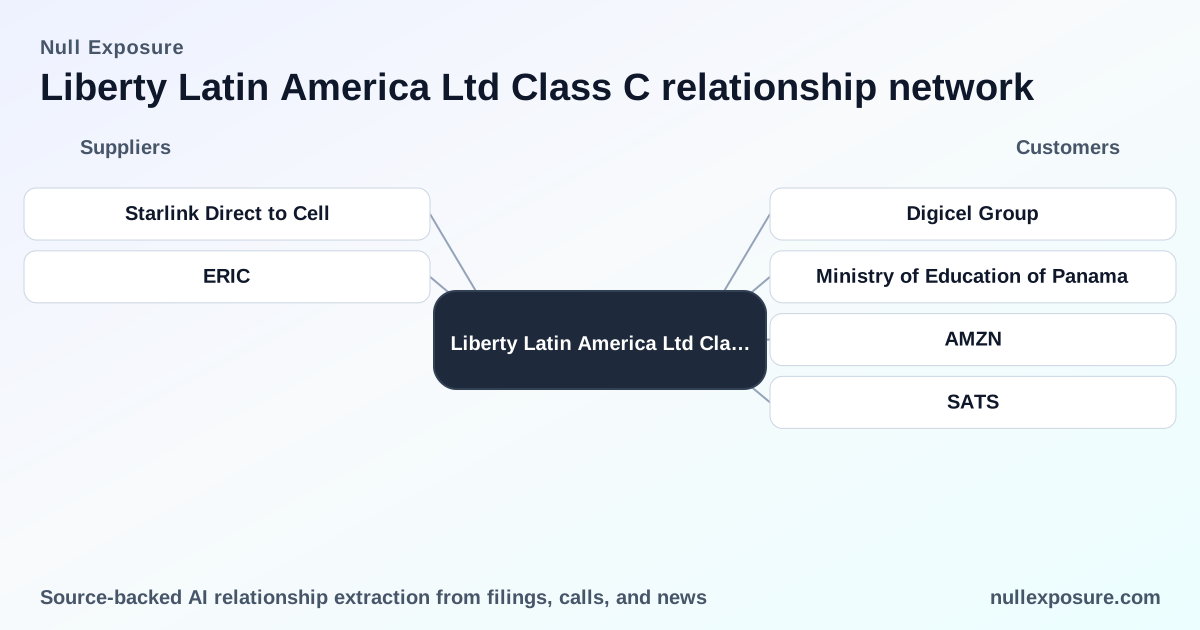
Liberty Latin America (LILAK) — customer relationships that shape revenue and risk
Thesis: Liberty Latin America monetizes an integrated mix of subscription consumer services, wholesale capacity contracts and enterprise solutions across Latin America and the Caribbean. Revenue drivers are ongoing subscription cashflows (residential fixed and mobile), long‑term wholesale capacity sales, and enterprise/government contracts that are operationally critical and revenue‑material in certain markets. Investors should value LILAK as a telecom operator whose growth and margin trajectory are tied to network asset utilization, B2B contract mix, and the ability to upsell cloud and managed services to existing customers.
For deeper mapping of counterparties and contract types, see NullExposure’s customer relationship resources at https://nullexposure.com/.
How management frames recent wins and strategic partners
Management’s public comments and the 2024 Form 10‑K show an operator executing both organic commercial wins and strategic partnerships to broaden services. Recent management statements emphasize expansion of enterprise and government footprints, cloud partnerships, and disaster response collaborations that reinforce the company’s role as both a consumer-facing telco and a supplier of critical network capacity.
A timely example: Liberty highlighted new public‑sector wins on the 2025 Q4 earnings call and announced an AWS partnership to localize compute and AI models for customers, signaling a push into higher‑margin enterprise services.
Detailed customer relationships (each result covered)
Ministry of Education of Panama (MEDUCA)
Liberty signed a nationwide contract to provide high‑speed Internet to all public schools in Panama, a large public‑sector deployment that strengthens its institutional revenue base and public‑sector profile. This win was disclosed on the 2025 Q4 earnings call in March 2026. (2025 Q4 earnings call, March 2026)
Digicel Group
Liberty operates programming and on‑demand content licensing in a joint venture relationship with Digicel Group, distributing content through third‑party broadcasters, cable networks and studios—as described in Liberty’s 2024 Form 10‑K. This underpins the company’s video/content revenue channels and strategic distribution agreements. (2024 Form 10‑K)
FLOW Jamaica (partnership with Starlink Direct to Cell) — Investing.com (ZA)
Liberty announced a collaboration with Starlink Direct to Cell to restore emergency connectivity for FLOW Jamaica customers affected by Hurricane Melissa; the announcement highlights Liberty’s role as a local operator coordinating satellite backup for resilience. Reported on Investing.com in May 2026. (Investing.com, May 2026)
FLOW Jamaica (same partnership) — Investing.com
A second Investing.com dispatch reiterated the Starlink collaboration to provide emergency communication services for FLOW Jamaica customers, reinforcing media coverage of Liberty’s disaster response and network continuity capability in Jamaica. (Investing.com, May 2026)
AMZN / AWS
Management described a recently announced partnership with AWS to bring AWS compute and AI models into Liberty’s local markets, enabling Liberty to bundle cloud compute and AI services for enterprise and carrier customers—publicly stated on the 2025 Q4 earnings call. This expands LILAK’s service set beyond connectivity to managed cloud solutions. (2025 Q4 earnings call, March 2026)
AWS (duplicate entry reflecting the same AWS partnership)
The company reiterated the AWS collaboration in the same earnings call commentary, stressing the operational intent to deploy AWS compute and AI locally for customers—underscoring the company’s strategic pivot toward integrated connectivity-plus-cloud offerings. (2025 Q4 earnings call, March 2026)
SATS (related to EchoStar / LPR Acquisition)
Liberty reported the close of the LPR Acquisition, which included acquiring EchoStar’s prepaid business and spectrum assets in Puerto Rico and the U.S. Virgin Islands in exchange for cash and international roaming credits, as disclosed in the 2024 Form 10‑K; this transaction expanded Liberty’s market assets and prepaid footprint in key U.S. territories. (2024 Form 10‑K)
EchoStar (prepaid business and spectrum assets)
Liberty specifically acquired EchoStar’s prepaid business and spectrum assets in Puerto Rico and USVI as part of the LPR Acquisition, a strategic asset purchase that added subscribers, spectrum and roaming economics to Liberty’s regional portfolio—documented in the 2024 Form 10‑K. (2024 Form 10‑K)
For a full relationship map and investor‑grade counterparty detail, consult NullExposure’s platform at https://nullexposure.com/.
Company‑level operating constraints and what they imply for valuation
The public record provides clear company‑level signals about how Liberty contracts and where revenue concentration and criticality sit:
-
Contracting posture — mix of long‑term and subscription revenue. Liberty recognizes substantial unfulfilled performance obligations from long‑term capacity contracts (primarily subsea) with an average remaining life around three years, alongside traditional 12–36 month postpaid consumer contracts and deferred upfront installation fees recognized over contract life. This contract profile produces predictable revenue streams but creates multi‑year delivery obligations tied to network capacity utilization. (Company filings)
-
Revenue stickiness — subscription backbone. Residential fixed and mobile subscription revenues are core to the income statement and are recognized over contractual periods, supporting recurring cash flow and predictable churn dynamics. (Company filings)
-
Counterparty breadth — government to individual. The company serves a broad counterparty set: governmental agencies, large and mid‑market enterprises, small businesses, and millions of individual subscribers across 20+ countries in Latin America and the Caribbean, indicating diversified end‑market exposure with pockets of government concentration in some jurisdictions. (Company filings)
-
Geographic focus — LATAM/Caribbean as primary demand center. The company’s operations and wholesale capacity sales are concentrated across Latin America and the Caribbean, with critical subsea and terrestrial fiber assets underpinning cross‑border revenue. Investors should treat region‑specific macro and weather risks as first‑order factors. (Company filings)
-
Relationship role — operator and service provider. Liberty functions as both a seller of consumer subscriptions and a service provider of wholesale capacity and managed enterprise solutions, positioning it to monetize under multiple commercial models but also exposing it to capital intensity and asset replacement cycles. (Company filings)
-
Maturity and stage — active expansion into cloud & resilience services. Recent strategic moves (AWS partnership, satellite emergency connectivity with Starlink for FLOW Jamaica) indicate a shift to higher‑value services and resilience offerings, complementing traditional telco revenue. (Earnings call; news coverage)
Investment implications: risks and upside
-
Upside: The AWS partnership and enterprise wins (e.g., Panama education contract) increase ARPU potential and margin expansion opportunities if Liberty successfully upsells compute/AI and managed services to existing customers. Winning government contracts increases revenue stickiness and gives Liberty steady revenue ladders tied to public budgets.
-
Risk: Long‑term wholesale capacity obligations and capital intensity of subsea/terrestrial networks maintain a high fixed‑cost profile; region‑specific concentration exposes earnings to hurricanes, regulatory shifts, and sovereign payment risks. Recent Starlink collaboration highlights operational exposure to natural disasters but also Liberty’s ability to source third‑party resilience solutions.
-
Valuation lens: Treat LILAK as a telecom operator with subscription cashflow durability offset by capex and contract fulfillment obligations; growth upside comes from enterprise/cloud monetization and higher network utilization.
For investors mapping counterparties and the commercial implications of Liberty’s contract mix, NullExposure provides structured visibility and relationship context at https://nullexposure.com/.
Key takeaway: Liberty Latin America is a network‑centric operator with a diversified customer base and rising enterprise/cloud ambitions; the balance between subscription durability and long‑term capacity obligations defines both its valuation floor and its strategic upside.