LIMN: Liminatus Pharma — equity-led development story with strategic investor backing
Liminatus Pharma is a clinical-stage immuno-oncology company that develops novel cancer therapies and currently monetizes through equity capital events and strategic partnership agreements rather than product revenue. The company’s cash runway and value creation are driven by financing transactions and milestone-linked collaborations, making investor and partner commitments the primary drivers of near-term value for shareholders. For deeper coverage of partner activity and investor signals, visit https://nullexposure.com/.
How Liminatus operates and how it makes money
Liminatus is pre-revenue and development-focused, headquartered in La Palma, California, advancing immuno-oncology assets through clinical programs rather than commercial sales. Company filings show Revenue TTM: $0; EBITDA: -$2.97M; Market Capitalization: ~$9.56M as of the latest quarter ending 2025-12-31, underscoring a pure research-and-development funding model. Shareholder composition skews toward insiders (38.5% insider ownership) with minimal institutional ownership (0.7%), which supports management control but increases financing dependence on private placements and strategic investors.
Monetization paths are standard for small biotech: equity raises, licensing or option agreements with partners, and potential milestone payments from strategic cooperation. Near-term value catalysts are financing events and any definitive strategic agreements that convert memoranda of understanding into funded transactions.
Operating model signals investors should read as a group
- Contracting posture: Liminatus is in a defensive contracting posture — the company relies on incoming capital commitments rather than delivering products to customers. That creates a negotiation dynamic where investors and strategic partners set transaction terms that can materially dilute existing holders.
- Concentration: Insider-heavy ownership and a small institutional base indicate concentrated control and limited secondary-market liquidity. That raises execution risk on larger financings and makes single strategic investors disproportionately influential.
- Criticality: Strategic capital providers and partnering counterparties are critical to Liminatus’s ability to continue clinical development; absent recurring operating revenue, clinical progress is contingent on successive financings.
- Maturity: Liminatus is an early-stage clinical company with high scientific and regulatory risk; operating metrics reflect pre-commercial status (zero revenue, negative margins).
These company-level characteristics shape valuation sensitivity: funding announcements and partnership details are primary information drivers for the equity.
Capital Trust Group Limited — the announced MOU and coverage
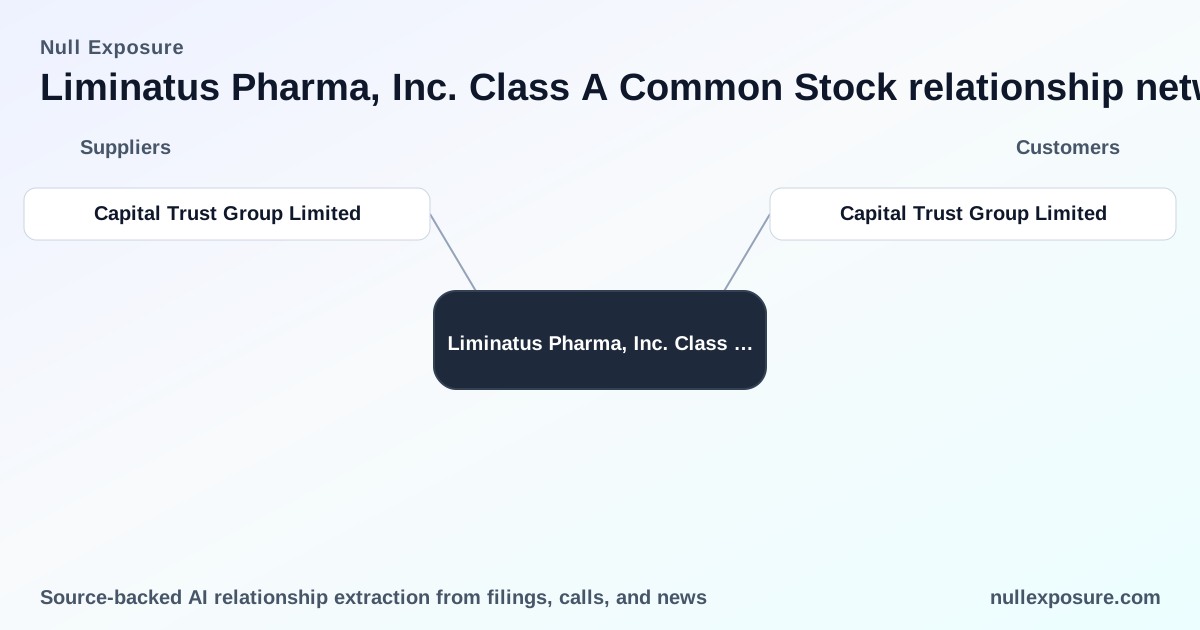
Liminatus disclosed a memorandum of understanding with Capital Trust Group Limited (CTG) outlining a potential USD 30 million equity investment via an earn-out mechanism and future strategic cooperation, conditioned on diligence and definitive agreements. The MOU frames CTG as a potential cornerstone investor whose execution would materially change Liminatus’s capital structure and runway.
Green Bay Press Gazette (press release)
The Green Bay Press Gazette reported on March 10, 2026 that Liminatus signed an MOU with Capital Trust Group under which CTG intends to subscribe to newly issued shares of Liminatus, subject to Nasdaq listing rules and U.S. securities laws. This release emphasizes the intended subscription structure and regulatory conditions for the transaction (Green Bay Press Gazette, 2026-03-10).
The Register-Guard (press release)
A parallel press release carried by The Register-Guard on March 10, 2026 repeated the MOU terms, noting CTG’s intention to subscribe to newly issued shares following diligence and negotiation of definitive agreements under applicable Nasdaq and U.S. securities requirements. The Register-Guard coverage reinforces that the transaction is currently conditional on standard regulatory and diligence checkpoints (The Register-Guard, 2026-03-10).
What the CTG MOU implies for investors
If executed, a $30 million committed program would materially de-risk near-term capital needs and extend development runway, but the MOU’s conditional language means execution risk remains. The earn-out structure and the need for Nasdaq and securities compliance introduce execution steps that will determine dilution patterns and the timing of capital inflows.
Each reported relationship, in plain English
- The Green Bay Press Gazette press release describes the MOU under which Capital Trust Group intends to subscribe to newly issued Liminatus shares as part of a proposed USD 30 million commitment, contingent on diligence and Nasdaq/U.S. securities compliance (Green Bay Press Gazette, March 10, 2026).
- The Register-Guard press release covers the same MOU terms, reiterating that CTG’s intended subscription is subject to completion of diligence, negotiation of definitive agreements, and compliance with Nasdaq listing rules and U.S. securities laws (The Register-Guard, March 10, 2026).
Both items reflect the same underlying commercial relationship: a potential strategic equity infusion from CTG structured through newly issued shares and staged through an earn-out mechanism.
Key risk and opportunity takeaways for investors
- Opportunity: A committed $30 million investment would be a significant de-risking event that funds clinical activities and could attract additional partners; strategic cooperation language suggests CTG could add operational or market access value beyond pure capital.
- Execution risk: The MOU is conditional on diligence, definitive agreements, and Nasdaq/U.S. securities compliance; these are concrete gateposts that will determine whether headlines convert into cash.
- Dilution and governance: Subscribing to newly issued shares will dilute existing holders; with insiders holding ~38.5% of shares and institutions at ~0.7%, any strategic investor that takes a material position will shift governance dynamics.
- Liquidity and valuation sensitivity: Market capitalization near $9.6M and a 52-week range from $0.159 to $33.66 indicate extreme trading volatility and low liquidity, which exaggerates the market reaction to financing news.
Practical investor actions
- Monitor filings and definitive agreements for the CTG transaction to assess structural terms — price per share, earn-out triggers, anti-dilution protections, and board representation.
- Track capital runway and use-of-proceeds language once definitive agreements are filed; capital deployment plans will determine the timeline for clinical milestones that drive value.
- Consider governance implications given insider concentration; a large outside investor could reshape strategic choices.
For a concise, searchable feed of partner and capital signals relevant to small-cap biotech investments, visit https://nullexposure.com/ for ongoing relationship monitoring.
Conclusion: where LIMN stands in a portfolio
Liminatus is a classic venture-style biotech equity: pre-revenue, dependent on financings and strategic deals, and highly binary around execution of investor commitments and clinical milestones. The CTG MOU is a material potential inflection point — converting it would fund development and change risk dynamics; failure to convert would underscore persistent financing risk. Investors should treat upcoming definitive agreements and regulatory clearances as the primary value checkpoints for LIMN.