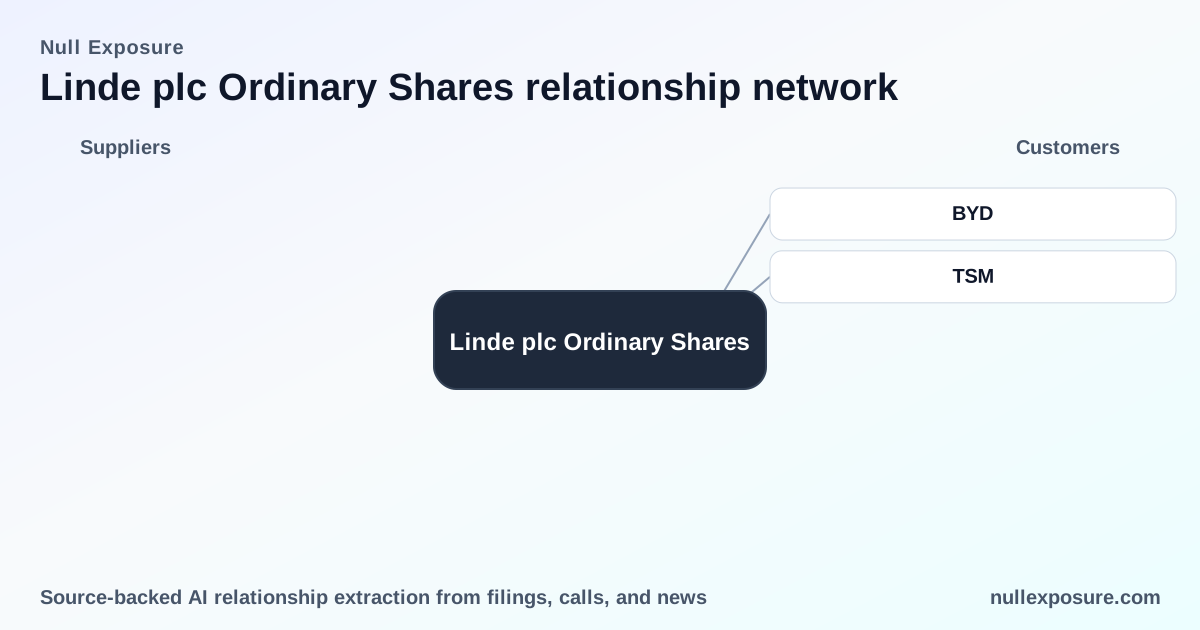
Linde (LIN) — customer relationships that underpin a capital-intense, recurring-revenue engine
Linde monetizes by owning and operating industrial gas production and distribution assets and by contracting customers on long-term supply agreements, on-site plant installations and shorter merchant or packaged-gas deals. Revenue derives from recurring gas sales, minimum purchase commitments, price escalators and engineering/plant sales, with a material portion of cash flows locked into multi-year to multi-decade arrangements that embed high switching costs.
For an investor or operator evaluating Linde’s customer footprint, the core thesis is simple: Linde sells indispensability — utility-like supply contracts that convert industrial demand into long-duration cashflow, while exposure to cyclical end-markets (semiconductors, chemicals, auto) and litigation risk remains. Learn more at https://nullexposure.com/.
Why Linde’s customer model is structurally sticky
Linde’s contracts come in three clear commercial flavors — on-site (tonnage), merchant (bulk liquid) and packaged (cylinder) — and each maps to different revenue resilience and margin profiles. According to Linde’s 2024 filing, on-site plants are typically built on or adjacent to customer sites and supplied by pipeline under total-requirement contracts that commonly run 10–20 years and include minimum purchase obligations and price escalators. Merchant agreements generally run 3–7 years, while packaged gases are sold under 1–3 year arrangements or purchase orders. These contract tenors create predictable cash flows and high customer criticality for large industrial users, while packaged and merchant sales provide flexibility and commercial exposure to spot pricing. The company also reports that approximately 65% of 2024 sales were outside the U.S., underlining its global footprint and regional management structure (Americas, EMEA, APAC).
- Contracting posture: long-tenor, minimum-purchase clauses and price escalators favor Linde’s revenue visibility and create significant switching costs.
- Concentration and criticality: on-site customers represent mission-critical relationships with high minimum commitments; packaged/merchant customers are less sticky.
- Maturity: a majority of core industrial relationships are mature and embedded, but engineering/plant sales remain project-driven.
- Scale of commitments: the company estimates the consideration related to future minimum purchase requirements and plant sales at roughly $58 billion, signaling substantial embedded forward revenue.
Customer mentions in recent reporting — what the headlines say
Below I cover each relationship that appeared in the provided results; each is summarized in plain English with a concise source reference.
BYD — a referenced industrial customer in China (InsiderMonkey, Mar 2026)
An earnings-call transcript noted BYD as an example of a Chinese customer whose growth trajectory drew comment during Linde’s discussions; the reference underscores Linde’s exposure to large industrial OEMs in China’s EV ecosystem. Source: InsiderMonkey Q4 2025 earnings call transcript (published Mar 10, 2026).
Intel — ties to semiconductor reshoring (ad-hoc-news, May 2026)
Market commentary links Linde to the semiconductor reshoring wave, noting direct ties to plants supplying Intel facilities, which positions Linde to capture incremental demand from domestic fab buildouts and localized supply chains. Source: ad-hoc-news sector overview (May 3, 2026).
TSMC — supply support for Taiwanese fab ramps (ad-hoc-news, May 2026)
The same sector piece highlighted Linde’s role supplying plants that serve TSMC facilities, reinforcing the view that semiconductor capital expenditure and fab ramp activity are near-term demand drivers. Source: ad-hoc-news sector overview (May 3, 2026).
TSM (TSMC referenced in earnings) — Fab 2 ramp and operational support (InsiderMonkey, Mar 2026)
Management remarks in the earnings transcript confirm Linde’s active role in supporting fab ramp activity — “Fab 2 … is ramping up at their end, and, obviously, we’re there fully supporting them on that” — indicating operational involvement on the ground during semiconductor capacity expansions. Source: InsiderMonkey Q4 2025 earnings call transcript (Mar 10, 2026).
TSMC (duplicate mention in earnings transcript) — repeated visibility in Fab programs (InsiderMonkey, Mar 2026)
TSMC is mentioned multiple times across the transcript and sector coverage, reflecting repeated operational engagement rather than a one-off reference; this repetition signals breadth of service across multiple semiconductor projects. Source: InsiderMonkey Q4 2025 earnings call transcript (Mar 10, 2026).
Huntsman — litigation and legacy supply exposure (PR Newswire, FY2022 case reported)
Huntsman secured a jury award against Praxair/Linde related to supply at its Geismar, LA MDI site, demonstrating legal and legacy operational risk associated with being a supplier to complex chemical manufacturers. This is an example of how supplier relationships can become material legal exposures. Source: PR Newswire press release on jury award (case referenced FY2022).
What these relationships mean for investors and operators
- Semiconductor reshoring and fab ramps (Intel, TSMC/TSM) are clear growth vectors: Linde is positioned to benefit from increased on-site and bulk demand as fabs commission gases and services. This is a structural demand tailwind for the merchant and on-site segments.
- Long-term contracted revenue is a defensive asset. The prevalence of 10–20 year on-site contracts with minimum purchase obligations turns industrial demand into quasi-annuity cashflow and supports valuation multiples for predictable earnings.
- Operational and legal risk is non-trivial. The Huntsman verdict underscores that supply relationships to chemical and specialty customers can produce litigation and cost exposures that erode margins and distract management. Investors should factor legacy liability and contract disputes into downside scenarios.
- Geographic diversification both reduces and introduces risk. Linde’s global footprint (65% sales outside the U.S.) buffers regional downturns but increases exposure to geopolitical and local regulatory factors.
Bottom line — positioning the risk/reward
Linde’s customer base is an asset: high-contractual visibility, embedded capital assets and minimum-purchase economics create durable cash flows, especially as industrial customers choose reliability over price for critical gas supply. At the same time, cyclical end-markets like semiconductors and auto provide upside, and legal/operational incidents (as with Huntsman) are real, idiosyncratic downsides. For investors and operators, the decision is between owning a capital-intensive, utility-like industrial supplier with secular growth opportunities tied to reshoring and green hydrogen transitions, versus acknowledging episodic litigation and project risk.
For more granular customer intelligence and to track evolving relationship signals, visit https://nullexposure.com/.
Bold takeaway: Linde converts industrial scale into predictable long-term cashflow through embedded on-site contracts, while semiconductor and chemicals exposure define its near-term upside and downside risk.