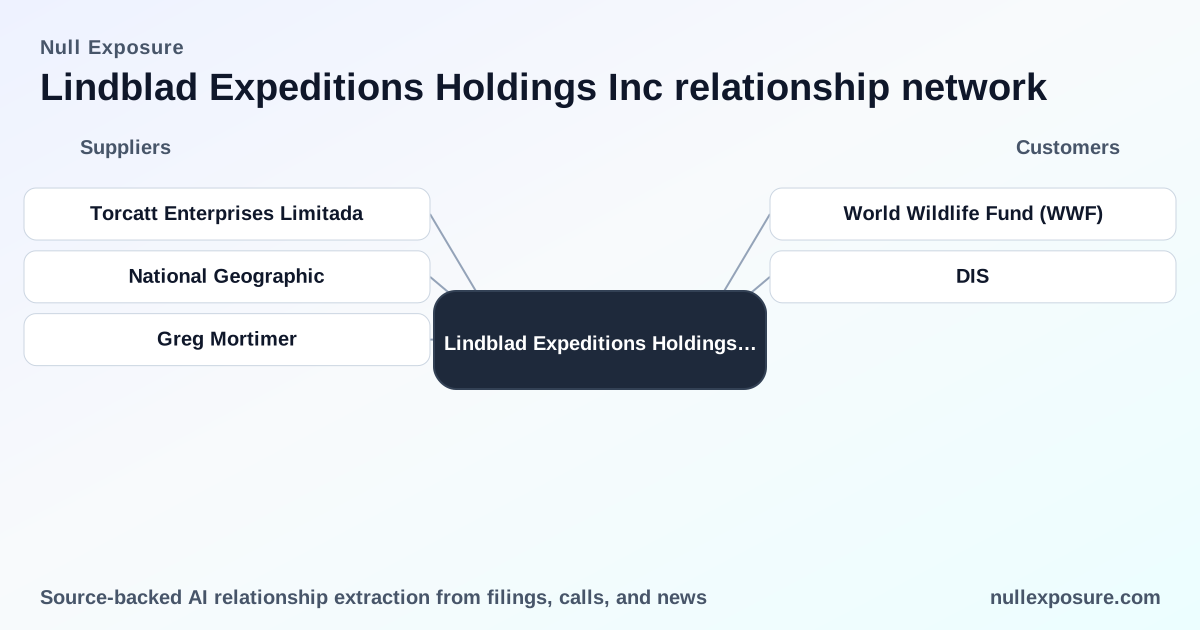
Lindblad Expeditions (LIND): Distribution partnerships, conservation branding, and a large forward-booking balance
Lindblad Expeditions operates premium small-ship expedition cruises and land-based adventure travel, monetizing primarily through guest ticket contracts and ancillary services (pre/post excursions, accommodations, air transfers). The company leverages branded distribution relationships and conservation partnerships to extend reach and justify premium pricing, while maintaining a sizable forward-booking liability—$318.7 million in unearned passenger revenue at year-end 2024—that both supports near-term revenue visibility and creates balance-sheet obligations. Learn more about how we track corporate customer exposures at https://nullexposure.com/.
Business model and operating posture: Lindblad sells experiential travel as a services business, contracts directly with largely individual consumers, and relies on channel partners to scale distribution. The company’s profile combines service-driven revenues, high concentration of U.S. guests, and meaningful advance-booking cashflows, making distribution relationships and brand credibility central to commercial performance.
How Lindblad sells experiences and where the leverage sits
Lindblad recognizes revenue as performance obligations are satisfied under guest contracts: the company acts as the seller of trips and related services rather than as an intermediary. Its offerings target affluent individual travelers (largest demographic: U.S. adults 50+), and expedition sailing guests sourced from the U.S. generated about 93% of global expedition-ticket revenue in 2024, underscoring North American concentration. Lindblad also operates globally with land itineraries across many countries, but revenue concentration remains heavily North America-centric.
Key operating signals:
- Contracting posture: seller of services with clear performance obligations (trip delivery, excursions, lodging and transport bundled into tour revenues), per the company’s revenue recognition statements in its 2024 filings.
- Concentration: heavy U.S. revenue weighting (~93% of expedition ticket revenue in 2024) creates geographic concentration risk.
- Scale and maturity: a $318.7 million unearned passenger revenue balance signals mature forward bookings and material short-term obligations.
- Customer type and segment: the primary counterparty is the individual traveler; business is service-centric (expedition cruising and land-based adventure travel).
- Materiality: certain ticketing items such as future travel certificates were disclosed as not significant at year-end 2024, indicating limited impact from that liability class.
If you want a structured view of Lindblad’s third‑party exposures and relationship signals, visit https://nullexposure.com/.
Customer relationships: the recorded links investors should parse
Below I cover every relationship referenced in the source results. Each entry is a plain-English summary with the cited source.
World Wildlife Fund (WWF)
Lindblad is the exclusive conservation travel partner of the World Wildlife Fund, a branding and mission-alignment relationship that enhances Lindblad’s conservation credibility and supports premium positioning for nature-focused travelers, according to Lindblad’s 2024 Form 10‑K discussion of strategic partnerships (FY2024).
Stardust Power (SDST) — private financing
Lindblad completed a private financing investment in Stardust Power, providing roughly $4.0 million in gross proceeds to Stardust on December 23, 2025, demonstrating Lindblad’s occasional role as a direct investor or financier beyond its core travel operations (news report, TradingView, December 2025 / FY2026).
Disney — 2025 Q4 earnings call (ticker DIS)
Management reported on the 2025 Q4 earnings call that distribution relationships with Disney expanded Lindblad’s reach into broader audiences and contributed to strong channel performance, highlighting the commercial benefit of the Disney partnership for bookings and brand exposure (Lindblad 2025 Q4 earnings call).
Disney — identical earnings-call reference (alternate record)
The company reiterated in the same 2025 Q4 call transcript that the Disney relationship is expanding distribution and audience reach; this duplicate record confirms the emphasis placed on Disney during that quarter’s commentary (Lindblad 2025 Q4 earnings call).
Disney — news coverage summarizing Q4 commentary (InsiderMonkey)
A news transcript summarizing Lindblad’s Q4 2025 remarks noted that bookings from earmarked Disney travel agents rose 35% year-over-year for the full year, quantifying the distribution uplift tied to the Disney channel (InsiderMonkey coverage of the Q4 2025 earnings call, FY2026 reporting).
Disney — news coverage (alternate label)
The same InsiderMonkey article reiterates that Disney-driven distribution materially increased bookings and broadened Lindblad’s audience, reinforcing the company’s public message about the importance of the Disney partnership to sales growth (InsiderMonkey, FY2026).
Disney — 2025 Q3 earnings call (ticker DIS)
On the 2025 Q3 earnings call Lindblad management stated that the Disney relationship continues to introduce the National Geographic Lindblad brand to new audiences and expanded distribution channels, confirming sustained strategic importance across multiple quarters (Lindblad 2025 Q3 earnings call).
Disney — duplicate Q3 earnings-call reference
A repeat record of the 2025 Q3 call again documents the company’s claim that Disney amplifies brand reach and distribution, underscoring that the relationship is an ongoing commercial channel rather than a one-time marketing initiative (Lindblad 2025 Q3 earnings call).
What these relationships mean for investors: opportunities and risks
- Distribution is operationally critical: the Disney relationship is a clear driver of incremental bookings—management quantified a 35% increase from Disney-affiliated agents—which makes channel continuity and contract terms a material commercial lever. Loss or deterioration of that channel would have outsized booking consequences.
- Brand and mission lift from WWF: the exclusive conservation partnership with WWF is a strategic asset for premium pricing and customer acquisition in the nature-tourism segment, supporting Lindblad’s value proposition vs. commoditized cruise alternatives.
- Capital deployment outside core operations: the private financing in Stardust Power signals that Lindblad occasionally deploys capital into equity or debt financings; investors should treat such investments as non-core and monitor magnitude and intent.
- Advance bookings give visibility—and obligation: the large unearned passenger revenue balance provides revenue visibility but represents a material deferred liability ($318.7 million) and potential source of cash flow stress if cancellations accelerate.
- Geographic concentration is a real risk: with roughly 93% of expedition ticket revenue sourced from U.S. guests in 2024, the company is highly exposed to U.S. consumer trends, travel sentiment and macro shocks that affect affluent older travelers.
Bottom line and investor action
Lindblad is a service-oriented, premium experiential travel operator that monetizes through direct guest contracts and leverages strategic distribution (notably Disney) and conservation partnerships (WWF) to sustain premium pricing and funnel bookings. The company’s forward-booking balance and concentrated U.S. customer base shape both its near-term revenue visibility and event-driven vulnerability.
For a deeper, evidence-based map of Lindblad’s counterparty relationships and exposures, visit https://nullexposure.com/ and review the customer profile.