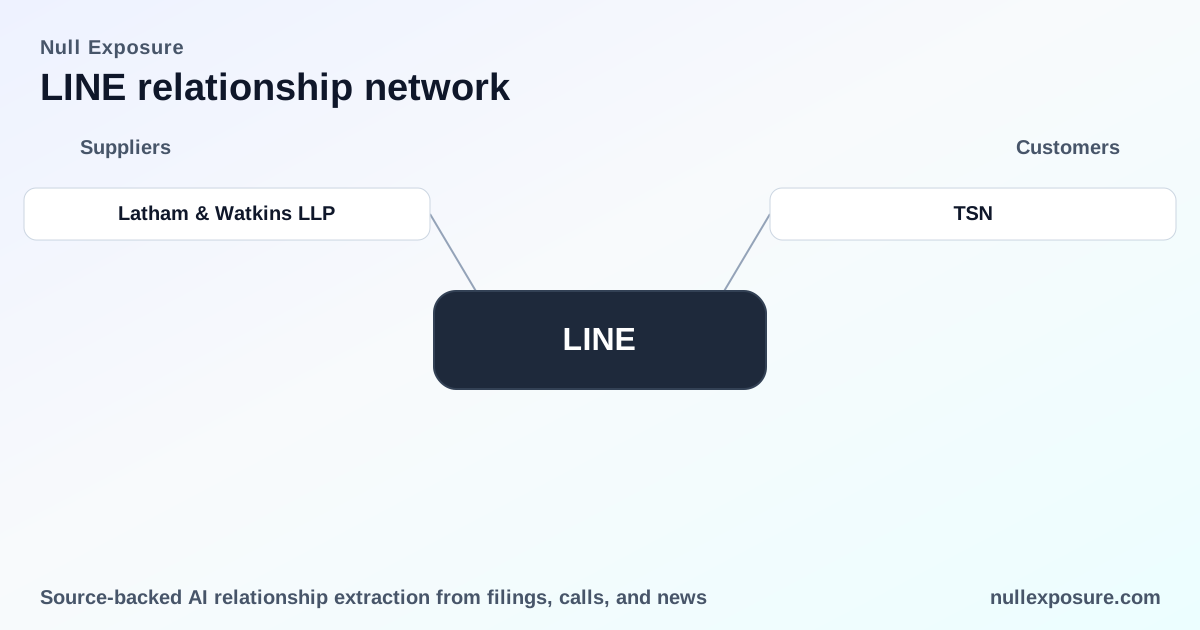
Lineage Inc. (LINE) — Customer Relationships and What They Mean for Investors
Lineage operates a global, temperature‑controlled warehousing and supply‑chain services platform that monetizes through storage fees, ancillary logistics services, and long‑term build‑to‑suit arrangements. Revenue comes from a mix of fixed‑term warehouse agreements, short‑term rate letters and tariff sheets, and value‑added services (processing, repackaging, managed operations) that together create recurring cash flow and differentiated operating leverage across high‑intensity, perishable goods customers. For investors, the company's economics are driven by a balance between contracted revenue stability from long‑term relationships and pricing flexibility—and volatility—from short‑term, on‑demand customers.
If you want a concise dataset of Lineage’s commercial footprint and implications for portfolio risk, start with a focused view of customers and contract structure at the company homepage: https://nullexposure.com/
The investor takeaway in one line
Lineage sells critical, mission‑critical infrastructure to large food retailers and distributors; revenues are concentrated (top 25 customers ≈32% of sales) but backed by a mix of durable long‑term leases and short‑term, price‑sensitive contracts—creating both stability and repricing opportunity.
How the customer map shapes the business model
Lineage’s operating model blends real estate and services economics. Contracts fall into two clear categories: negotiated, multi‑year warehouse agreements (including build‑to‑suit deals) that lock in minimum storage guarantees, and short‑term instruments—rate letters and tariff sheets—that provide on‑demand capacity and rapid price resets. The company reports more than $1.1 billion of unsatisfied performance obligations tied to non‑cancelable contracts, underscoring a material base of contracted, future revenue even as significant volumes are governed by short‑term terms that reset frequently.
- Contracting posture: A deliberate hybrid: long‑term agreements (1–5 years typical; 10–20 years for build‑to‑suit) provide revenue floors, while rate letters and tariff sheets allow quick pricing responses to cost inflation or demand shifts.
- Concentration and criticality: Top 25 customers supply about 32% of revenue, and the largest customers typically use multi‑facility footprints—this creates both bargaining power and client dependence.
- Geographic reach: North America (69% of warehousing revenue) dominates, with meaningful Asia‑Pacific and European footprints; this tilts operational and regulatory risk toward NA while preserving growth optionality overseas.
- Relationship maturity and growth: The customer base is long tenured (weighted average relationship >30 years for top clients) and mature, but technology rollouts like Lineage Link are still ramping, offering incremental margin expansion potential.
For a deeper look at contract quality, pricing flexibility and counterparty mix, visit the company’s investor overview: https://nullexposure.com/
What the constraints tell investors about risk and optionality
The company‑level signals drawn from public disclosures show a controlled but mixed risk profile:
- Short‑term pricing exposure is material: rate letters and tariff sheets allow frequent updates and are typically under one year, which gives Lineage pricing agility but exposes near‑term revenue to demand cycles.
- Long‑term revenue ballast exists: warehouse agreements and build‑to‑suit contracts create multi‑year cashflow visibility and accounted unsatisfied obligations of $1.127 billion (as disclosed).
- Large‑enterprise counterparty mix lowers credit risk: the customer base includes household names across retail, manufacturing and distribution, which reduces payment volatility while concentrating revenue.
- Global scale with North American bias: operations span 488 warehouses worldwide, but 313 are in North America, so macro events in the U.S. disproportionately affect performance.
- Service orientation enhances stickiness: revenue is not just rent—Lineage provides processing, repackaging and end‑to‑end logistics, which widens customer switching costs and supports margin capture.
Customer relationships reported in recent media — what investors should note
Below I cover each relationship mentioned in the results and the precise source for that mention.
TNMG — LINE as a consumer‑facing integration in Taiwan
TNMG integrated LINE (Taiwan’s dominant messaging app) into its iGood Price‑Drop Radar to embed product tracking and price alerts directly within everyday conversations, reducing friction for consumers who want automatic discount notifications. This is a customer‑facing partnership leveraging LINE’s messaging reach in Taiwan (PR Newswire, March 10, 2026).
Tyson Foods (entry 1) — greenfield construction partnership in Dallas, TX
Lineage disclosed an arrangement to start construction on a new greenfield facility in Dallas under an agreement with Tyson Foods, signaling strategic expansion with a major food producer that likely involves build‑to‑suit economics and long‑term volume commitments (TradingView summary of a 10‑K, referenced March 10, 2026).
SBET / SharpLink Gaming — staking activity on a blockchain named Linea
SharpLink Gaming deployed and staked $170 million of ether on Linea, a Layer‑2 blockchain; this mention references a blockchain named Linea rather than Lineage the warehousing firm, so investors should treat this as an unrelated name overlap in crypto reporting, not a commercial customer of Lineage’s logistics business (The Block, May 3, 2026).
TSN (entry 2) — duplicate report of the Tyson Foods arrangement
A second media capture reiterates the construction and expansion arrangement with Tyson Foods—again noting a Dallas greenfield and European expansion—confirming media traction around Lineage’s strategic projects with Tyson (TradingView, March 10, 2026, later capture).
What these named relationships imply for valuation and risk
- Strategic customers like Tyson indicate attractive contractual economics: build‑to‑suit and greenfield deals support long‑dated revenue visibility and justify higher capital intensity.
- Name‑overlap coverage (Linea vs. Lineage) creates noise: investors must filter industry reporting carefully to avoid misattributing blockchain activity to the logistics operator.
- Short‑term contracts keep the stock sensitive to volume and pricing cycles, while long‑term deals underpin valuation multiples tied to steady NOI growth and property reuse.
Bottom line for operators and investors
Lineage’s customer mix is a core competitive asset: large, multi‑facility customers deliver scale and stickiness while short‑term tariff mechanisms provide market‑responsive pricing. Risk centers on client concentration (top 25 ≈32% of revenue), North America exposure, and the operational execution of new greenfield and expansion projects.
For a concise reference on the company’s customer structure and practical signals for underwriting, see the company snapshot at https://nullexposure.com/ — or reach out through the site for a tailored review.
Bold claims above are grounded in the company’s disclosures on contract types, geography, customer concentration and specific media mentions; treat each named relationship in the press as a directional signal for commercial strategy rather than a standalone valuation driver.