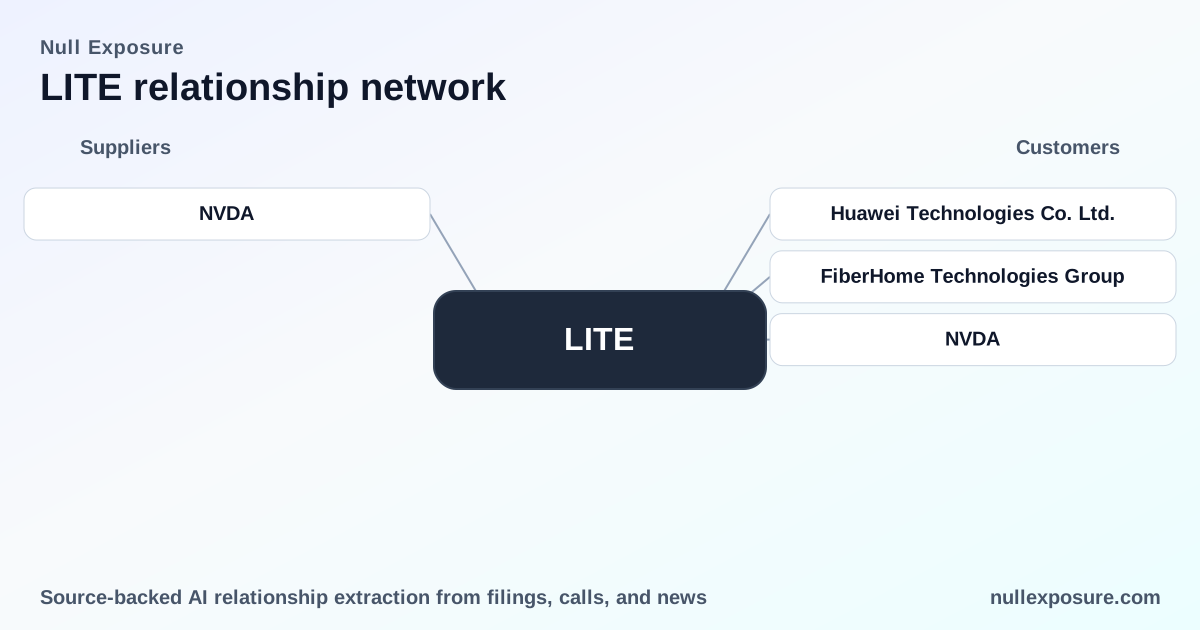
Lumentum (LITE) — the optics supplier at the center of hyperscaler AI buildouts
Lumentum manufactures and sells optical and photonic components — from indium phosphide lasers to VCSELs and high‑speed transceivers — and monetizes by selling hardware and capacity commitments to cloud hyperscalers, AI infrastructure providers and network equipment manufacturers, plus a smaller industrial/consumer laser business. Revenue is driven by large enterprise buyers and short‑term purchase orders, while strategic long‑term commitments (notably from NVIDIA) de‑risk production investment and lock in future sales. For quick access to the platform that aggregated these signals, visit https://nullexposure.com/.
Why the market is fixated on Lumentum now
Lumentum sits at the intersection of two secular trends: hyperscale data center networking and next‑generation AI interconnects. The company sells the optical building blocks that move data as light rather than electricity — a product set that is critical to the scaling of AI clusters. In March 2026, NVIDIA announced a strategic program that combined a $2 billion equity injection with multi‑billion dollar purchase commitments and capacity access rights for advanced laser components; that agreement converted a portion of Lumentum’s long‑term demand profile from spot purchase orders into contracted capacity rights and back‑book. The market reacted accordingly, repricing Lumentum to reflect both the growth opportunity and the capital commitment required to bring U.S. fabrication capacity online (news coverage, March 2026).
All active customer relationships and what they mean for investors
NVIDIA / NVDA — the strategic anchor customer
NVIDIA entered a multiyear, non‑exclusive strategic agreement that includes a $2 billion investment and multibillion‑dollar purchase commitments for advanced laser components, plus capacity access rights and support for a new U.S. fabrication facility. This deal secures long‑range demand for Lumentum’s indium phosphide lasers and materially changes the company’s production planning and capital allocation. (TradingView/Zacks summary; multiple March 2026 press reports.)
Google — hyperscaler capex as a revenue engine
Google is cited as one of the hyperscalers whose massive capex drives demand for Lumentum’s high‑speed transceivers and optics for data center networks; hyperscaler spending forms a core demand pillar for Lumentum’s Cloud & Networking segment. (Markets FinancialContent analysis, April 2026.)
Microsoft — another hyperscaler buyer supporting optical networking demand
Microsoft is identified alongside Google and Meta as a hyperscaler whose infrastructure investments underpin demand for Lumentum’s Cloud & Networking products, contributing to the company’s backlog and revenue trajectory. (Markets FinancialContent analysis, April 2026.)
Meta — part of the hyperscaler cohort driving growth
Meta is grouped with other hyperscalers whose shift to light‑based networking and increased AI infrastructure spending supports Lumentum’s product roadmap and order flows. (Markets FinancialContent analysis, April 2026.)
Amazon — buyer of transceiver components for large data centers
Amazon is referenced as a customer archetype that purchases high‑speed optical transceivers and modules; these purchases reflect the broad hyperscaler market that Lumentum serves. (Markets FinancialContent analysis, April 2026.)
Apple — industrial tech and VCSEL exposure
Apple represents the consumer end‑market exposure in Lumentum’s Industrial Tech segment: VCSELs for 3D sensing (FaceID) and precision lasers used in manufacturing form a smaller, but strategically different, revenue stream. (Markets FinancialContent/Finterra write‑up, April 2026.)
Huawei Technologies Co. Ltd. — export control constraint
Lumentum disclosed that final export rules prevent sales of certain products subject to the EAR to identified Huawei entities without a BIS license, creating explicit compliance and shipment restrictions for that counterparty. (Lumentum FY2025 Form 10‑K.)
FiberHome Technologies Group — restricted by export controls
FiberHome is named in the company’s 10‑K as a customer subject to export control restrictions since May 2020; the filing states that BIS could expand restrictions to other customers or otherwise restrict shipments. This is a direct compliance downside that affects available markets in certain jurisdictions. (Lumentum FY2025 Form 10‑K.)
What the relationship mix reveals about Lumentum’s operating model
- Contracting posture: Lumentum predominantly sells under short‑term purchase orders and contracts without long‑term volume guarantees, which implies revenue is weighted to spot orders and near‑term shipments; however, strategic transactions (for example, NVIDIA’s purchase commitments) introduce a new layer of longer‑horizon demand. This is a company‑level signal drawn from public disclosures.
- Counterparty profile and criticality: Customers are large enterprises (hyperscalers, AI infrastructure providers, NEMs) whose purchases are high‑value and mission‑critical to Lumentum’s Cloud & Networking business, making those relationships operationally critical to revenue. This is a company‑level signal.
- Geographic concentration: Lumentum ships globally — 81% of FY2025 revenue was from customers outside the United States, with material sales in APAC and the Americas — which both diversifies market exposure and raises geopolitical and export‑control sensitivity. This is a company‑level signal from FY2025 reporting.
- Concentration risk: The company reports that a single customer comprised approximately 16% of fiscal‑year revenue in FY2025, indicating meaningful customer concentration that investors must monitor when evaluating churn or procurement shifts.
- Relationship maturity and stage: Lumentum describes longstanding, mature relationships with market‑leading customers but operates in an active growth phase driven by AI capex, so the portfolio blends mature account depth with accelerating order intake.
- Business segments: The company’s revenue mix is hardware‑centric (optical and photonic components), infrastructure‑oriented (network transceivers and subsystems), and includes a manufacturing/industrial laser business that provides diversification across end markets.
For an investor primer and deeper relationship mapping, see https://nullexposure.com/ for the full platform view.
Risks to track and the upside scenario
- Export controls are an immediate downside risk. The FY2025 10‑K names Huawei and FiberHome as entities constrained by U.S. export rules, and Lumentum warned that BIS actions could expand — this directly limits addressable markets for specific product lines. (Lumentum FY2025 10‑K.)
- Customer concentration and short‑term contracting increase volatility. Heavy dependence on a few hyperscalers and PO‑based purchasing elevates revenue cyclicality, even as strategic commitments reduce execution risk over the medium term.
- Upside from de‑risking capital spend via strategic commitments. NVIDIA’s $2 billion strategic investment and purchase commitments convert a portion of future demand into predictable capacity utilization and justify U.S. facility expansion; that deal materially raises the revenue runway for Lumentum’s AI optics business (multiple March 2026 news reports).
- Operational execution and timing of ramp. The value of long‑term commitments accrues only if Lumentum executes capacity expansions to meet schedule; backlog commentary (> $400M optical circuit switch backlog in recent earnings coverage) supports the near‑term revenue path but requires disciplined capital deployment. (MarketBeat/earnings coverage, March 2026.)
Bottom line — positioning for a photon supercycle
Lumentum is a capital‑goods supplier whose economics depend on large enterprise customers, short‑term purchasing behavior, and a few strategic long‑term commitments that can reshape capacity investment. Export controls and customer concentration are the principal risks; NVIDIA’s strategic program and hyperscaler capex create a sizable upside if execution on U.S. capacity and product ramps is flawless. For analysts and operators modeling Lumentum, the key variables to stress are: timing of fab capacity, the pace of hyperscaler transitions to photonic switching, and any incremental export‑control actions that restrict end markets.
If you want a consolidated view of these customer relationships and company signals for portfolio or vendor due diligence, visit https://nullexposure.com/ for the full analysis hub.