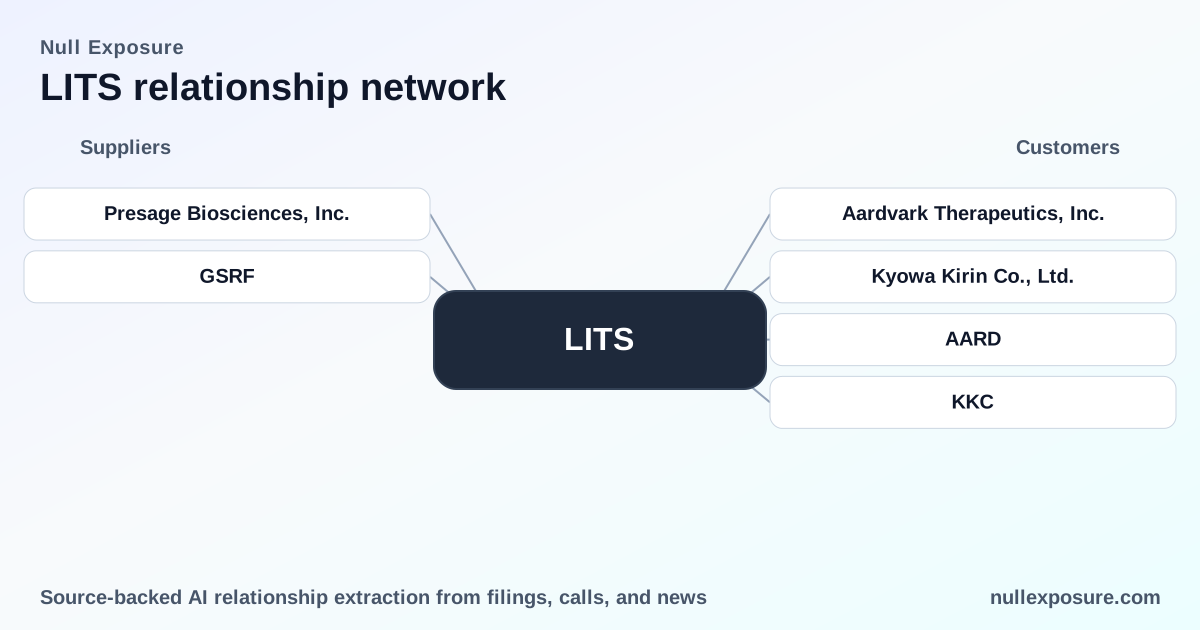
Lite Strategy (LITS): Customer relationships reveal an asset-monetization, capital-markets–driven business model
Lite Strategy operates as a clinical-stage pharmaceutical company that monetizes primarily through discrete asset transactions and commercialization service agreements rather than recurring product sales. The company generates cash by selling or licensing clinical-stage assets and by contracting commercialization services, while equity raises and PIPE financing supply working capital and strategic flexibility.
If you are evaluating Lite Strategy’s customer footprint for investment or operational due diligence, review the relationships below and the company-level signals that define how those relationships convert into cash and governance influence. For a concise company profile and ongoing relationship monitoring, visit https://nullexposure.com/ for more context.
What the customer set tells an investor about how Lite Strategy runs its business
Lite Strategy’s customer relationships are episodic and transaction-oriented. The FY2025 Form 10‑K shows the firm completed an asset sale and continues to operate under commercialization agreements that produce irregular service revenue. With trailing revenue effectively zero and a negative gross profit in the most recent reporting period, revenue realization is event-driven rather than recurring, and capital markets activity underpins liquidity and strategic moves.
Contracting posture: Lite Strategy executes fixed, project-based contracts (asset purchase agreements, commercialization service agreements) that transfer IP or deliver services over defined periods. Governance influence from capital providers is material: the company disclosed a side letter with a PIPE purchaser that included a board nomination right, indicating capital providers can obtain direct governance levers.
Concentration and criticality: Relationships generate occasional, concentrated cash inflows—one-off asset sales or service milestones—so counterparty performance on specific delivery or closing events is critical to near-term cash. The KKC commercialization agreement historically generated modest revenue in FY2024 and none in FY2025, underscoring revenue volatility.
Maturity: The business remains clinical-stage and transitional: asset divestitures and commercialization partnerships are the primary monetization pathways while the company transitions capital structure and treasury strategy (including a large PIPE and digital-asset treasury initiatives reported in late 2025).
Relationship-by-relationship read: the counterparties that matter today
Aardvark Therapeutics, Inc. — buyer of ME‑344 / WE‑868
Lite Strategy sold rights, title and interest in assets related to ME‑344 to Aardvark Therapeutics under an Asset Purchase Agreement, receiving an initial payment of $0.5 million plus a $55,000 reimbursement at closing, according to Lite Strategy’s FY2025 Form 10‑K. Multiple press releases and industry outlets (Chainwire, Decrypt, GlobeNewswire, Nov 2025) recapped the transaction and described ME‑344 as being developed by Aardvark under the name WE‑868, citing the sale alongside Lite Strategy’s capital market activity. (Sources: Lite Strategy FY2025 Form 10‑K; Chainwire/Decrypt/GlobeNewswire press coverage, Nov 2025)
Kyowa Kirin Co., Ltd. (KKC) — commercialization partner with limited recent revenue
The FY2025 Form 10‑K states Lite Strategy recognized no revenue during the year ended June 30, 2025 under the KKC Commercialization Agreement; by contrast, FY2024 revenue associated with that agreement totaled $752,000 (services performed over time $743,000; pass-through services $9,000). A trading‑summary of the 10‑K reiterated that all deferred revenue connected to the KKC deal was recognized in FY2024, leaving no related revenue in FY2025. (Sources: Lite Strategy FY2025 Form 10‑K; TradingView summary of FY2025 10‑K)
Note on duplicated press references: news feeds and press release aggregators repeated the Aardvark sale coverage across outlets (QuiverQuant, Bitget, GlobeNewswire and others), confirming market notice of the transaction and its linkage to Lite Strategy’s broader capital-market moves in FY2026 reporting. (Sources: GlobeNewswire / QuiverQuant / Bitget coverage, Nov 2025)
Constraints and company-level signals that shape partner economics
-
Governance tied to capital providers: Lite Strategy disclosed a Side Letter with a PIPE purchaser (GSR Strategies LLC) that granted the purchaser the right to nominate a board member, a company-level governance signal found in SEC disclosures tied to the July 2025 PIPE. This demonstrates that financing counterparties obtained direct oversight levers, influencing strategic decisions beyond transactional customer deliveries. (Source: Lite Strategy public filings relating to the July 22, 2025 PIPE / Side Letter disclosure)
-
Event-driven cash generation: The FY2025 financials show zero revenue TTM and a negative gross profit, while the 10‑K confirms an asset sale for a modest cash consideration—this is consistent with a model that converts IP and services into non‑recurring cash events rather than steady operating income. Treat revenue from commercialization agreements as project-specific and timing-sensitive, not recurring.
-
Customer relationships are low-frequency but high-impact: The KKC commercialization agreement produced a discrete revenue recognition event in FY2024 and nothing in FY2025; the Aardvark transaction converted a clinical asset into near-term cash. For underwriting, assume concentration risk around contractual milestones and closings rather than diversified, subscription-style revenue.
-
Capital markets and treasury strategy are central operating levers: Public disclosures and press releases link asset monetizations with a $100 million PIPE and an active digital-asset treasury strategy announced in late 2025, indicating the company uses equity financing and asset sales in combination to fund operations and strategic initiatives. (Source: Lite Strategy press release and SEC filing commentary, Nov–Jul 2025)
Investment implications — how to think about risk and upside
- Upside derives from successful asset monetizations and partnership milestones; the Aardvark sale is a clear example of monetizing non-core or early‑stage assets to fund operations.
- Downside is liquidity and revenue volatility; periodic recognition of commercialization revenue and infrequent asset sales create cashflow variability that necessitates reliance on capital raises and PIPE investors.
- Governance risk is non-negligible; side letters associated with PIPE financing can transfer board influence to financiers, affecting strategic flexibility and counterparty negotiations.
For investors focused on operational counterparties, the takeaways are straightforward: Lite Strategy’s customers act as buyers and commercialization partners in transactional arrangements, and those relationships deliver lump-sum or milestone-based cash rather than predictable recurring revenue. Monitor future 10‑K/10‑Q disclosures and press releases for further evidence of asset sales, milestone payments, or renewed commercialization activity.
For deeper signal tracking on Lite Strategy’s counterparties and evolving commercial terms, see additional resources at https://nullexposure.com/.
Bold conclusion: Lite Strategy is a capital‑markets‑levered, asset-monetization biotech whose customer relationships are transactional and timing-sensitive; investment outcomes depend on successful execution of discrete commercial events and continued market access to PIPE-style financing.