Live Ventures (LIVE) — Customer Relationship Risk & Revenue Implications
Live Ventures operates as a diversified owner-operator across flooring manufacturing, steel fabrication and retail businesses, monetizing through product sales, installation services, and retail cash sales across several subsidiaries. Revenue is generated from manufacturing contracts and wholesale distribution, retail point-of-sale, and ancillary service fees (installation, rent reimbursements); the holding-company structure concentrates governance while operating cash flows are dispersed across discrete operating units.
For a focused view of client exposure and commercial posture, explore broader relationship intelligence at https://nullexposure.com/.
What the customer list reveals about how Live does business
Live Ventures runs multiple business models under one public company umbrella: manufacturing-led B2B channels (carpet and steel products), retail B2C outlets (Vintage Stock and Flooring Liquidators), and installation/service revenues recognized over time. Company disclosures and segment descriptions indicate a U.S.-centric footprint and a mix of counterparty types dominated by individual consumers for retail segments and specialized distributors/manufacturers for industrial segments.
Key operating-model takeaways:
- Geography is concentrated in North America, reflecting the company’s retail and manufacturing catchment and supporting a domestic revenue profile (company filings and segment notes).
- Counterparties skew toward individuals for retail and organizations for manufacturing and distribution, creating a bifurcated credit and revenue risk profile.
- Contracting posture is transactional: retail sales are point-in-time cash or card transactions, installation services are recognized over time, and manufacturing/distribution relationships are ordinary commercial contracts rather than long-term exclusive supply agreements.
- Spend concentration at the customer level is limited—public disclosures show related-party rent reimbursements in the low‑hundreds of thousands, consistent with a spend band that is material for a vendor but not a strategic revenue anchor.
- Governance and capital structure are notable: insider ownership exceeds 70% and institutional ownership is low, which shapes strategic flexibility and minority-investor oversight.
All disclosed customer relationships and what they imply
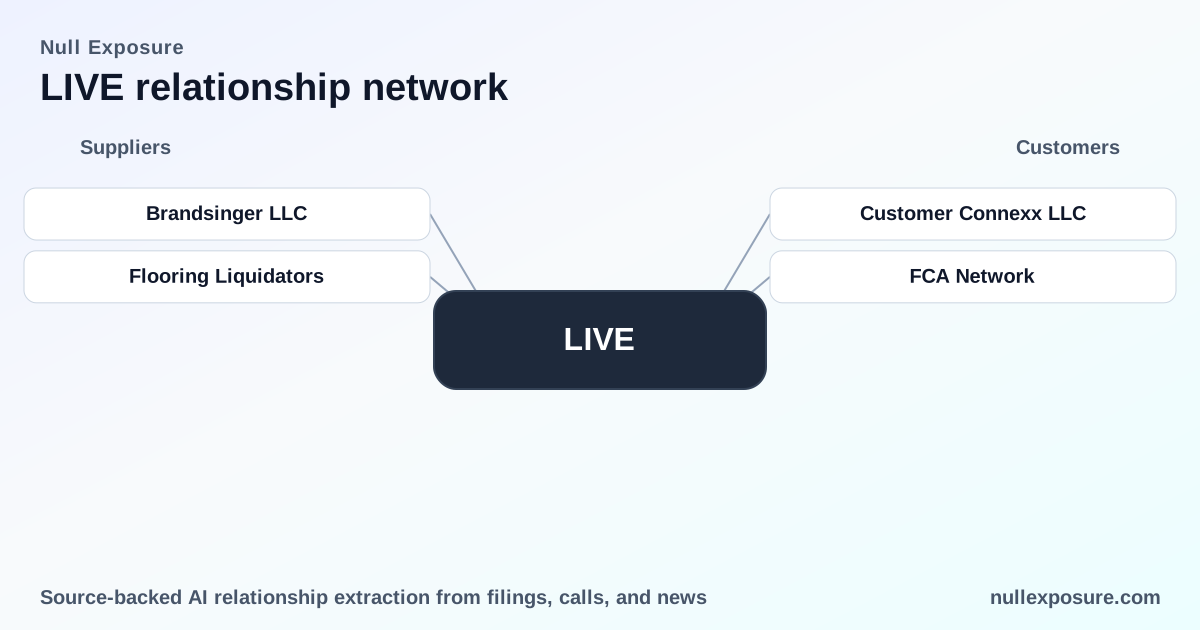
Customer Connexx LLC — tenant relationship tied to affiliate history
Customer Connexx LLC, formerly a subsidiary of ALT5, previously rented approximately 9,900 square feet of Live Ventures’ Las Vegas office space out of a 16,500 square foot facility, indicating related-party or affiliated tenant activity and modest reimbursement revenue. This is disclosed in Live Ventures’ FY2025 Form 10‑K and shows how the company monetizes real estate and recovers occupancy costs in addition to operating revenue (Live Ventures FY2025 10‑K).
FCA Network — channel buyer for Marquis product lines
A February 2020 industry report noted that members of the FCA Network purchase from Marquis, Live Ventures’ flooring manufacturing business, indicating Marquis leverages industry buying groups and dealer networks to move product into retail channels (FCNews, February 2020). This underscores Marquis’ distribution strategy through trade channels rather than exclusive direct-to-end-user dependence.
How these relationships fit into the company’s financial footprint
Live Ventures’ publicly reported metrics frame the commercial scale behind these relationships: FY‑TTM revenue of approximately $442 million and gross profit of $146 million, with operating margin near 3.2% and market capitalization roughly $39 million (company financial summary). Those figures position the company as a low‑multiple, asset‑rich operator where manufacturing margins are modest and scale benefits are incremental.
- The Customer Connexx rental exposures are immaterial to consolidated revenue but illustrate a recurring source of low‑hundreds‑of‑thousands in reimbursements; filings show ALT5 paid the company $117,000 and $194,000 in rent and reimbursed expenses for FY2025 and FY2024, respectively (company disclosures).
- The FCA Network relationship highlights Marquis’ channel-driven go-to-market, which reduces single-account concentration but increases dependency on dealer flows and inventory turns.
Investment implications — what investors should track
Live Ventures’ customer network signals a blended risk profile: retail cash flows provide visibility but are lower margin and more volume‑sensitive; manufacturing revenue depends on dealer/distributor throughput rather than a small set of strategic contracts. Key implications:
- Revenue diversification is real but shallow. Multiple subsidiaries lower single-buyer risk, yet consolidated scale remains modest, making earnings sensitive to cyclical demand in home improvement and industrial fabrication.
- Counterparty credit risk is dispersed. Retail-facing segments expose the company to consumer spending cycles while manufacturing segments expose it to dealer inventory and construction activity.
- Related-party and occupancy reimbursements are visible but limited. Recovered rent under $200k per year is notable for cash flow smoothing but not a core profit driver.
- Governance concentration matters. With insiders holding over 70% of shares, strategic decisions, dividend policy, and capital allocation will reflect controlling interests rather than broad institutional pressure (public ownership data).
Monitor these indicators over the next reporting cycles:
- Same-store retail trends and installation backlog for Flooring Liquidators and Vintage Stock.
- Marquis order book and dealer inventory levels reported in quarterly segment commentary.
- Any changes to related-party arrangements (rent, services) disclosed in subsequent 10‑Q/10‑K filings.
Bottom line — concise investor takeaways
- Live Ventures monetizes via three distinct levers: manufacturing sales, retail point-of-sale, and service/reimbursement income. That structure lowers dependency on any single buyer but keeps margins exposed to commodity and retail cycles.
- Disclosed customer relationships are transactional and non-strategic at scale: Customer Connexx contributes modest occupancy reimbursement revenue and FCA Network is a dealer channel for Marquis, reflecting normal distribution dynamics.
- Company-level signals—U.S.-centric exposure, mixed counterparty types, and concentrated insider ownership—define the risk-return profile. Active monitoring of segment-level revenue trends and dealer/channel health gives the clearest read on near-term earnings volatility.
For faster, structured access to relationship intelligence and to benchmark Live Ventures against peer customer networks, visit https://nullexposure.com/.
Key risk checklist:
- Retail demand volatility and inventory obsolescence.
- Dealer/distributor inventory swings affecting manufacturing shipments.
- Governance concentration limiting external influence on capital allocation.
This analysis synthesizes the company’s FY2025 disclosures and relevant industry reporting to assess customer relationships and their financial consequences for investors.