LLYVK: Sponsor and distribution relationships that shape the live-entertainment thesis
Liberty Live Group operates and monetizes live entertainment through a three-legged model: ticketing and events, global sponsorships, and media/distribution rights. Management frames growth as the multiplication of marquee IP (Formula 1 and related assets) with consumer-brand partnerships and strategic distribution deals that broaden reach and enable premium pricing. For investors that means value is driven less by short-term box-office results and more by long-term, multiyear commercial relationships and media agreements that scale audience monetization across channels. Explore the relationship detail and implications below — or visit https://nullexposure.com/ for deeper corporate relationship intelligence.
How management frames partnerships and why it matters
Management repeatedly highlighted partnerships as a deliberate revenue lever. In the 2025 Q3 earnings call, executives positioned Formula 1’s strategy as expanding consumer-brand tie‑ups and distribution relations to “bring the sport closer to today’s multidimensional fan.” That description signals a contracting posture focused on multi-year, brand-led sponsorships and strategic distribution rather than one-off event deals (LLYVK 2025 Q3 earnings call, March 7, 2026).
Company financials reinforce the commercial focus: Revenue TTM of $381.95M and Gross Profit of ~$73.5M show monetization at scale, while negative EBITDA of –$25.6M and an operating margin weakness indicate reinvestment or timing between rights-driven upfront costs and recurring revenue realization. The balance of marquee partners and distribution relationships shapes both growth potential and downside concentration risk.
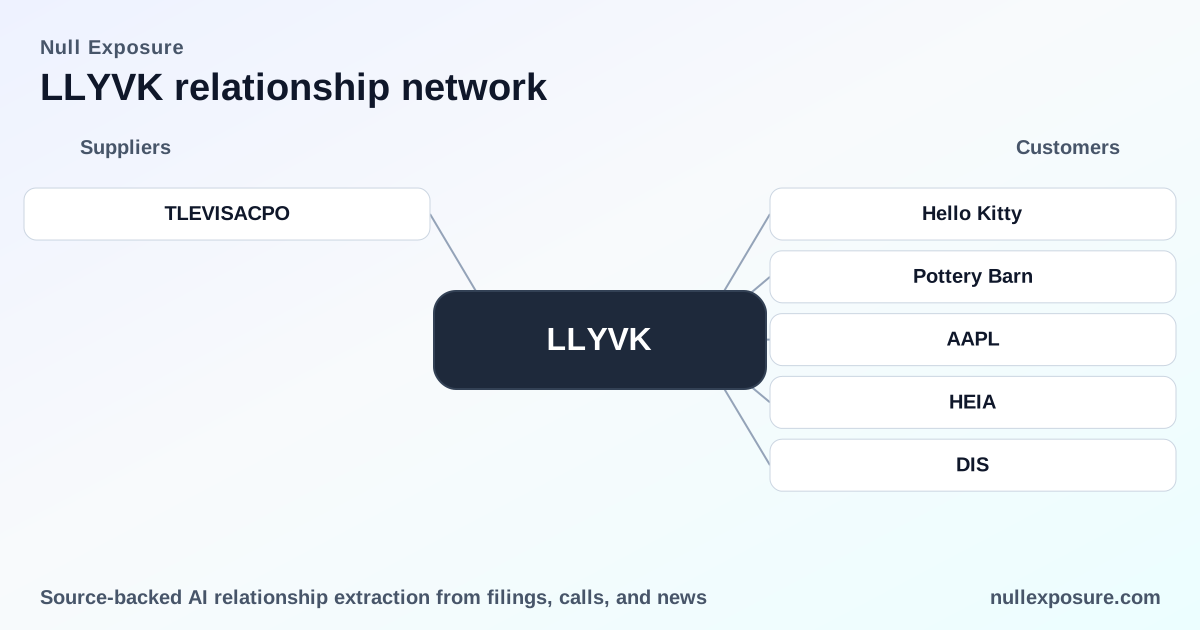
Customer relationships disclosed in the record (what management actually named)
Below I list every relationship management or media coverage referenced in the disclosed materials. Each entry is a plain-English take with its source.
-
Pottery Barn
Management noted that F1 has partnered with high-quality consumer names including Pottery Barn as part of a push to engage fans with lifestyle brands; the mention was made on the 2025 Q3 earnings call. (LLYVK 2025 Q3 earnings call, March 7, 2026) -
Hello Kitty
Management cited Hello Kitty as another consumer brand partner that helps position the sport with broader lifestyle audiences, referenced in the same 2025 Q3 earnings call disclosure. (LLYVK 2025 Q3 earnings call, March 7, 2026) -
AAPL
The company disclosed a landmark U.S. distribution partnership with Apple intended to highlight innovation across both brands and to position Formula 1 for the next phase of U.S. growth. This was described on the 2025 Q3 earnings call and referenced as a strategic distribution arrangement. (LLYVK 2025 Q3 earnings call, March 7, 2026) -
Apple
Management reiterated the Apple distribution deal on the 2025 Q3 earnings call, emphasizing the partnership’s role in advancing U.S. distribution and brand positioning for Formula 1. (LLYVK 2025 Q3 earnings call, March 7, 2026) -
Heineken
Management announced a renewal with global partner Heineken in a multiyear arrangement, signaling continuity with established beverage sponsorships that historically underpin event-level commercial revenue. (LLYVK 2025 Q3 earnings call, March 7, 2026) -
HEIA
The same Heineken renewal appears in disclosures under the HEIA ticker reference; management described the deal as a renewed multiyear global partnership in the 2025 Q3 call. (LLYVK 2025 Q3 earnings call, March 7, 2026) -
DIS
Press coverage (Hollywood Reporter) highlighted comments by Formula 1’s CEO about media-rights renewal activity, specifically noting that the group had renewed media rights with ESPN, a Disney property, after the current contract expired in 2025; the article also covered ticket demand commentary. (Hollywood Reporter, March 10, 2026) -
ESPN
The Hollywood Reporter coverage specifically referenced renewal of media rights with ESPN and management’s commentary on ticket demand and the overall media strategy for Formula 1. (Hollywood Reporter, March 10, 2026)
What these relationships imply for contracting posture and business characteristics
- Contracting posture: The disclosures point to a preference for multiyear, high‑profile partnerships (Heineken renewal, Apple distribution). That posture reduces churn but increases long-term exposure to partner brand health and negotiated term structures.
- Concentration: The presence of a small set of global partners (Heineken, Apple, ESPN/Disney) implies concentration at the top end; these partners are commercially critical and public-facing.
- Criticality: Media and distribution deals (Apple, ESPN) are critical to audience reach and monetization; sponsorships (Heineken, consumer brands) are critical for premium on-site and brand-extension revenue.
- Maturity: The mix indicates enterprise-level maturity—Formula 1 secured legacy sponsorships while adding new consumer-lifestyle tie-ups—consistent with a business moving from event-based sales to recurring global commercial agreements.
These are company-level signals: there were no extracted contractual constraint excerpts provided that tie contractual terms or liability to an individual partner.
Risk and valuation context investors should weigh
- High valuation multiples versus negative EBITDA: Market capitalization sits at roughly $8.65B with EV/Revenue ~26.9 and EV/EBITDA ~62.0, demanding successful execution on partner monetization and distribution scaling to justify current prices.
- Sponsorship and media renewal timing: Renewals and distribution rollouts (Apple U.S. deal and ESPN media rights) will materially influence revenue trajectory and margin conversion.
- Audience sensitivity: Management said ticket demand remains robust, but multiples require sustained premium pricing and growth across channels. Any deterioration in partner renewals or distribution performance would have outsized impact given concentration.
Where operators and investors should focus next
- Track execution milestones for the Apple distribution deal in the U.S. and the operational impact on subscriber/viewing metrics that will drive advertising and sponsorship value.
- Monitor the financial contribution of renewed sponsorships (Heineken) and new consumer-brand partnerships (Hello Kitty, Pottery Barn) in management’s quarterly disclosures.
- Watch margin conversion: with negative EBITDA today, the path to scalable profitability depends on how distribution economics and sponsor renewals translate to recurring revenue.
For investors and operators seeking a concise, relationship‑level dossier or to monitor future disclosures, visit https://nullexposure.com/ for ongoing coverage and structured tracking of Liberty Live’s commercial partners.
Conclusion: Liberty Live’s commercial value thesis rests on converting high-visibility partnerships and distribution deals into predictable, repeatable revenue streams. The handful of global partners named in recent disclosures are both the company’s competitive advantage and its primary concentration risk, and execution on these relationships will determine whether current valuation multiples are justified.