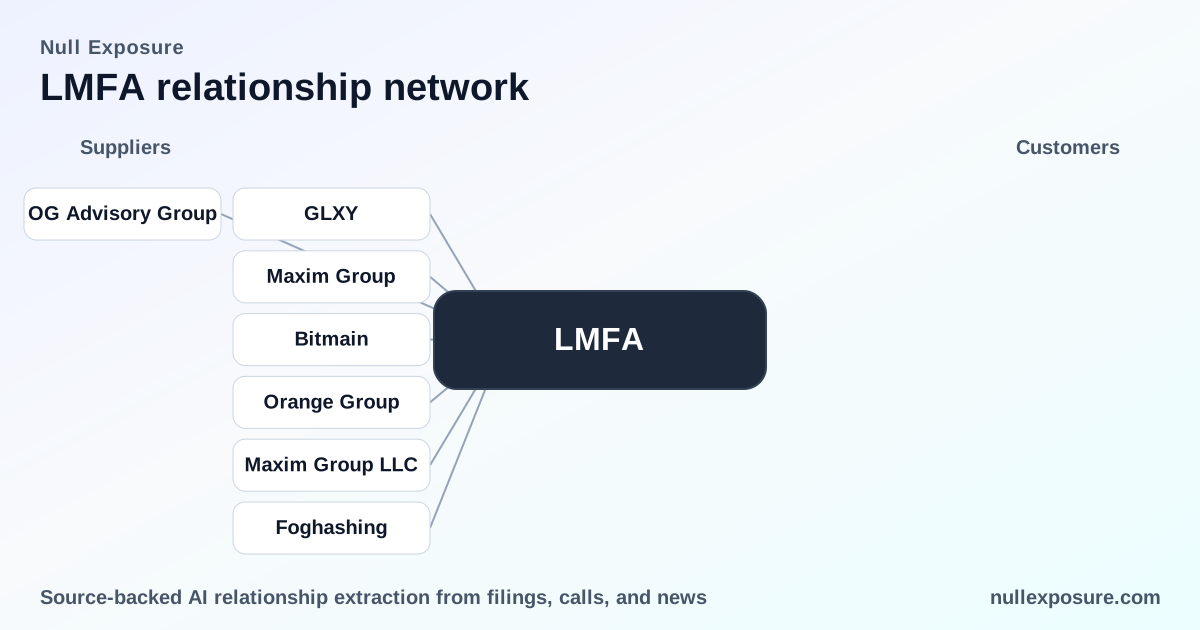
LM Funding America (LMFA): Customer Relationships and Operational Constraints — What investors should know
LM Funding America is a specialty finance company that monetizes through two principal channels: originating and purchasing receivables/loans for nonprofit community associations (primarily in Florida) and ancillary financing and service arrangements tied to digital asset infrastructure and mining activity. Revenue derives from interest and financing spreads on specialty loans and from fees/receivables related to non-finance services; the company reported roughly $7.72 million in trailing revenue and a $200,000 receivable from a sale of assets disclosed in its latest results. For investors focused on customer counterparty risk, the profile is a mix of regional concentration, mid-sized loan exposures, and transactional service relationships. Learn more at https://nullexposure.com/.
The investment thesis in one paragraph
LMFA generates yield by underwriting and acquiring association receivables and short-duration loans to nonprofit community associations while opportunistically financing infrastructure and mining-related projects; this creates a portfolio that is sensitive to geographic and sector concentration (Florida/associations and targeted hosting projects) and to the cash-collection economics of distressed receivables. The company’s contract mix — from amendable short-term mining arrangements to multi-month amortizing loans — drives capital allocation, reserve policies, and credit risk concentration.
What the customer footprint looks like and why it matters
LMFA’s customer-facing model has several defining characteristics that drive both return and risk:
- Concentration by counterparty type. The company’s specialty finance business focuses on incorporated nonprofit community associations, a concentrated and idiosyncratic borrower class that drives credit policy and collections playbooks. This profile supports predictable underwriting norms but also concentrates systemic exposure to association-level delinquencies (company filings covering the specialty finance segment).
- Regional concentration. The specialty finance activities are primarily focused in Florida, with selective out-of-state financing for discrete infrastructure projects (company disclosures). Regional concentration raises sensitivity to state-level economic and regulatory cycles.
- Dual contracting posture. LMFA operates with a mix of long-term, amortizing loans (structured financing for projects) and short-duration, terminable service contracts (notably tied to mining pool services), creating a blended liquidity and contractual risk profile.
- Mid-sized individual exposures. Documented transactions place single-counterparty loan facilities in the $1–$10 million band, enough to be material to a company with a modest balance sheet and market capitalization in the low millions.
These operational characteristics translate to credit concentration risk, cash-flow seasonality, and counterparty operational dependence — all relevant inputs when modeling downside scenarios for investor returns.
The reported customer relationship(s) you need on your radar
Symbiont — a receivable tied to an asset sale
LMFA reports a $200,000 receivable from the sale of Symbiont assets, recorded in the company’s FY2025/FY2026 results. This line item reflects a transactional, non-recurring receivable rather than an ongoing lending exposure. According to LMFA’s financial release on GlobeNewswire (March 27, 2026), the receivable is presented as part of Note 7 of the financial statements.
Operational constraints and what they imply for credit and revenue durability
Below are the constraints and disclosures that shape LMFA’s business model and customer risk posture, presented as company-level signals unless a disclosure names a specific counterparty.
- Contracting posture: mixed long-term and short-term exposure. LMFA has disclosed a long-term-style Loan Agreement for project financing (disclosed June 6, 2024) that provides an amortizing principal schedule over 24 months following a change date; concurrently, the firm describes certain customer contracts — notably within its mining operations — as terminable at will and continuously renewed, effectively short-duration relationships. The coexistence of these contract types means liquidity planning must bridge immediate contract turnover against scheduled loan amortizations (company disclosure, June 6, 2024; Item 1A risk-factor excerpts).
- Named project finance counterparty (Tech Infrastructure). LMFA explicitly disclosed a Loan Agreement with Tech Infrastructure JV I LLC for a credit line initially up to $2.5 million, later amended to $2.9 million, to support build-out of a 15 MW hosting facility in Calumet, Oklahoma; principal amortization and interest terms are specified in the agreement. This contract is material relative to LMFA’s balance sheet and exemplifies the firm’s strategy of financing infrastructure projects alongside its association receivables business (company Loan Agreement disclosure, June 6, 2024; amendment July 16, 2024).
- Counterparty type and collection profile: nonprofit associations. The specialty finance segment explicitly serves incorporated nonprofit community associations, a borrower class with specialized legal and collection dynamics; revenue is generated by purchasing rights to delinquent assessments and by structuring tailored funding products. This client base creates idiosyncratic legal and timing risk for recoveries (company segment disclosure).
- Geographic concentration: primarily Florida with targeted out-of-state projects. The firm’s core receivable business is focused in Florida, while the project finance example in Oklahoma demonstrates selective geographic expansion for higher-ticket opportunities. Concentration in a single state accelerates exposure to regional economic cycles and regulatory shifts (company disclosures).
- Dual commercial role: buyer and service provider. LMFA both purchases receivables (a buyer of payment streams) and provides services tied to Bitcoin mining infrastructure, where it contracts with mining pool operators and derives small-fee revenue (noted as about 0.5% of daily Bitcoin mined in one disclosure). This dual role diversifies revenue sources but complicates operational oversight.
- Spend band and exposure magnitude. The disclosed project finance facilities fall in the $1 million–$10 million range, which is material for a company with a small market capitalization and limited institutional ownership; this amplifies single-counterparty impact on balance-sheet volatility.
Risk implications and investor action points
- Concentration risk is the central theme. The combination of Florida-focused receivables, mid-sized project loans, and a modest market capitalization produces outsized sensitivity to individual counterparty credit events or regional shocks.
- Profitability depends on collections and non-recurring receipts. The $200,000 receivable from Symbiont is a one-off cash flow item; recurring performance depends on collection rates on association receivables and on the performance and contractual stability of financing agreements like the Tech Infrastructure loan.
- Contract mix requires careful liquidity modeling. Investors should stress-test scenarios across short-term terminable service revenue loss and delayed recoveries on amortizing loans.
Key takeaway: LMFA’s customer base mixes predictable, localized receivable origination with episodic, mid-sized financing deals and transactional service arrangements; the result is a high-concentration, cash-collection driven business that demands focused credit and regional risk oversight.
If you want a consolidated view of LMFA’s customer relationships and constraints across filings and press releases, see the primary research portal at https://nullexposure.com/.