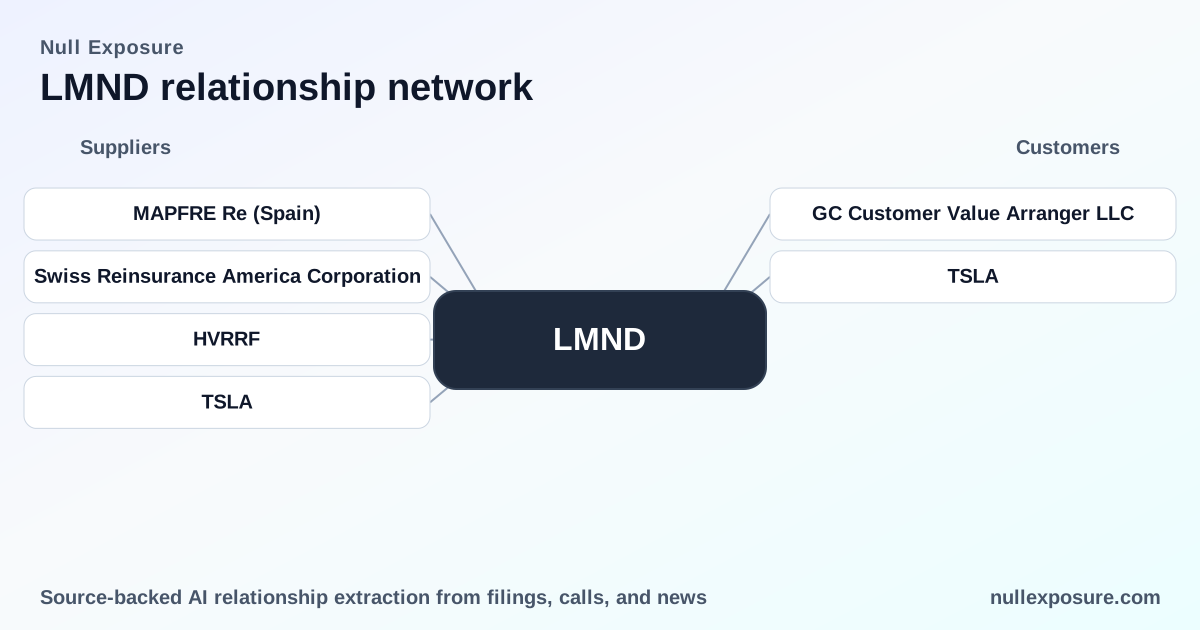
Lemonade (LMND): Customer Relationships, Commercial Constraints, and the Tesla Inflection
Lemonade sells direct-to-consumer personal lines insurance and monetizes through earned premiums, underwriting profits and fee income from its insurance operations across the U.S. and Europe; the company combines a subscription-style retention model for homeowners and renters with usage- and telematics‑based car products that open high‑margin cross‑sell opportunities. Investors should view customer relationships as the operating lever — retention, product mix (subscription vs pay‑per‑mile), and anchor partnerships determine top‑line scalability and margin expansion. For a faster read on relationship signals and implications, see NullExposure’s customer intelligence hub: https://nullexposure.com/.
The quick thesis for investors
Lemonade’s economic model depends on converting a large, low‑acquisition digital user base into recurring premium streams while adding telematics and autonomous‑vehicle products that generate usage‑based premiums and richer risk signals; this builds lifetime value per customer and creates a path to profitable growth if loss ratios remain controlled. The newly publicized tie‑ups around autonomous car insurance — notably with Tesla — are an acceleration vector for premium diversification and distribution, but also concentrate exposure and operational dependency on high‑visibility partners.
How Lemonade contracts and where revenue actually comes from
Lemonade writes primarily short‑term insurance contracts (standard one‑year policies) while also offering six‑month, pay‑per‑mile auto policies and subscription‑style renewal economics that drive visibility into future revenue. Contracting posture: short‑term & usage‑based with subscription dynamics. The company’s revenue footprint is concentrated in North America but supported by a pan‑European license, making its operating model cross‑border and consumer‑centric rather than enterprise heavy.
- Contract maturity and billing mechanics: Policies are generally one year and premiums are earned pro rata; pay‑per‑mile auto uses a base monthly fee plus a per‑mile component recorded daily from telematics.
- Customer type and criticality: The business serves individual retail customers and relies on high retention; customer churn and acquisition cost dynamics are central to growth.
- Geographic concentration: The U.S. is the primary market (nearly half of gross written premium from CA, NY and TX), with EMEA operations enabled by pan‑European licensing.
- Materiality signals: Geographic concentration in three U.S. states creates catastrophe risk that is material to financial results, and customer retention is explicitly critical to the company’s growth thesis.
If you want recurring monitoring and structured relationship intelligence for portfolio diligence, NullExposure provides curated signals and source linkage: https://nullexposure.com/.
Relationship filings and press: every listed relationship summarized
GC Customer Value Arranger LLC
Lemonade’s FY2024 10‑K documents multiple Amended and Restated Customer Investment Agreements with GC Customer Value Arranger LLC acting as Arranger on behalf of investors, indicating a structured investment or capital‑arrangement relationship documented in 2024–2025 filings. (Source: Lemonade FY2024 10‑K, Amended and Restated Customer Investment Agreement entries dated Jan 8, Jun 27 2024 and Feb 3, 2025.)
Tesla — earnings call mention (company text: "Tesla")
Management stated on the Q4 2025 earnings call that a key growth vector is “autonomous insurance,” specifically the new Lemonade Autonomous Car product launched initially with Tesla, underscoring a commercial rollout into FSD vehicles. (Source: Lemonade 2025 Q4 earnings call transcript, March 2026.)
TSLA — earnings call duplicate entry (inferred symbol TSLA)
The Q4 2025 call reiterates that the autonomous car product was launched starting with Tesla, confirming the company’s go‑to‑market for telematics pricing tied to autopilot/AI operation states. (Source: Lemonade 2025 Q4 earnings call transcript, March 2026.)
Tesla — Blockonomi earnings preview (news)
A Blockonomi earnings preview noted Lemonade’s specialized insurance offering for Tesla FSD customers and called out an approximate 50% reduction in per‑mile costs for FSD users, positioning Lemonade as a first mover in autonomous insurance pricing. (Source: Blockonomi news piece, May 2026.)
Tesla — TradingView coverage of stock move
TradingView reported a 16.4% intraday jump in LMND after Morgan Stanley upgraded the stock, attributing the upgrade to the Tesla partnership and the implied auto insurance opportunity. (Source: TradingView news, May 2026.)
TSLA — Finviz short‑term bounce commentary
Finviz highlighted the company’s autonomous car insurance launch with Tesla FSD models as the catalyst for a short‑term recovery narrative in Lemonade’s stock action. (Source: Finviz news, March 2026.)
Tesla — InsiderMonkey on Morgan Stanley move
InsiderMonkey summarized analyst activity, noting Lemonade unveiled car insurance for autonomous vehicles starting with Tesla FSD units in January, and linked the launch to positive analyst reactions. (Source: InsiderMonkey coverage, May 2026.)
TSLA — repeated Finviz mention
A second Finviz note repeated that the autonomous car insurance launch tied to Tesla FSD models is the market catalyst, reinforcing media convergence on the Tesla tie. (Source: Finviz news, March 2026.)
Tesla — MarketBeat feature "Could Rewrite Pricing"
MarketBeat framed the Tesla arrangement as potentially transformative for auto insurance pricing, highlighting the strategic significance of a telematics/autonomy pricing product. (Source: MarketBeat, March–May 2026 alerts.)
Tesla — Morgan Stanley upgrade coverage on Investing.com
Investing.com reported the Morgan Stanley upgrade, explicitly linking the analyst action to Lemonade’s partnership with Tesla to offer auto insurance. (Source: Investing.com, May 2026.)
Tesla — Simply Wall St index commentary
Simply Wall St connected the launch of Lemonade Autonomous Car insurance for Tesla FSD to the company’s broader positioning as a tech‑driven insurer following index inclusion. (Source: Simply Wall St, May 2026.)
Tesla — InsiderMonkey Q4 results summary
A Q4 results piece reiterated Lemonade Autonomous Car as a major highlight and reiterated that the product initially targets Teslas with telematics‑based real‑time pricing. (Source: InsiderMonkey Q4 2025 report, March 2026.)
Tesla, Inc. — additional news mention
A separate media item referred to Tesla, Inc. in the same context as other outlets: Lemonade’s telematics product is initially focused on Tesla vehicles and prices risk based on parked, human‑driven, or AI‑operated states. (Source: News coverage of Q4 results, March–May 2026.)
Operational constraints that shape risk and upside
- Contracting and revenue rhythm: Short‑term policy terms and pay‑per‑mile auto policies create frequent renewal events and the need for constant underwriting discipline; this generates high recurring revenue visibility but demands continuous customer retention execution.
- Product mix risk/opportunity: Usage‑based auto products and telematics for autonomous operation increase margin potential through dynamic pricing while introducing dependency on telematics data fidelity and partner integrations.
- Concentration risk: Approximately half of GWP is concentrated in California, New York and Texas, creating material catastrophe exposure that can swing results in a single year.
- Customer criticality: Retaining and expanding the customer base is core to the thesis; operational execution on claims, pricing and digital experience directly impacts unit economics.
- Maturity profile: The business is still scaling revenue (strong YoY growth) while operating margins remain negative, so partnership wins like Tesla are high‑leverage events for profitability if loss ratios stay controlled.
Investment takeaway
Lemonade has transitioned from a pure renters/homeowner digital insurer into a broader, usage‑driven personal lines platform where partnerships — notably the Tesla autonomous insurance rollout — materially change distribution and pricing capability. The upside is substantial: telematics and autonomy pricing create new premium pools and cross‑sell potential. The downside is concentrated geographic exposure and execution risks around telematics integrations and loss‑ratio control.
For institutional-grade customer relationship monitoring and to track how these partner signals evolve, visit NullExposure’s platform: https://nullexposure.com/.