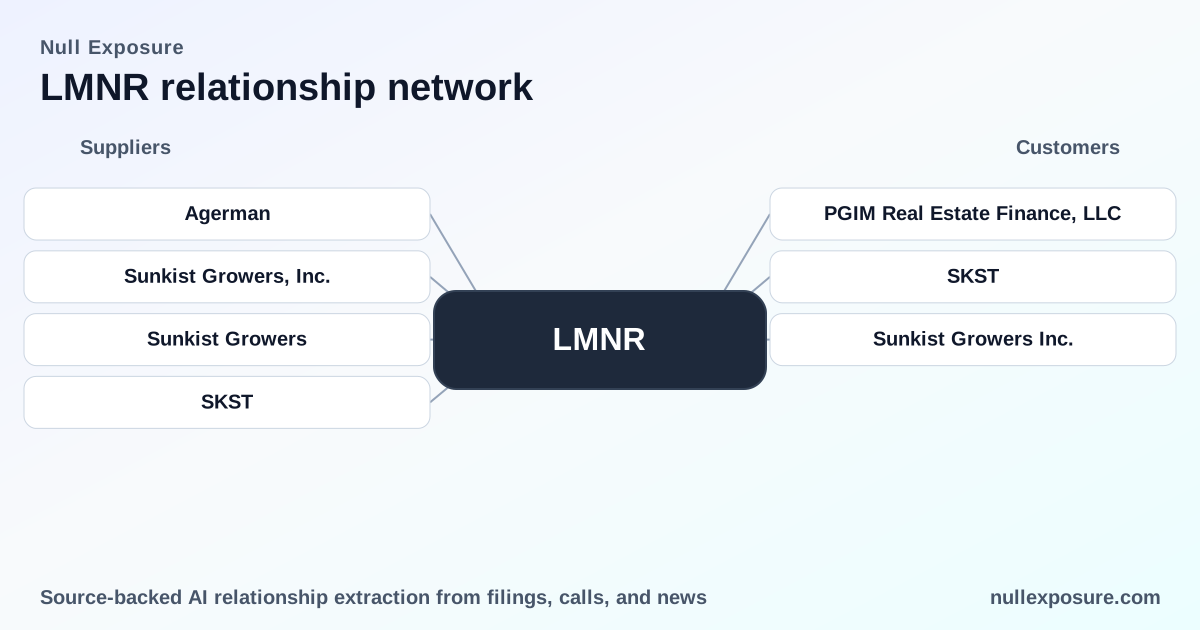
Limoneira Co (LMNR): Customer relationships that shape cashflow and strategic optionality
Limoneira is a vertically integrated agribusiness and real estate developer that monetizes through fresh produce sales (primarily lemons and increasingly avocados), farm management and crop marketing agreements, and periodic land sales / development proceeds. Revenue streams are a blend of seasonal commodity receipts and lumpy real-estate transactions, with recent corporate actions—sales of land interests and a re‑integration of citrus marketing with Sunkist—designed to reshape cashflow timing and reduce cost-to-market. For a granular view of how these customer and counterparty ties translate into earnings and liquidity, see NullExposure’s intelligence offering: https://nullexposure.com/.
What investors should watch: commercial posture and why these relationships matter
Limoneira’s customer network is not just produce buyers; it includes marketing cooperatives, institutional land lenders and third‑party capital partners that fund monetization of higher-value real estate assets. That hybrid model creates four investment-relevant characteristics:
- Contracting posture: management is actively restructuring commercial relationships — shifting citrus marketing into Sunkist and terminating third‑party farm management arrangements — which changes revenue cadence and reduces internal marketing cost.
- Concentration and criticality: strategic partnerships such as with Sunkist are functionally critical because marketing contracts directly change seasonal revenue recognition and margins.
- Maturity and cash timing: the company is converting land into staged proceeds (multi‑year promissory notes and TIC sales), producing lumpy but high‑value cash inflows rather than steady fee income.
- Counterparty sophistication: counterparties range from cooperatives (Sunkist) to institutional financiers and private holding companies, which implies varied negotiation leverage and differing legal protections on sale structures.
These dynamics make Limoneira a mixed operational business: agricultural margins remain seasonal and commodity‑driven while land monetizations drive liquidity and balance sheet improvement.
Relationship-by-relationship breakdown (each result in the record)
-
PGIM Real Estate Finance, LLC (press release, Yahoo Finance, March 10, 2026)
Limoneira terminated a farm management agreement with PGIM effective March 31, 2025, removing approximately $2.9 million of fourth-quarter farm management revenue that had existed in FY2024. This reduction reflects a deliberate shift away from that management fee line. (Limoneira press release via Yahoo Finance, March 10, 2026.) -
Peak Holdings (TradingView report, May 3, 2026)
Limoneira signed a Purchase and Sale Agreement to sell an 80% tenant‑in‑common interest in its 724‑acre Paso Robles property, including vineyards, for $16 million, reallocating capital from non-core land holdings. (TradingView coverage, May 3, 2026.) -
Sunkist (earnings call transcript reported by InsiderMonkey, Q1 FY2026)
Management described a strategic transition of lemon sales and marketing back to Sunkist, which will alter seasonal sales cadence and centralize marketing with the cooperative. (Q1 FY2026 earnings call transcript via InsiderMonkey, May 2026.) -
Peak Holdings, LLC (The Globe and Mail press release, May 3, 2026)
A Limoneira subsidiary, Windfall Investors, LLC, agreed on April 14, 2026 to sell an 80% tenant‑in‑common interest to Peak Holdings, LLC for $16 million, structured as $10 million cash plus a $6 million promissory note secured by a deed of trust. (Press release summarized in The Globe and Mail, May 3, 2026.) -
East Area II (BizWire / FinancialContent, March 23, 2026)
Limoneira expects to receive approximately $180 million in total proceeds across multiple counterparties—Harvest, LLC; B II, LLC; and East Area II—spread over seven fiscal years, with $10 million received in FY2025 and $15 million in FY2024. These are staged payments tied to land transactions. (Limoneira corporate filing / BizWire, March 23, 2026.) -
Harvest (BizWire / FinancialContent, March 23, 2026)
Harvest is one of the named buyers/partners in the multi‑year proceeds schedule that underpin the company’s plan to reallocate capital to avocado expansion and development projects. (Corporate disclosure via BizWire, March 23, 2026.) -
Sunkist Growers Inc. (BizWire / FinancialContent, March 23, 2026)
Management documented the formal merger of Limoneira’s citrus sales and marketing into Sunkist Growers Inc., a step intended to improve efficiency and reduce marketing costs. (Investor release via BizWire, March 23, 2026.) -
SKST (Limoneira Q4 2025 earnings call, March 7, 2026)
On the 2025 Q4 call, management explicitly stated the company’s “return to Sunkist” as an example of strategic repositioning to lean on a larger marketing cooperative. (LMNR 2025Q4 earnings call, March 7, 2026.) -
Sunkist Growers Inc. (Yahoo Finance reporting on FY2025 results, March 10, 2026)
The company framed the Sunkist arrangement as a mechanism to address global lemon oversupply and to reposition toward sustainable competitive advantages through centralized marketing. (Limoneira FY2025 results press release via Yahoo Finance, March 10, 2026.) -
PGIM Real Estate Finance, LLC (SG Yahoo Finance, March 10, 2026 — duplicate entry)
A duplicate disclosure confirms termination of the farm management agreement with PGIM effective March 31, 2025 and the associated revenue impact in FY2025 Q4. (Limoneira press release, March 10, 2026.) -
Sunkist (LMNR 2025Q4 earnings call record — duplicate)
Earnings‑call commentary reiterated the tactical rationale for returning citrus marketing to Sunkist to achieve cost and cadence benefits. (LMNR earnings call Q4 2025, March 7, 2026.) -
Sunkist Growers, Inc. (FreshFruitPortal, March 16, 2026)
Independent industry coverage notes that Sunkist has taken responsibility for managing Limoneira’s fresh citrus sales since the transition, externally validating the operational change. (FreshFruitPortal, March 16, 2026.) -
LLCB II, LLC (BizWire / FinancialContent entry, March 23, 2026)
One of the named counterparties in the staged $180 million proceeds schedule; these special‑purpose entities are funding a long‑dated monetization cadence for Limoneira land assets. (Investor release via BizWire, March 23, 2026.) -
B II, LLC (BlueBook Services reporting, May 3, 2026)
BlueBook Services cites B II, LLC as a participant in the multi‑year proceeds plan, confirming that Limoneira is monetizing land via several LLC purchasers and structured payment terms. (BlueBook Services, May 3, 2026.) -
East Area II (BlueBook Services duplicate, May 3, 2026)
A second mention corroborates the East Area II role in the staged proceeds; the repetition across outlets reinforces the materiality of the multi‑year receipts. (BlueBook Services, May 3, 2026.) -
Harvest, LLC (BlueBook Services duplicate, May 3, 2026)
BlueBook Services repeats that Harvest, LLC is part of the multi‑year proceeds program, highlighting the same $10M/$15M timing points disclosed for FY2024–FY2025. (BlueBook Services, May 3, 2026.) -
Sunkist Growers, Inc. (SG Yahoo / Yahoo Finance duplication, March 10, 2026)
Multiple outlets restate that the Sunkist merger of marketing functions is a deliberate strategic move with near‑term effects on revenue seasonality. (Yahoo Finance / SG Yahoo Finance reporting, March 10, 2026.)
Constraints and what they signal about the operating model
- Geography is broad and export‑oriented. Limoneira sells citrus to the United States, Canada, Asia and other international markets, signaling diversified channel exposure across North America and APAC, and an operational footprint that includes a leased 1,200‑acre Santa Clara ranch in Argentina. This breadth reduces single-market concentration risk but increases currency and logistics exposure. (Company disclosure excerpts describing sales geography.)
- Primary role is seller/producer. The company markets and sells citrus directly to food service, wholesale and retail customers, confirming a seller posture rather than purely asset‑manager behavior; this gives Limoneira direct control over distribution decisions and margin capture. (Company marketing and sales description.)
- Maturity of monetization is staged. The $180 million expected proceeds are spread over seven fiscal years, indicating deliberate, multi‑year balance sheet management rather than one‑off asset disposal. (March 2026 investor disclosures.)
Investment implications and decisive takeaways
- Sunkist is a structural positive for distribution and cost control. Centralizing citrus marketing with Sunkist changes revenue cadence but increases distribution scale and reduces internal selling costs.
- Land monetizations materially improve near‑term liquidity but create lumpy earnings. The Peak Holdings TIC sale and the staged $180M proceeds program are cash‑positive moves; investors should expect irregular earnings contributions and improved balance sheet flexibility rather than steady margin improvement.
- Counterparty mix matters. Institutional financiers (PGIM) exiting farm management, and private LLC purchasers taking land interests, signal that Limoneira is optimizing owner economics and de‑risking operational management in favor of capital recycling.
For active investors and operators assessing LMNR, the core question is whether the proceeds and marketing consolidation offset commodity margin pressure and stabilize returns across the company’s mixed agribusiness/real‑estate model. For further analysis of Limoneira’s customer exposures and counterparty credit posture, explore NullExposure’s customer intelligence at https://nullexposure.com/.