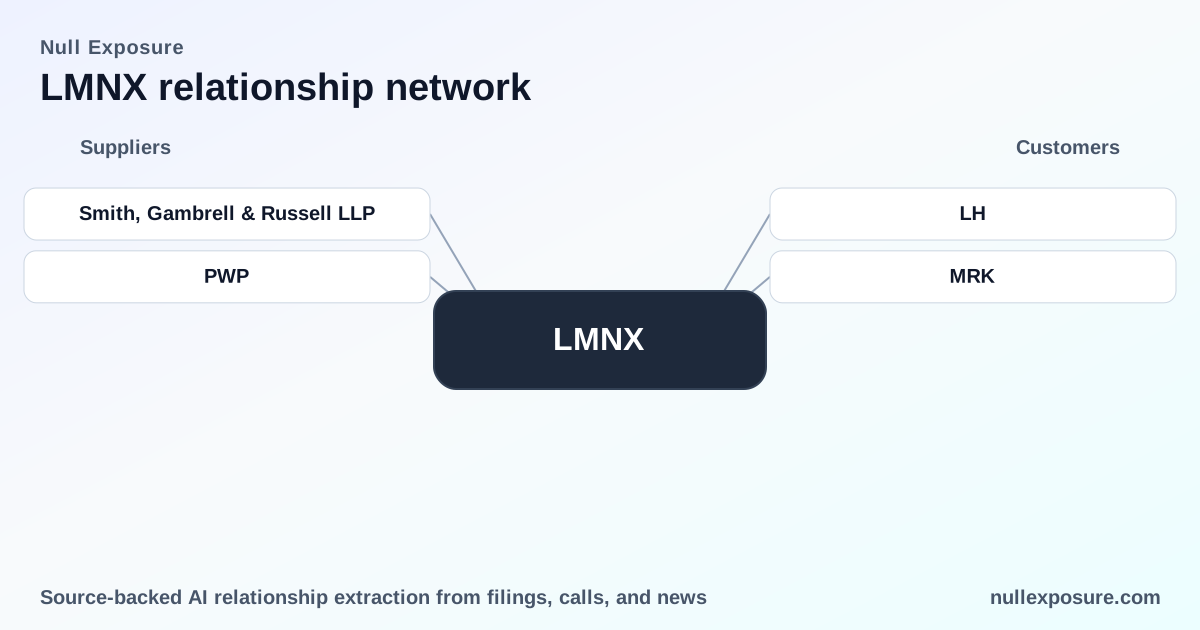
Luminex (LMNX) — customer relationships that shape revenue reach and product positioning
Luminex operates as a platform provider of multiplexing instrumentation, assay systems, and regulated software, monetizing through instrument sales, consumables/reagents, distribution partnerships, and diagnostic development/commercialization agreements with larger diagnostics and pharmaceutical customers. For investors, the company’s revenue profile is driven by channel partnerships that extend commercial reach, project-based work for companion diagnostics, and recurring consumables tied to installed bases. For deeper context on how these commercial links affect valuation workstreams, visit https://nullexposure.com/.
How Luminex gets paid: a commercial playbook, not a single product bet
Luminex sells laboratory instruments (Luminex 200, FLEXMAP 3D, MAGPIX), diagnostic kits that integrate with those platforms, and regulated software such as SYNCT. The business model blends capital equipment sales that create an installed base with higher-margin, recurring consumables and licensed distribution deals that accelerate geographic reach. In parallel, development and commercialization agreements with pharmaceutical and diagnostics companies convert development expertise into milestone and royalty-style economics. This hybrid model produces mixed revenue cadence — lumpy instrument and development revenue, steady consumables afterward — and requires active commercial partnerships to scale internationally.
Customer relationship map: partners, customers, and what they do for Luminex
Below are the relationships identified in public reporting and industry coverage. Each entry is a concise, plain-English take on the commercial role and the published source.
-
Bio‑Techne Corporation (TECH) — Bio‑Techne has distribution rights to sell Luminex multiplexing instrumentation, including the Luminex 200, FLEXMAP 3D and MAGPIX platforms across major global markets, extending Luminex’s channel reach outside direct-sales territories. Source: PR Newswire announcement and CLP Mag reporting (FY2015).
-
Affymetrix (eBioscience) (AFFX) — Affymetrix’s business unit eBioscience entered a distribution agreement to sell Luminex’s Magpix, Luminex 200, and Flexmap 3D products across specified countries in the Americas, Asia, and Europe, evidencing Luminex’s reliance on third‑party channel partners for international penetration. Source: CLP Magazine coverage (FY2020).
-
LabCorp (LH) — Company filings flagged the loss of the LabCorp women’s health business as having a measurable impact on Luminex’s growth and future results, indicating a concentration sensitivity to large laboratory customers. Source: Luminex fourth-quarter and full-year 2020 results release via PR Newswire (FY2021).
-
Grifols (GRFS) — Grifols’ FDA-approved ID‑CORE XT test integrates PCR amplification with Luminex technology to identify genetic markers for red blood cell antigens, illustrating Luminex’s role as an enabling technology provider within commercial diagnostic kits. Source: PR Newswire coverage of FDA clearance (FY2018).
-
Merck (MRK) — Luminex entered a development, regulatory submission and commercialization agreement to build a companion diagnostic using xMAP technology to measure Alzheimer’s biomarkers, demonstrating Luminex’s capability to execute CDx programs for large pharma clinical pipelines. Source: CLP Magazine article describing the Merck collaboration (FY2020).
-
St. John Hospital and Medical Center — Clinician commentary accompanying FDA and CE announcements cited St. John’s use of SYNCT software to improve daily laboratory workflow, signaling end‑user adoption of Luminex’s regulated software in hospital settings. Source: PR Newswire release on SYNCT clearance (FY2016).
What these partnerships imply about Luminex’s operating model and strategic constraints
The collection of public relationships reflects several company‑level commercial characteristics investors should incorporate into models:
-
Channel‑heavy contracting posture. Luminex routinely grants distribution rights to established diagnostics vendors and business units, which accelerates market penetration but transfers pricing and renewal risk to partners.
-
Concentration and client sensitivity. Company-level disclosures explicitly referenced the financial impact from losing a major account (LabCorp), indicating revenue concentration risk when large laboratory clients or channel partners shift purchasing or contract status.
-
Product criticality within partner workflows. Inclusion of Luminex technology inside commercially approved diagnostic kits (e.g., Grifols) and pharma CDx programs (e.g., Merck) shows technical stickiness and clinical criticality once assays are validated on Luminex platforms, supporting durable consumables revenue tied to installed base.
-
Contract maturity and project cadence. Partnerships span years and sometimes involve regulatory submissions and commercialization milestones, indicating a mix of longer‑term, project‑based engagements (CDx, regulatory work) and ongoing distributorships that provide steady but partner‑dependent revenue.
-
Regulatory and product diversification. FDA clearances for software and kit integrations demonstrate Luminex operates in regulated channels, adding both barriers to entry and time‑to‑market complexity that can protect installed revenue once approvals are secured.
Investment implications and the risk checklist
These relationship dynamics create a set of actionable monitoring points for investors and operators:
-
Watch contract renewals and geography rollouts. Distribution agreements with the likes of Bio‑Techne and Affymetrix extend reach but require active renewal and performance; any disruption could slow international growth.
-
Monitor top‑customer concentrations. The LabCorp disclosure is a concrete reminder that losing a major account can be earnings‑negative; track customer revenue disclosure and large account pipeline updates.
-
Assess CDx program milestones. Collaborations such as the Merck work convert technical capability into milestone and potential royalty economics — progress through regulatory and clinical milestones will drive valuation re‑ratings.
-
Track integration wins in regulated kits. Inclusion in commercial tests (e.g., Grifols’ ID‑CORE XT) signals recurring consumables demand; investors should prioritize announcements of additional kit approvals or OEM integrations.
-
Regulatory and commercialization execution. Software clearances like SYNCT broaden addressable markets but require evidence of commercial uptake and reimbursement pathways to justify premium multiples.
Bottom line and next steps for due diligence
Luminex’s commercial model is channel-centric, clinically integrated, and dependent on a mix of large laboratory customers and strategic partnerships. That mix creates both upside — through recurring consumables and protected CDx work — and downside through partner concentration and contract renewal risk. For focused coverage on how these partnership dynamics affect risk-adjusted forecasts and scenario analysis, see our platform at https://nullexposure.com/.
Key takeaway: investors should balance the durable economics of consumable-linked installed base revenue against the short‑term volatility introduced by large customer contract events and partner distribution terms.