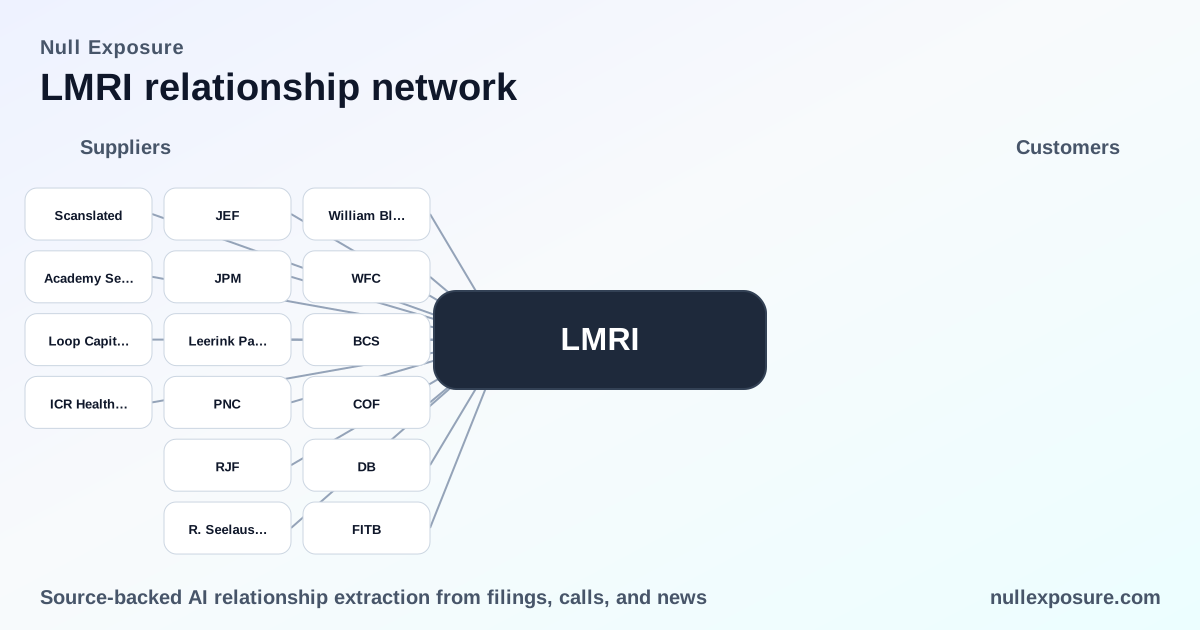
Lumexa Imaging (LMRI): Customer relationships driving roll-up growth and margin leverage
Lumexa Imaging operates and monetizes a roll-up of diagnostic imaging centers across the U.S., generating patient and payor revenue from MRI, CT and ancillary imaging services while expanding through partnerships with health systems and tuck‑in acquisitions. The business converts scale into negotiated contracting with hospitals and payors, and captures incremental EBITDA by consolidating back‑office and radiology coverage. Revenue runs north of $1.02B (TTM), while the company is in a phase of network expansion and margin normalization. For relationship-level analytics and marketplace context, visit https://nullexposure.com/.
Why customer relationships matter for valuation and execution
Lumexa’s value proposition is not just the physical asset base of outpatient imaging centers; it is the contractual access to patient volumes provided through local health system partnerships. These relationships determine referral flow, payer mix, and utilization — the three levers that move revenue and normalized EBITDA in an asset-heavy consolidated platform. Given Lumexa’s modest operating margin (about 1.7% operating margin TTM) juxtaposed with negative reported EPS, the path to durable profitability runs through deeper, stable relationships with health systems and disciplined integration of acquisitions.
From a company-level perspective, there are no formal customer constraints disclosed in the public relationship payload we reviewed; this absence is itself a signal of flexibility in contracting posture and deal execution. The firm’s balance of insider control (reported insider ownership 81%) and institutional participation (33%) points to concentrated governance that accelerates dealmaking while concentrating execution risk.
The relationships disclosed in the latest public transcript
These are the customer relationships specifically referenced in Lumexa’s public communications during the FY2026 period.
Atrium Health — tuck-in expansion and strengthened local linkage
Lumexa completed a small tuck‑in acquisition of a facility in North Carolina described as an extension of its strong partnership with Atrium Health, signaling ongoing co‑development and localized growth driven by an existing system relationship. This was disclosed during the company’s Q4 2025 earnings call transcript (published May 3, 2026) on Investing.com.
Source: Investing.com, Lumexa Q4 2025 earnings call transcript (May 3, 2026).
University of Pittsburgh Medical Center (UPMC) — new partnership for lower‑cost, convenient imaging
Lumexa said it entered a new partnership with UPMC in the back half of the prior year to help the health system deliver lower‑cost, higher‑quality and more convenient imaging to its patient base, indicating Lumexa’s role as a local access and operations partner for large integrated health systems. This was described in the same Q4 2025 earnings call transcript.
Source: Investing.com, Lumexa Q4 2025 earnings call transcript (May 3, 2026).
What these relationships imply about Lumexa’s operating model
- Contracting posture: Lumexa operates as a partner and operator for health systems, pursuing collaborative deals and asset acquisitions tied to system referrals; the company’s communications emphasize partnership extensions and platform expansion rather than one-off vendor relationships.
- Concentration and criticality: Relationships with large systems like Atrium Health and UPMC are inherently high criticality for local referral volumes and utilization; such partnerships can materially affect center throughput and payor mix in the served geographies.
- Maturity of relationships: The mix of a new UPMC partnership and tuck‑in activity with Atrium Health points to growth-stage commercial maturity — Lumexa is actively converting health system relationships into accretive site acquisitions and operating arrangements.
- Disclosure signal: The customer payload contained no formal constraints (no exclusivity clauses or termination language were provided), which at the company level suggests flexible contracting terms and the ability to scale across multiple systems.
Financial and strategic implications for investors and operators
Lumexa’s public metrics give a clear context to the customer relationship thesis: Revenue TTM ~$1.02B and EV/EBITDA ~13.2, with a market capitalization near $979M. The company trades at roughly 0.96x Price/Sales, and analysts collectively skew positive (consensus target price ~$18.86 with a majority Buy/Strong Buy stance). For investors, the presence of system partnerships is a double benefit: they create protected referral channels and improve visibility on utilization growth, but they also concentrate execution risk in localized service relationships.
Operators and acquirers should track three operational signals closely:
- Referral stability from system partners — sustained referral volumes from Atrium and UPMC will show up in utilization and revenue per site.
- Integration cost curve — tuck‑ins should deliver measurable SG&A and radiology cost synergies; investors should expect margin improvement evidence in sequential quarters.
- Contract terms and termination exposure — the public narrative highlights partnership expansion, but detailed contract recourse and duration remain material to downside risk.
For deeper customer and counterparty analytics on Lumexa and comparable health‑system partnerships, see our relationship intelligence center at https://nullexposure.com/.
Actionable watchlist and key takeaways
- Monitor the cadence of tuck‑in acquisitions and whether they are primarily positioned as system extensions (like Atrium) or standalone volume plays.
- Track utilization and payer mix tied to system partnerships; durable increases in outpatient MRI/CT volumes are the clearest path to lifting operating margins.
- Governance and control are concentrated: high insider ownership accelerates strategic moves but concentrates execution risk for minority investors.
- Earnings commentary (transcripts and management guidance) will be the best near‑term signal for whether partnerships with system operators like Atrium and UPMC are converting into predictable cashflow.
Bottom line: Lumexa’s partnerships with health systems are core strategic assets that drive referral flow and make the roll‑up model viable; investors should treat each new health‑system relationship as a binary growth and integration event that materially affects utilization and margin trajectory.