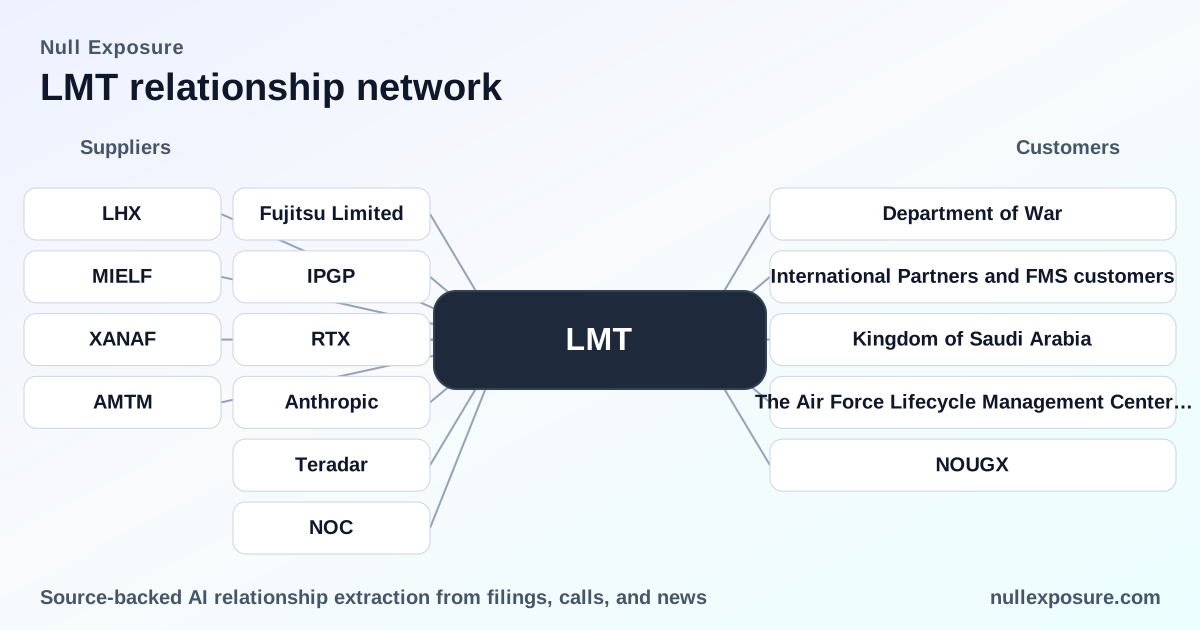
Lockheed Martin (LMT): Customer Relationships and Contract Signals Investors Should Track
Lockheed Martin is a global prime contractor that designs, manufactures and sustains advanced air, sea, space and missile systems and monetizes through long-term, government-backed contracts, foreign military sales (FMS) and major program sustainment agreements (notably F-35 and other platform families). The company’s revenue profile is dominated by government work and multi-year program economics, producing predictable backlog conversion and sizable receivables that reflect multi-year billing cycles. For a concise view of relationship intelligence and contract exposure, visit the Null Exposure homepage: https://nullexposure.com/.
Executive takeaway: concentration, contract tenor and program-critical customers
Lockheed’s business model is built on long-cycle, high-dollar commitments to governments and allied partners, which creates both durable revenue visibility and client concentration risk. The company reported that 72% of 2025 sales came from U.S. Government work (63% from the Department of War/DoD), signaling that Lockheed is a government-centric prime whose commercial exposure is limited relative to defense & civil sales (FY2025 Form 10‑K). Contract tenor is long and capital-intensive: programs span multiple years with complex technical requirements and material contract assets that are expected to bill in subsequent fiscal periods. These are company-level signals: long-term contracts, government counterparty profile, global customer footprint, and program-critical materiality.
If you want a consolidated feed of these relationship signals for modeling or diligence, see Null Exposure: https://nullexposure.com/.
How constraints shape the operating model
- Contracting posture: Lockheed operates on a long-cycle basis; many contracts span several years and include complex technical deliverables, which increases predictability of revenue but also lengthens realization of contract cash flows (FY2025 10‑K).
- Counterparty concentration: The company’s principal customers are U.S. Government agencies and allied governments, generating the majority of revenue and receivables (FY2025 10‑K).
- Geography and criticality: Lockheed is global in scope but materially dependent on North American government spend; the DoD relationship is explicitly critical, given the 63% DoD share of revenue (FY2025 10‑K).
- Commercial scale: Receivables and contract assets are large (billions of dollars), consistent with > $100M spend bands and program-level materiality for major customers (FY2025 10‑K).
- Role and stage: Lockheed functions primarily as a manufacturer and prime seller and runs an active portfolio of contract assets expected to be billed in the near term (FY2025 10‑K).
Named customer relationships: what each means for investors
International Partners and FMS customers
Lockheed sells F-35 aircraft and related systems through international partner arrangements and Foreign Military Sales channels; these customers represent a major export and sustainment revenue stream. Source: Lockheed Martin FY2025 Form 10‑K (discussing aircraft sales to U.S. services and International Partners and FMS customers).
Kingdom of Saudi Arabia
Saudi Arabia is a named international purchaser for Lockheed’s Multi-Mission Surface Combatant (MMSC) program, indicating strategic export work in naval systems. Source: Lockheed Martin FY2025 Form 10‑K referencing the MMSC program.
Department of War (DoD)
The DoD accounted for 63% of Lockheed’s 2025 revenue, making it the single largest and most critical customer; this underpins the company’s materiality and contract concentration risk. Source: Lockheed Martin FY2025 Form 10‑K (sales by customer).
U.S. Government (federal agencies and allies)
Lockheed identifies U.S. Government agencies and allied governments as its principal customers, driving the majority of consolidated sales and receivables. Source: Lockheed Martin FY2025 Form 10‑K.
U.S. Army
The U.S. Army is a prime contracting authority for recent production awards, including full-rate production contracts for rocket launchers that serve both U.S. forces and allied FMS recipients. Source: The Defense Post (April 30, 2026) reporting on the Army award.
U.S. Marine Corps
The U.S. Marine Corps is an intended end customer on several production programs covered under U.S. Army contracts, reflecting cross-service procurement patterns. Source: The Defense Post (April 30, 2026).
U.S. Navy
Lockheed won work to provide training devices and services for the E‑130J Phoenix II as part of an industry team supporting the Navy’s TACAMO mission, indicating integration work with other primes. Source: Lockheed Martin news release (April 29, 2026).
The Air Force Lifecycle Management Center, Simulators Division
Lockheed won a $1.9 billion ID/IQ contract for C‑130J Maintenance and Training Systems (JMATS IV), reinforcing large, multi‑year sustainment contracts with Air Force lifecycle authorities. Source: ClearanceJobs summary of the contract award (Feb. 27, 2026).
International customers under HIMARS/FMS (Canada, Australia, Estonia, Sweden, Taiwan)
A single full-rate production contract cited by media covers rocket launcher production for U.S. forces and export via FMS to Canada, Australia, Estonia, Sweden and Taiwan, demonstrating the blend of U.S. prime awards and allied replenishment channels. Source: The Defense Post (April 30, 2026).
Kingdom of Canada (Canada)
Canada is specifically named as an FMS recipient for rocket launcher production on the HIMARS-related award, adding to Lockheed’s NATO/allied revenue base. Source: The Defense Post (April 30, 2026).
Sweden
Sweden is listed among allied recipients under foreign military sales for launcher systems, reflecting European demand for U.S.-produced artillery and missile systems. Source: The Defense Post (April 30, 2026).
Estonia
Estonia is named as an allied FMS recipient on the same production award, illustrating Lockheed’s reach into smaller allied defense markets via U.S. channels. Source: The Defense Post (April 30, 2026).
Taiwan
Taiwan is listed among FMS end users on the rocket launcher production contract, highlighting geopolitical sensitivity and export control considerations in certain sales. Source: The Defense Post (April 30, 2026).
Northrop Grumman
Lockheed participates on industry teams with Northrop Grumman (for TACAMO E‑130J efforts), underscoring collaborative prime/subprime relationships in large Navy programs. Source: Lockheed Martin news release (April 29, 2026) and a Northrop Grumman supplier award list (2026).
LHX (L3Harris)
L3Harris is a supplier/partner on solid rocket motors and propulsion systems for integrated missile and missile-defense programs that involve Lockheed as a prime. Source: L3Harris and other earnings call excerpts (Q4 2025 / Q1 2026 transcripts).
MOG‑B (supplier award on PAC‑3)
A supplier (MOG‑B) reported receiving a Lockheed supplier award for 100% on‑time delivery on the PAC‑3 missile program, which signals Lockheed’s supplier performance importance and quality thresholds in missile programs. Source: MOG‑B Q4 2025 earnings call.
KTOS (Kratos reference)
Kratos referenced multi‑year DoD initiatives that include Lockheed and Raytheon, underscoring program-level interdependence across primes and smaller system integrators. Source: Kratos Q4 2025 earnings call.
FTAIM (LMCES divestiture)
FTAI Aviation completed its acquisition of Lockheed Martin Commercial Engine Solutions (LMCES) in Montréal, showing Lockheed’s selective divestiture of certain commercial MRO assets. Source: FTAI press release / AviTrader coverage (2024–2026 reporting).
VTOL / Bristow Group
Lockheed’s Sikorsky business and Bristow Group signed a long‑term support arrangement for the Sikorsky S‑92 fleet, evidencing sustainment contracts and support economics for legacy rotorcraft platforms. Source: FinancialContent / MarketBeat reporting (2026).
PCG partners (EMBERPOINT / PG&E collaboration)
Lockheed joined utilities and tech partners (including PG&E, Salesforce, Wells Fargo) in EMBERPOINT LLC, a venture applying autonomous systems and AI to wildfire detection and response—an example of Lockheed’s expansion into civil resilience ventures. Source: HomelandPrepNews and industry coverage (2026).
FEIM (Frequency Electronics)
FEIM is identified as a primary supplier of timing standards to Lockheed and other primes; FEIM’s market performance is treated as a bellwether for space/sensor supply-chain health. Source: FinancialContent market coverage (Jan 2026).
BLDE (Blade – Sikorsky S‑76 mention)
Blade’s use of Sikorsky S‑76 aircraft in commercial routes highlights Lockheed’s Sikorsky footprint in commercial and VIP rotorcraft markets. Source: AINonline coverage (Apr 2023 / referenced 2026).
KRMN, KRMN & other supplier mentions
Smaller suppliers and subcontractors referenced Lockheed in award contexts, underscoring the deep supply‑chain network that supports prime contracts. Source: ULA/KRMN and other earnings call excerpts (2025–2026).
RTX (Raytheon / RTX)
RTX appears alongside Lockheed on regional missile and command system programs (e.g., Patriot restock), indicating overlapping program footprints and competitive/cooperative dynamics in the missile market. Source: TS2.Tech coverage (2026).
Investment implications — what to watch next
- Revenue concentration risk is core: the DoD/U.S. Government dependence gives revenue stability but creates political and budgetary sensitivity; model exposure to DoD budget shifts and sequestration scenarios.
- Program life cycles: long-term contracts create backlog visibility but also deferred cash and large contract assets; watch receivables and progress‑payment trends in quarterly reporting.
- Export & FMS risk: international customers (Saudi Arabia, Canada, Australia, Sweden, Estonia, Taiwan) diversify demand but introduce export control and geopolitical execution risk.
- Supply chain and supplier performance: supplier awards and supplier‑level reporting (e.g., MOG‑B, L3Harris, FEIM) are leading indicators of program health; supplier disruptions would have disproportionate effects on program schedules.
- Adjacency growth: initiatives such as EMBERPOINT show Lockheed expanding into civil resilience and autonomy—monitor revenue capitalization and partner economics separately from defense backlog.
For a structured, machine‑readable view of these relationships and to integrate them into model inputs, explore the Null Exposure relationship product at https://nullexposure.com/.