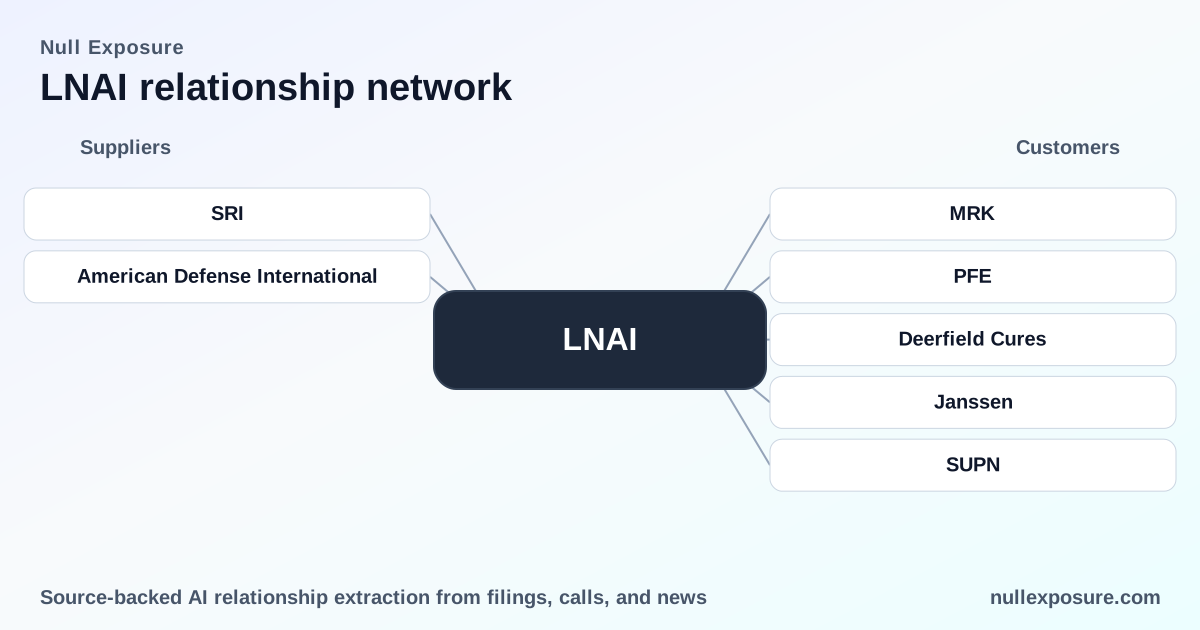
Lunai Bioworks (LNAI): Customer Relationships and What They Signal for Investors
Thesis: Lunai Bioworks operates as a pre-clinical biotechnology company that monetizes proprietary AI-enabled life‑science tools and biodefense services through a mix of strategic collaborations and contracted engagements; revenue is currently limited, and early-stage partnerships—both legacy and newly announced—constitute the primary pathway to commercialization and cash inflows. Investors should value LNAI as a partnership-driven, IP-anchored play where customer relationships determine near-term revenue credibility and de‑risking of R&D spend. Learn more about relationship intelligence at https://nullexposure.com/.
How Lunai makes money and why customers matter
Lunai emerged from a merger that brought in BioSymetrics as an internal division, combining AI platforms for disease subtyping with biodefense analytics. The company’s commercialization model is contract and collaboration driven: revenue comes from defense contracts and B2B engagements with pharmaceutical and clinical partners rather than product sales to consumers. Financials reflect that structure—Lunai reported no revenue through the latest periods and remains pre‑commercial, so the progression of announced relationships into fee‑generating contracts drives the valuation trajectory.
Operationally, Lunai’s posture is that of a small-cap biotech with concentrated counterparty exposure: the company leverages a few high‑quality partners to validate its AI stack and convert IP into paid work. Partnerships with large pharma or defense agencies are both validation points and potential revenue catalysts.
Relationships that define the near-term roadmap
Below I cover every relationship referenced in the public reporting set and state the sourcing for each entry. Each line is a concise, plain-English summary with a source citation.
-
Pfizer (PFE) — A March 2026 investor write-up on ts2.tech states that BioSymetrics, now part of Lunai, historically collaborated with Pfizer as a legacy partner carried into the merged entity’s portfolio. Source: ts2.tech article, first seen March 10, 2026.
-
Pfizer (duplicate mention) — The same ts2.tech piece repeats Pfizer as one of BioSymetrics’ established pharma collaborations that contribute to Lunai’s inherited partnership base. Source: ts2.tech article, March 10, 2026.
-
Merck (MRK) — The ts2.tech coverage identifies Merck among legacy collaborators through BioSymetrics, providing Lunai with a referenceable enterprise relationship that supports its commercial pitch to other large pharma customers. Source: ts2.tech article, March 10, 2026.
-
Supernus (SUPN) — The same March 2026 article lists Supernus as one of the legacy collaborators; this denotes Lunai’s exposure to specialty‑pharma partnerships as part of its historical footprint. Source: ts2.tech article, March 10, 2026.
-
BioSymetrics — A May 3, 2026 press item captured on Finviz reports that Lunai secured a first revenue‑generating defense collaboration through BioSymetrics, deploying its AI platform for chemical threat assessment and indicating that additional engagements are under discussion. Source: Finviz news item, May 3, 2026.
-
Deerfield Cures — The March 2026 ts2.tech piece includes Deerfield Cures among the legacy collaborators that transferred into Lunai’s ecosystem via the merger, providing private‑capital and research linkage advantages. Source: ts2.tech article, March 10, 2026.
-
Janssen — The ts2.tech article also lists Janssen as a legacy collaborator through BioSymetrics, offering Lunai an enterprise‑scale reference in the infectious‑disease and immunology space. Source: ts2.tech article, March 10, 2026.
-
BioSymetrics (quantisnow/PR pickup) — A second May 3, 2026 media pickup recorded at Quantisnow reproduces the company release that Lunai’s BioSymetrics unit has won a defense collaboration and is discussing further work. This confirms the Finviz pickup and signals consistent messaging across outlets. Source: Quantisnow/PR, May 3, 2026.
Key relationship takeaway: the BioSymetrics division is both the origin of Lunai’s legacy pharma links (Pfizer, Merck, Janssen, Supernus, Deerfield) and the active commercial lead that has converted into at least one revenue‑generating defense engagement as of early May 2026.
What the constraint signals tell investors about operating risk
The public constraint evidence yields several company‑level operating signals that affect contracting, concentration, criticality, and maturity:
-
Contracting posture and customer types: Evidence shows Lunai targets a mixed set of institutional buyers—hospitals, clinics, insurers, pharma, biotech, research centers, clinicians—and also acknowledges individual patients as potential end users, implying a hybrid B2B/B2C design in product strategy. This is a company‑level signal drawn from product positioning language rather than a single named customer.
-
Geographic footprint: Lunai is actively developing across EMEA and North America, with explicit management intent to staff in the UK, Netherlands, Germany, and to roll out in the U.S. from Amsterdam/London support teams. That signals regional expansion ambition and multi‑jurisdictional commercialization complexity.
-
Relationship role and stage: The constraints data classify typical counterparties as buyers and indicate an active relationship stage for at least some engagements—consistent with the announced defense collaboration through BioSymetrics. This supports the conclusion that Lunai has moved beyond purely exploratory partnerships into operational contracting.
-
Concentration and maturity: Given the company’s pre‑commercial status and small market capitalization (roughly $11.8M), counterparty concentration is high and maturity of revenue streams is low; the defense collaboration is an early de‑risking event but not yet a diversified revenue base.
These signals collectively imply that Lunai’s revenue runway depends on converting a small number of high‑quality relationships into repeatable, fee‑for‑service contracts. For workflow and procurement teams at target customers, Lunai’s product is positioned as a critical analytics input for compliance and threat assessment—raising the bar on reliability and contracting terms.
Learn more about how relationship coverage deepens due diligence at https://nullexposure.com/.
Investment implications — upside, risks, and what to watch next
-
Upside: Enterprise and defense contracts convert IP into cash quickly relative to milestone‑based biotech deals; the May 2026 defense collaboration is a material proof point for the AI platform and positions Lunai to pursue similar government and pharma engagements.
-
Risks: High counterparty concentration, zero historical revenue, and pre‑clinical status create execution risk—if legacy pharma references do not translate into paid pilots, valuation will track funding cadence rather than commercial traction. Operational complexity from multi‑region rollout also increases execution cost.
-
Catalysts to monitor: formal contract awards and invoicing from the BioSymetrics defense engagement, any repeatable paid pilots with Pfizer/Merck/Janssen (if they materialize beyond legacy reference), and announcements showing revenue recognition or multi‑period engagements.
Bottom line
Lunai Bioworks is a partnership‑centric biotech with its immediate commercial credibility tied to the BioSymetrics unit and a small set of legacy pharma relationships. The May 2026 defense contract is the first concrete revenue signal, but investors should treat revenue diversification and conversion of pharma references into paid work as the critical path to valuation improvement. For focused relationship intelligence and to track customer conversion events that change the risk profile, visit https://nullexposure.com/.