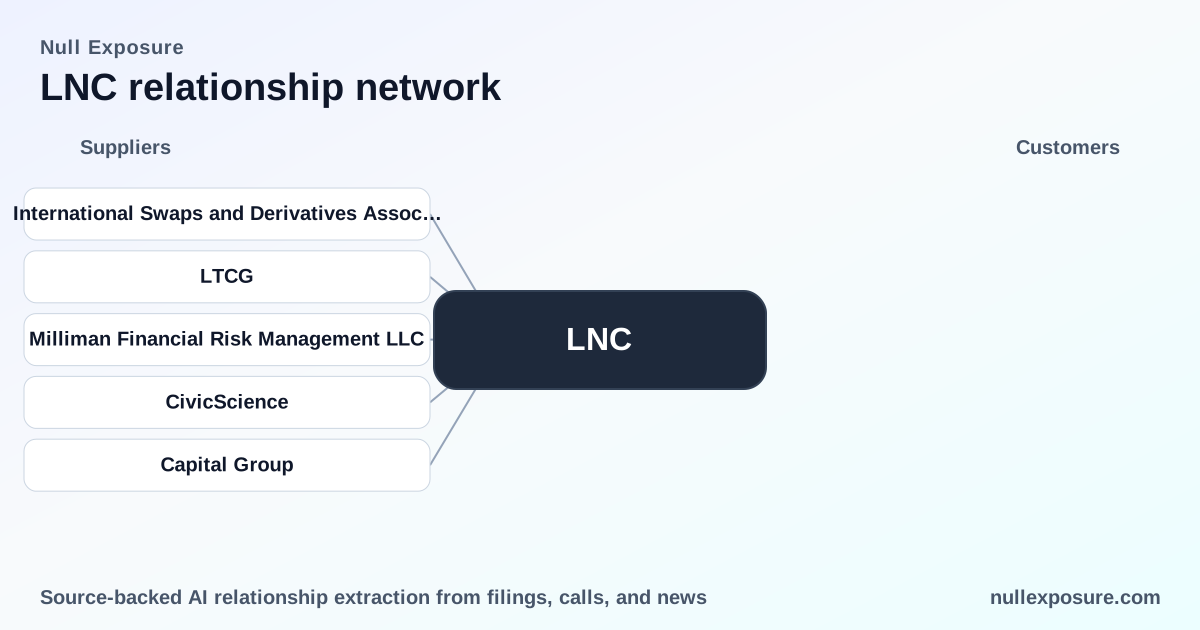
Lincoln Financial (LNC) — Customer Relationships and Distribution Signals
Lincoln Financial monetizes a diversified suite of life insurance, annuity and retirement services by selling products through a wholesale distribution network of independent intermediaries and institutional channels and by servicing sponsored retirement plans and group-protection contracts. Revenue derives from policy premiums, investment spreads in annuities, and recurring fees for retirement plan services — a blend that produces stable, recurring cash flow with distribution-driven growth dynamics. For a focused look at the company’s counterparty footprint and channel risks, see more at https://nullexposure.com/.
Quick take: what investors should hold front of mind
Lincoln is a mature life-insurance and retirement-services operator with $18.27 billion in trailing revenue and roughly $7.06 billion market capitalization, executing a business model that depends on breadth of distribution and the stickiness of plan and group clients. The company reports results across Annuities, Life Insurance, Group Protection and Retirement Plan Services, and explicitly emphasizes expanding its industry-leading wholesale distribution through Lincoln Financial Distributors.
Documented customer relationships — what’s on the record
Lincoln’s customer-relationship coverage in the provided search results is narrow but informative. Below I summarize each relationship item that the records returned.
- LNC-P-D: A fintech provider, BizEquity, partnered with Lincoln Financial Group in a collaboration noted in published local business press; the mention links Lincoln to fintech distribution and advisory partnerships that can augment small-business and advisor-facing capabilities. According to a BizJournals report dated September 24, 2018, BizEquity formed a partnership with Lincoln Financial Group that positions fintech tools alongside Lincoln’s distribution channels.
(That is the single relationship flagged in the results set; the source is the BizJournals article referenced above.)
Distribution and go-to-market: channel structure matters
Lincoln’s operating model is channel-centric. Company filings and disclosures describe distribution through independent sales representatives and through Lincoln Financial Distributors, which sells annuities, life and retirement-plan products through financial institutions and other intermediaries. These disclosures explicitly note that Lincoln’s sales representatives are not captive, making Lincoln reliant on incentive alignment with third-party intermediaries and wholesale distributors.
- Contracting posture: Lincoln uses hybrid contracting — long-term institutional relationships for retirement-plan and group products, and variable, commission-based relationships with independent reps for retail annuities and life products. This structure creates recurring servicing revenue on plan assets but variable acquisition economics on retail flows.
- Channel concentration: The company’s reliance on intermediaries reduces single-customer concentration on end clients, but it concentrates risk in distribution partners: if intermediaries favor competitors (driven by product attractiveness or commission economics), sales can reallocate away from Lincoln.
- Role dynamics: Company disclosures classify Lincoln simultaneously as seller, distributor, reseller and service provider — an operator that both originates and services long-duration liabilities while relying on partners to place product.
Customer mix: breadth across firm sizes and sectors
Lincoln’s product set intentionally spans employer sizes and institutional types, which is an explicit strategic signal:
- The firm markets Group Protection to employers from small companies under 100 employees up to large employers with 10,000+ employees.
- Its retirement plan book covers 401(k), 403(b) and 457 markets, therefore serving educational institutions, not-for-profit healthcare organizations, governmental and private-sector plans.
- BOLI/COLI (bank-owned life insurance and corporate-owned life insurance) distribution targets banks and mid- to large-sized corporations, primarily through intermediaries.
Taken together, these statements signal diversified counterparty exposure across small business, mid-market, large enterprise and non-profit sectors, reducing reliance on any single client type while increasing dependence on the stability of intermediary relationships.
Operational constraints that shape credit and growth dynamics
The constraint signals in the record provide actionable operating-model insights for investors evaluating customer risk and opportunity.
- Distributor dependence is structural: Lincoln’s growth initiatives explicitly target expanding wholesale distribution, signaling that incremental sales will be distribution-led rather than direct-to-consumer. This creates scalability in reach but structural vulnerability to intermediary economics (commission competition, product placement).
- Non-captive sales force increases go-to-market variability: Independent sales representatives can move to competitors offering better economics or product features, so product competitiveness and sales incentives directly influence organic growth.
- Service orientation supports recurring revenue: Retirement Plan Services and Group Protection create multi-year servicing relationships that generate fees and reduce churn, which is credit-supportive for long-duration liabilities.
- Counterparty diversity reduces single-client risk: The mix across small-business plans, mid-market corporate clients, large employers and non-profits is a company-level signal pointing to broad revenue sources rather than narrow dependency.
None of these constraints tie to a specific named customer in the dataset; they function as company-level signals that explain how Lincoln’s customer relationships influence revenue quality and distribution risk.
Investment implications and risk checklist
- Bull case drivers: Broad institutional and retail distribution, large installed base of plan assets, and recurring servicing fees support margin stability and cash flow predictability. The company’s trailing revenue base and established channels underpin valuation at current multiples.
- Primary risks: Competitive commission pressure among independent distributors, product substitution by rivals, and potential migration of advisors if agent economics are unfavorable. These are direct channel risks rather than single-client credit issues.
- Balance-sheet and product risk: As a life and annuity writer, Lincoln’s economics are sensitive to interest rate environments and reserve adequacy; distribution performance influences new business volumes that replenish fee-bearing assets.
How to use these signals in diligence
- Prioritize evaluation of distribution economics (commission levels vs. peers) and advisor retention metrics when modeling new-business volumes.
- Monitor plan-servicing retention and fee compression in Retirement Plan Services for forward-looking recurrence of fee income.
- Map intermediary relationships to sales outcomes: a wide, healthy distributor network supports scale; a concentrated or undercompensated network is a leading indicator of sales risk.
For a deeper reading on relationship signals and comparable issuer profiles, visit https://nullexposure.com/.
Bottom line
Lincoln operates as a distribution-first life insurer and retirement services provider whose revenue mix is anchored in long-duration contracts and recurring plan servicing but whose growth is dependent on third-party distribution economics. The documented relationship evidence is limited in scope but consistent with corporate disclosures emphasizing partnerships and intermediated channels; investors should underwrite both the stability of servicing revenue and the variability of intermediary-driven new business when assessing LNC’s forward performance.