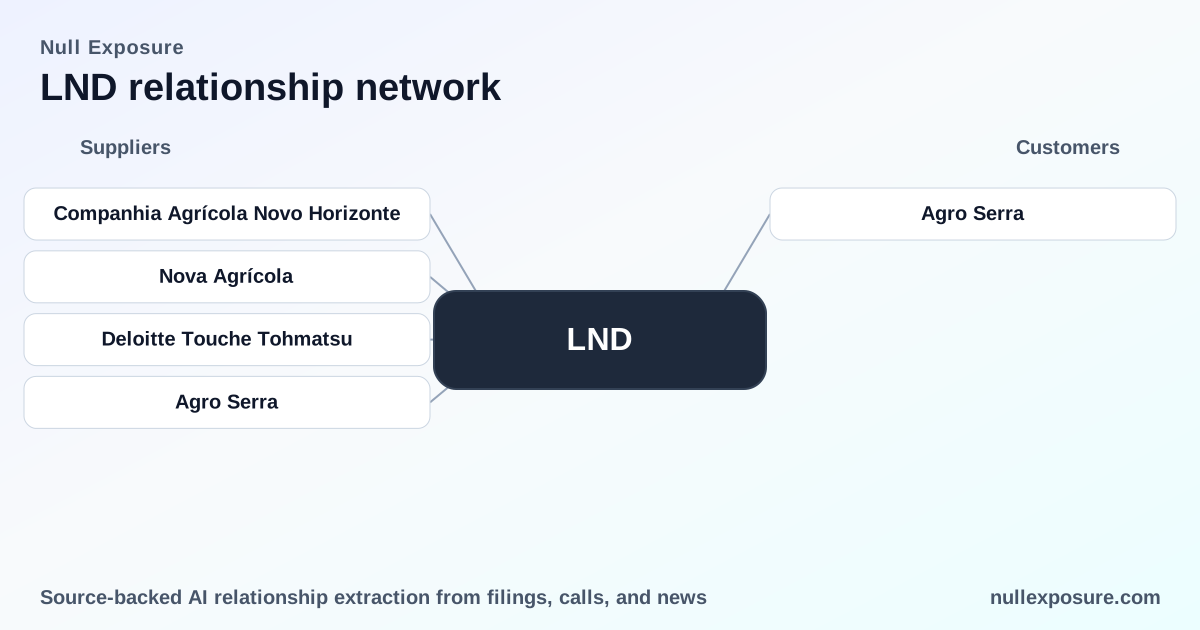
BrasilAgro (LND) — customer map and what an Agro Serra tie means for investors
BrasilAgro acquires, develops and sells rural properties and operates a portfolio of agricultural assets in Brazil; it monetizes through land sales, farm-level crop sales (including sugarcane) and the recurring economics of developed agricultural operations. Revenue is generated both from property dispositions and ongoing agribusiness production, and recent reporting highlights a material operational linkage between BrasilAgro’s São José farm and the sugar mill formerly owning that land, Agro Serra. For a concise, investor-focused customer view, see https://nullexposure.com/.
Business snapshot: BrasilAgro is a NYSE-listed agribusiness/property developer with a Market Capitalization of roughly $382m and Revenue TTM of ~BRL 965m (reported in USD-equivalent), while trailing margins and EBITDA show pressure (negative EBITDA and a slim profit margin). The company runs a dual business model — land development/liquidation and commodity production — which creates mixed cash generation profiles and varying counterparty exposure.
How BrasilAgro makes money and why customer links matter
BrasilAgro’s operating model combines property-level economics with commodity offtake. The company develops and operates farms and sells or leases improved rural properties; where it retains operations, it sells produced crops into local value chains. This hybrid model produces episodic capital gains when properties are sold and recurring agricultural revenues tied to crop cycles and local buyers. Financials show meaningful revenue but weak operating profitability, which places an emphasis on asset rotation and working capital tied to harvest cycles and offtaker relationships.
Key financial signals:
- Revenue (TTM): 965.2m (local reporting converted to USD basis in the overview).
- Market cap: $381.5m.
- Operating margin and EBITDA are under pressure, indicating dependence on successful asset sales and efficient farm operations to deliver cash flow.
The customer relationships in public reporting
The public customer-scope intelligence contains two news references linking BrasilAgro’s São José farm activity to Agro Serra. Each listed relationship below is summarized directly from the source.
Agro Serra — AgFeed report (March 10, 2026)
BrasilAgro’s São José farm in Maranhão is identified as the company’s “most profitable” property primarily because its main activity is sugarcane cultivation, and that cane is supplied to the Agro Serra mill, which was the former owner of the land. (AgFeed, March 10, 2026: https://agfeed.com.br/negocios/brasilagro-planeja-ampliar-area-de-cana-em-busca-de-resultados-mais-doces/)
Agro Serra — Comprerural report (March 10, 2026)
Reporting indicates that, despite a reduction in planted area, sugarcane production destined for Agro Serra increased materially — from under 1 million to 1.5 million tonnes per harvest — underscoring an expanded throughput relationship between São José and the mill. (Comprerural, March 10, 2026: https://www.comprerural.com/fazenda-da-brasilagro-e-avaliada-em-r-475-milhoes-veja-onde/)
What the Agro Serra link means for concentration and contracting posture
The two independent press reports establish a clear commercial connection: São José’s economics are materially tied to sugarcane production sold to Agro Serra. From an investor standpoint this implies several structural characteristics of BrasilAgro’s customer exposure:
- Concentration risk: A large single-buyer relationship at a farm level creates exposure to the milling counterparty. If Agro Serra accounts for a substantial share of São José’s crop sales, any pricing or take-or-pay renegotiation would materially affect farm-level cash flows.
- Contracting posture: The historical fact that Agro Serra was the former owner of the land suggests an incumbent, operationally integrated supply relationship rather than an ad hoc spot sale arrangement; that strengthens supplier bargaining continuity but also embeds dependency.
- Criticality: São José is called out as BrasilAgro’s current “most profitable” farm because of cane output. This makes the Agro Serra off-take relationship strategically important to BrasilAgro’s near-term operational performance.
- Maturity: The relationship is operationally mature — production has scaled up (reported to 1.5 million tonnes per harvest) — indicating the supply chain is established and not at the pilot stage.
These characteristics shape credit and operational risk: concentrated offtake increases earnings volatility if the mill reduces purchases or if cane prices move unfavorably, while an established supply relationship reduces execution risk around harvest and logistics.
Constraints and company-level signals
No customer-scope contractual constraints or compliance caveats are present in the source feed for this review. The absence of explicit constraint data in the customer channel is itself a signal: public reporting captures operational links through trade press rather than formal, disclosed long-term contracts in filings. Investors must therefore rely on operational disclosures and local media to gauge counterparty terms and resilience.
Investment implications and risk checklist
- Revenue composition: BrasilAgro blends land-sale upside with agronomic cash flow; investors should model both episodic property dispositions and recurring crop sales when forecasting cash generation.
- Counterparty dependency: The Agro Serra relationship elevates farm-level concentration for São José, which is currently a key driver of profitability; this is a single-farm, single-mill concentration that can amplify earnings variability.
- Operational leverage: Increased cane throughput (from under 1 million to 1.5 million tonnes per harvest) demonstrates operational scale at that asset, improving fixed-cost absorption but also raising exposure to commodity price cycles.
- Disclosure gaps: With no formal customer contract details in the customer-relationship feed, credit and counterparty risk assessment requires primary diligence — commercial contracts, pricing terms and volume commitments should be requested in investor diligence.
Final thought for investors
BrasilAgro’s asset-light development ethos combined with localized agribusiness operations creates a mixed cash-flow profile where individual farm relationships — such as the São José–Agro Serra supply tie — can materially influence near-term profitability. Monitor disclosures for contractual terms with Agro Serra, harvest volumes and pricing, and the cadence of property sales to judge whether recurring operations or asset rotations will drive value in the coming quarters. For an investor-facing customer mapping and to track changes in BrasilAgro’s counterparty footprint, visit https://nullexposure.com/.
Bold takeaways:
- São José farm’s profitability is closely tied to sugarcane sales to Agro Serra.
- Production scale-up to 1.5 million tonnes per harvest raises both operational leverage and counterparty concentration.
- No formal customer-contract constraints are public in the feed; direct diligence on contract terms is essential.