Cheniere (LNG) — customer map and what it means for cash flow durability
Thesis: Cheniere Energy monetizes U.S. liquefied natural gas through long‑term sale and purchase agreements (SPAs) and an integrated marketing function that sells uncontracted production into the spot market; the company’s business model is driven by long‑dated contracted cash flows, broad geographic liftings, and a credit‑secure counterparty base that reduces revenue volatility while preserving optional upside from short‑term sales. For a concise view of customer relationships and the underlying contract structure, see Null Exposure’s portal: https://nullexposure.com/.
Overview — how Cheniere makes money Cheniere builds and operates large LNG liquefaction terminals (Sabine Pass and Corpus Christi) and sells LNG under two economic levers: (1) long‑term SPAs that generate fixed, predictable fees and baseload volumes, and (2) marketing and short‑term sales that capture margin from market dislocations. The company’s publicly disclosed financials show heavy EBITDA contribution from contracted volumes and significant negotiating leverage derived from long weighted‑average contract lives and parent company credit support for many counterparties.
Quick navigation
- Relationship summaries (complete list)
- How the contracts shape cash flow and risk
- Investment implications and what to watch
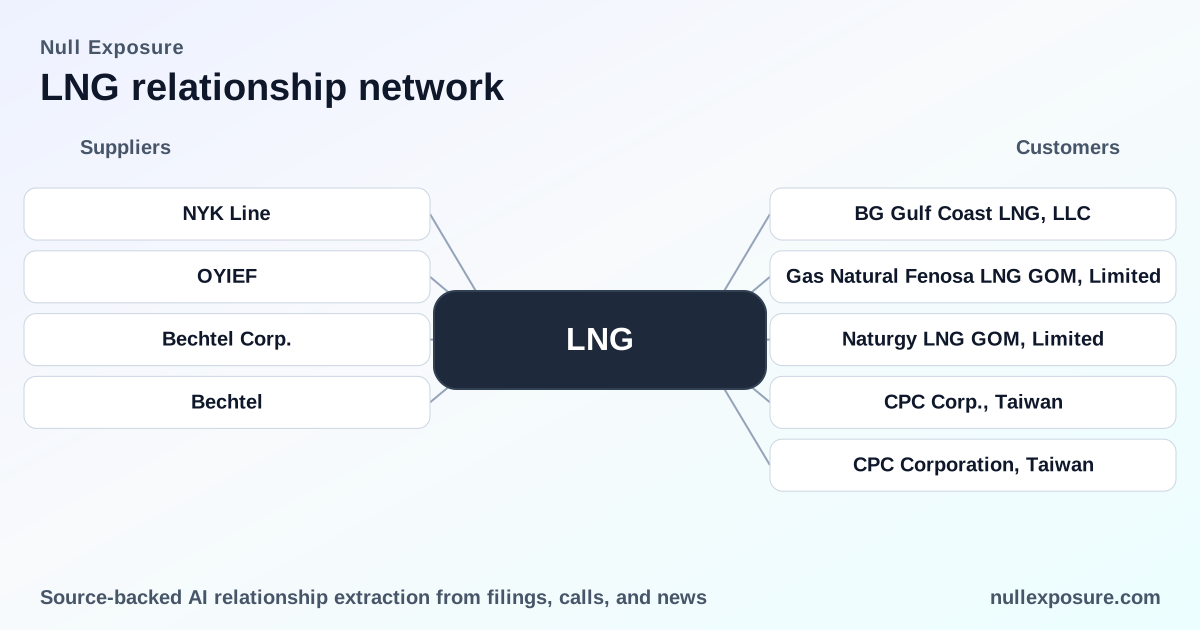
H2 — All named customer relationships and what they practically are The section below covers every counterparty in the disclosed results.
-
Gas Natural Fenosa LNG GOM, Limited
Cheniere (through Sabine Pass LNG, SPL) is the seller under an LNG Sale and Purchase Agreement (FOB) dated November 21, 2011 originally with Gas Natural Aprovisionamientos and subsequently assigned to Gas Natural Fenosa LNG GOM, Limited; this is a classic long‑dated FOB SPA that secures delivery obligations and fixed fees. This relationship is documented in Cheniere’s FY2024 Form 10‑K. -
Naturgy LNG GOM, Limited
Naturgy is the assignee referenced in follow‑on paperwork: Cheniere disclosed a letter agreement dated June 8, 2023 converting contract references from LIBOR to SOFR as an amendment to the November 21, 2011 SPA that was assigned to Naturgy LNG GOM, Limited, reflecting contract housekeeping and benchmark reform implementation in the 10‑K (FY2024). -
BG Gulf Coast LNG, LLC
Cheniere lists an Amended and Restated LNG Sale and Purchase Agreement (FOB) dated January 25, 2012 with BG Gulf Coast LNG, LLC; that SPA is recorded in the FY2024 10‑K and represents another long‑term commercial anchor for SPL cargoes. -
CPC Corporation, Taiwan (CPC)
Cheniere Marketing signed a long‑term SPA with CPC for up to 1.2 million tonnes per annum delivered from 2026 through 2050, expanding delivered‑basis sales into Taiwan and adding a 25‑year commitment to Cheniere’s portfolio; this contract was reported in March 2026 by LNG Industry and covered in trading press around the 2025 full‑year results. (See LNG Industry, TradingView coverage, March 2026.) -
CQP (Cheniere Partners)
Cheniere Partners (ticker: CQP) has an operational relationship with Cheniere where Cheniere provides specified management services to the partnership; Cheniere disclosed this contractual service arrangement in company press material and related filings (Cheniere press release and corporate updates, FY2022).
H2 — What the contract evidence tells investors about operating characteristics Cheniere’s customer relationships collectively reveal a consistent operating model rather than a scattershot portfolio.
-
Long‑term backbone with spot optionality. Company disclosures emphasize long‑term SPAs and IPM agreements with a weighted average remaining life of roughly 15 years as of December 31, 2024, and indicate that approximately 95% of anticipated production from the liquefaction projects was contracted through the mid‑2030s (FY2024 10‑K). This produces highly visible cash flow for project financing and shareholder returns.
-
Short‑term exposure is deliberately retained. Cheniere explicitly sells uncontracted volumes through Cheniere Marketing into the global spot market, so the company preserves upside from market tightness while maintaining a stable base from SPAs (FY2024 disclosures).
-
Counterparty credit posture is conservative. The company states that substantially all long‑term third‑party arrangements are executed with a creditworthy parent or supported by guarantees or collateral, which materially reduces counterparty credit risk on long‑dated receipts (FY2024 10‑K).
-
Global offtake footprint and revenue diversification. Revenue attribution in the 2024 filing shows customer receipts across the United States, Singapore, Ireland, the U.K., South Korea, Spain, India, Switzerland, China, Taiwan and other countries, underscoring a geographically diversified customer base and demand exposure to multiple regional gas markets (FY2024 10‑K).
-
No single customer concentration risk at the 10% revenue threshold. Cheniere discloses no customer accounted for 10% or more of consolidated revenue in 2024, a company‑level signal that commercial revenue is broad enough to avoid single‑counterparty dependency (FY2024 10‑K).
H3 — Contracting posture, criticality, maturity — how to think about risk Investors should treat Cheniere as a quasi‑infrastructure cashflow business with commodity exposure layered on top.
-
Contracting posture: Predominantly long‑term, fee‑based SPAs with inflation adjustments and variable components tied to Henry Hub, which supports debt capacity and predictable distributable cash flow. The company’s own statements emphasize long‑dated contracts and structured cash flows as future liquidity sources (FY2024 10‑K).
-
Counterparty concentration and credit quality: Broad geographic offtake and parental guarantees concentrate credit risk at the sovereign and large‑enterprise level rather than single small counterparties. This reduces counterparty risk but retains market exposure through delivered and FOB contract terms.
-
Maturity and optionality: With a long weighted‑average remaining life on SPAs, Cheniere’s base business is mature; however, retained uncontracted volumes and new long‑term SPAs such as CPC’s 25‑year deal demonstrate an ongoing ability to monetize incremental capacity and capture both term and delivered demand.
H2 — Investment implications and monitoring checklist
- Durable base cash flows: Long‑dated SPAs and credit protections justify an infrastructure valuation frame for much of Cheniere’s enterprise value.
- Commodity sensitivity: Short‑term sales and variable SPA components expose earnings to Henry Hub and regional spreads—monitor U.S. gas supply, LNG arbitrage windows, and freight.
- Contract roll and new offtake: Watch new SPAs (e.g., delivered deals such as CPC) and the pace at which incremental capacity is contracted; these directly drive growth in distributable cash flow and de‑levering potential.
- Regulatory and benchmark risk: Benchmark transitions (LIBOR→SOFR) and contract amendments indicate operational housekeeping that investors should track for legal/contractual continuity (see Naturgy amendment disclosure, FY2024 10‑K).
For a structured, up‑to‑date view of Cheniere’s counterparty network and contract attributes, visit Null Exposure: https://nullexposure.com/.
Conclusion — clear creditable cash flow pattern Cheniere’s customer relationships are dominated by long‑term SPAs backed by creditworthy counterparties and supplemented by marketing sales for spot upside. The documented agreements with counterparties such as Gas Natural/Fenosa, Naturgy, BG Gulf Coast, CPC (Taiwan), and Cheniere Partners illustrate a portfolio that balances predictability and commercial optionality—an operating model consistent with infrastructure‑style valuation but with embedded commodity cyclicality that investors must actively monitor.