LINKBANCORP (LNKB): Strategic exits, a proposed merger, and what customers reveal about franchise risk
LINKBANCORP operates as the bank holding company for LINKBANK, a regional commercial bank focused on personal and business lending, deposit gathering and cash services across Pennsylvania, the greater Delaware Valley and nearby mid-Atlantic markets. The company monetizes through net interest margin on originated loans and fee income from deposit and service businesses, generating roughly $118 million in trailing revenue and delivering a mid-teens return on equity. For investors, the near-term story is corporate restructuring—branch sales and a proposed stock-for-stock combination—that reshapes both the customer footprint and the deposit base. For operators, the transactions reveal concentration of retail and municipal deposits and a customer mix weighted to small businesses and nonprofits. Learn more at the Null Exposure homepage: https://nullexposure.com/
What the New Jersey branch divestiture tells investors
LINKBANK executed a focused contraction of its geographic footprint by selling its New Jersey operations and three branch locations to American Heritage Federal Credit Union. This is a tactical asset-sale intended to remove a non-core market presence while transferring deposits and associated loans, suggesting management preference for regional consolidation rather than incremental multi-state branch expansion. According to a PR Newswire release in March 2026, regulatory approvals were received to complete the New Jersey branch sale to American Heritage FCU. A local report from Cutoday noted American Heritage, a $4.9 billion credit union, agreed to buy three LINKBANK branches as part of the transaction (coverage dated March 2026).
The proposed Burke & Herbert transaction and shareholder scrutiny
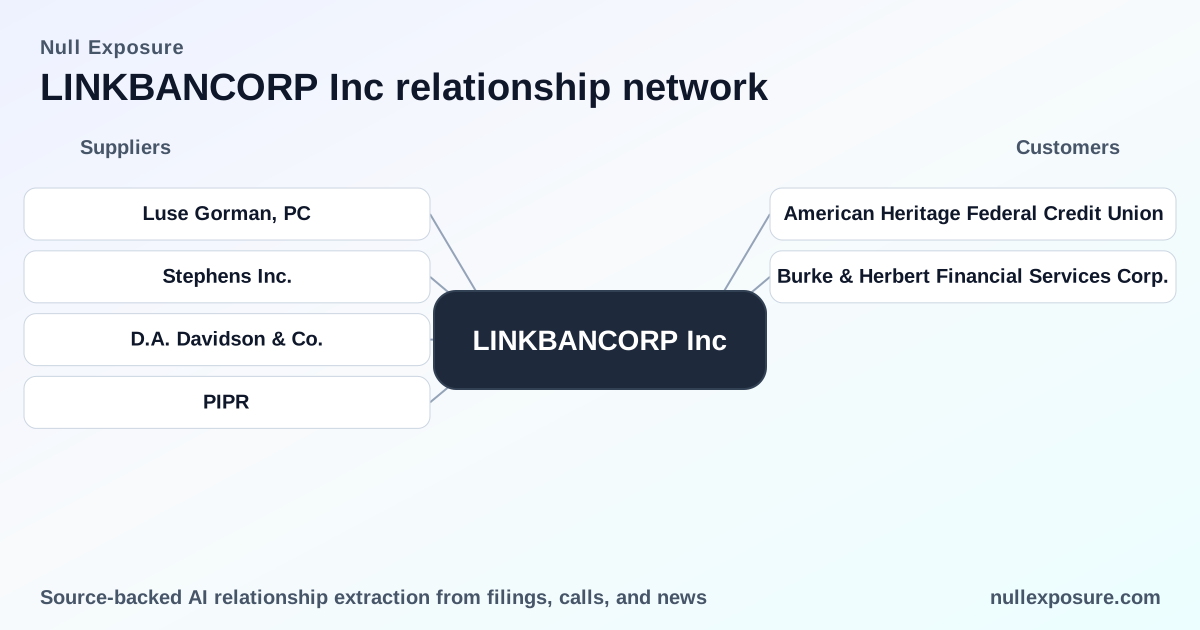
LINKBANCORP has a signed deal to be acquired by Burke & Herbert Financial Services Corp. in a stock-for-stock exchange, with LINK shareholders to receive 0.1350 shares of Burke & Herbert common stock for each LINK share. The proposed combination represents a control-change exit that consolidates community banking assets in the region and crystallizes value for LINK shareholders on a multiple that the market will judge against standalone prospects. Multiple news outlets reported the exchange ratio in early March 2026, and investor-interest law firms publicly flagged the transaction for fairness review in May 2026; Halper Sadeh LLC announced an inquiry into whether the deal is fair to LINKBANCORP shareholders.
Mapping every public customer relationship mentioned in coverage
- American Heritage Federal Credit Union — FY2025: LINKBANCORP confirmed regulatory approvals to complete the sale of its New Jersey operations to American Heritage FCU, transferring loans, three branch locations and related deposits; this was reported via PR Newswire in March 2026 (https://www.prnewswire.com/news-releases/linkbancorp-inc-announces-receipt-of-regulatory-approvals-for-new-jersey-branch-sale-302412424.html).
- Burke & Herbert Financial Services Corp. — FY2026 (Sahm Capital coverage): Reports noted the agreed acquisition structure—0.1350 shares of Burke & Herbert stock per LINK share—presenting a definitive M&A term sheet for LINK shareholders (March 2026 coverage at https://www.sahmcapital.com/news/content/are-ehab-dvn-lnkb-ceco-obtaining-fair-deals-for-their-shareholders-2026-03-03).
- Burke & Herbert Financial Services Corp. — FY2026 (Finviz summary): Secondary market coverage reiterated the same exchange ratio and deal terms, underscoring wide distribution of the transaction terms in March 2026 (Finviz news summary, March 2026; https://finviz.com/news/327606/are-pen-stkl-bco-lnkb-obtaining-fair-deals-for-their-shareholders).
- American Heritage Federal Credit Union — FY2024 (local reporting): Local business press documented the purchase of three LINKBANK branches by American Heritage FCU and put the acquirer’s size at roughly $4.9 billion in assets, highlighting the strategic buyer profile (Cutoday coverage, March 2026; https://www.cutoday.info/Fresh-Today/American-Heritage-FCU-To-Buy-3-LINKBANK-Branches).
- Burke & Herbert Financial Services Corp. — FY2025 (investor-rights notice): An investor-rights law firm, Halper Sadeh LLC, announced an investigation into whether the sale of LINKBANCORP to Burke & Herbert for 0.1350 shares per share is fair to LINK shareholders, signaling active dissent and procedural scrutiny (Aijourn reporting, May 2026; https://aijourn.com/lnkb-stock-alert-halper-sadeh-llc-is-investigating-whether-the-sale-of-linkbancorp-inc-is-fair-to-shareholders/).
Operating model and business constraints that matter to investors and operators
LINKBANCORP’s customer profile and accompanying disclosures produce several actionable operating signals:
- Contracting posture: short-term liquidity exposures. Brokered deposits were disclosed to mature in the first quarter of 2025, indicating a chunk of funding was explicitly short-dated and required active rollover or replacement strategies. This is a company-level signal from the December 31, 2024 notes.
- Counterparty mix includes government/municipal concentration. The company reported $44.2 million of municipal deposits that exceeded FDIC insurance limits as of year-end 2024, indicating exposure to large public deposit relationships that are uninsured above limits and therefore operationally and reputationally important.
- Retail-heavy and community-commercial orientation. The Bank’s core customers are individuals, small businesses, mid-market commercial borrowers and nonprofit organizations, delivered through branch solutions centers and digital channels; this customer mix drives predictable deposit stickiness but limits scale economies in high-margin commercial corridors.
- Geographic concentration in the mid‑Atlantic. Lending and deposit origination are concentrated in south-central/eastern Pennsylvania, northern Virginia, eastern Maryland, Delaware and southern New Jersey—a regional concentration that increases idiosyncratic risk to economic cycles in those states.
- Roles and revenue model: both buyer and seller, primarily services. LINKBANK functions as a traditional community bank—originating loans, gathering deposits and providing fee-for-service banking—while occasionally acting as a seller of branch operations to redeploy capital. Monthly service fees are recognized over the service period, indicating recurring fee revenue components.
- Maturity and stage: active but transactional. Relationships are operational and ongoing, but the recent branch sale and proposed merger indicate a franchise in transition away from standalone regional growth toward consolidation or exit.
These constraints collectively frame a bank with service-oriented, geographically concentrated revenue, tactical short-term funding requirements and material municipal deposit concentrations, all of which elevate reliance on disciplined liquidity management and effective execution of M&A integration or divestiture plans.
Key takeaways for investors and bank operators
- For investors: The Burke & Herbert exchange ratio converts LNKB’s equity story into a survivable payout today; the market will price that against LINK’s standalone metrics—9.66 trailing P/E and a book value of $8.18 per share—so compare implied accretion/dilution and the potential premium to local peers. Regulatory approvals for the American Heritage branch sale reduce geographic overhead and transfer deposit risk off LINK’s balance sheet.
- For operators: Expect near-term balance-sheet simplification and a narrower branch footprint; liquidity management is the immediate operational priority given the disclosed short-term brokered deposit maturities and uninsured municipal deposits.
If you want a deeper read on how these customer-level facts translate into balance-sheet and valuation shifts, explore our research hub: https://nullexposure.com/
Conclusion: LINKBANCORP is a compact regional bank whose customer relationships and recent transactions reveal strategic contraction and an imminent control change. Investors should value the stock through the lens of a consolidation exit and the operational constraints of regional deposit concentration; operators should prioritize liquidity execution and smooth hand-off of divested branches.