Alliant Energy (LNT): Customer Relationships That Shape a Regulated Utility Investment
Alliant Energy is a regulated Midwestern utility that monetizes electricity and gas distribution through its two operating utilities (IPL in Iowa and WPL in Wisconsin), plus a modest non‑utility services book, collecting recurring regulated cash flows while pursuing targeted non‑utility investments and contractual off‑takes. For investors, the company’s customer footprint is a mix of stable, long‑term retail demand and selective commercial contracts that influence capital allocation and risk exposure. For a quick view of the platform and relationships discussed here, visit https://nullexposure.com/.
Operational snapshot Alliant’s core business generates predictable revenue from retail electric and natural gas sales to roughly one million electric and ~430,000 gas customers across the Midwest; non‑utility activities (including wind assets and services) supplement utility earnings but are not revenue‑concentrated. Financials through the latest quarter show a regulated profile with steady margins and a modest growth outlook driven by capital investment plans and customer additions.
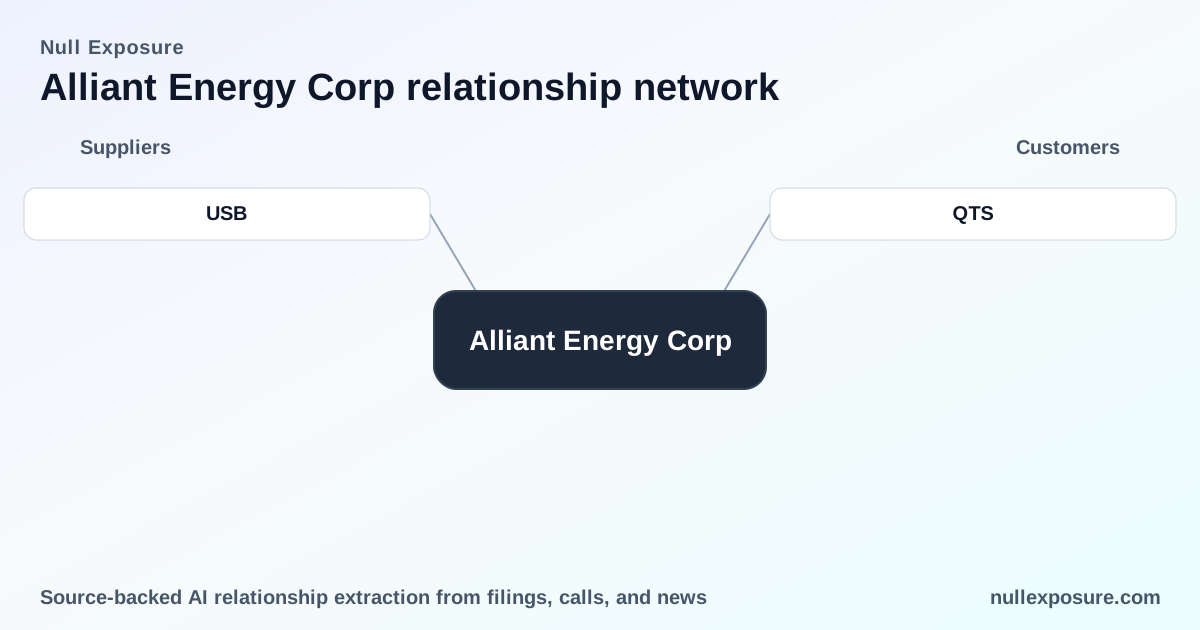
Customer relationship map: the three external names in public reporting The following covers every named customer or partner relationship surfaced in public reporting and news through FY2026. Each entry includes a concise plain‑English summary and a source reference.
QTS — renegotiated electric service agreement for a relocated data‑center project Alliant renegotiated an electric service agreement with data‑center operator QTS tied to a relocated project, which management described as reinforcing the company’s flexibility and balanced generation portfolio while keeping the four‑year capex plan on track. This was disclosed in FY2026 earnings commentary and multiple March 2026 news reports (see Alliant’s FY2026 earnings call and contemporaneous coverage; e.g., company remarks reported by InsiderMonkey and Rigzone in March 2026: https://www.insidermonkey.com/blog/alliant-energy-corporation-nasdaqlnt-q4-2025-earnings-call-transcript-1700297/; https://www.rigzone.com/news/midwest_utility_alliant_posts_higher_annual_profit_on_rate_increases-20-feb-2026-183033-article/).
WD (Walker & Dunlop) — sale of underperforming asset portfolio originally acquired from Alliant Walker & Dunlop reported selling a portfolio of underperforming assets that it had acquired from Alliant in 2021, signaling a secondary market disposition of non‑core assets that Alliant once owned. This disposition was mentioned in Walker & Dunlop’s Q4 2025 reporting and noted by CityBiz in March 2026 (https://www.citybiz.co/article/811307/walker-dunlop-reports-fourth-quarter-2025-financial-results/).
SCOR / Proximic by Comscore — data partnership to commercialize predictive audiences Alliant made 500 of its predictive audience segments available through Proximic by Comscore’s Data Partner Network, expanding how marketers and partners can access audience signals derived from Alliant’s work; the partnership was described in a March 2026 press release covering marketing and audience monetization efforts (press release via Providence Journal, March 2026: https://www.providencejournal.com/press-release/story/17185/alliant-partners-with-proximic-by-comscore-to-help-marketers-maximize-audience-scale-with-predictive-audiences/).
What the relationship profile reveals about Alliant’s operating model The publicly reported relationships and corroborating constraints point to a mixed but coherent business model. Key company‑level signals investors should weigh:
- Contracting posture — long‑term orientation. Alliant operates with long‑dated commercial arrangements where relevant: the company reports long‑term power purchase and service agreements (PPAs and service contracts) that underpin revenues for non‑utility generation and that can include multi‑decade guarantees. This is a structural feature of utility economics that supports predictable cash flows (constraint evidence references long‑term PPAs and a parent guarantee tied to an operating agreement expiring in 2047).
- Customer concentration — low single‑counterparty risk. Management discloses that no single customer represented 10% or more of consolidated revenues, which implies revenue diversification across a large retail base and multiple commercial counterparts.
- Role balance — seller of core commodity and provider of services. Alliant is primarily a seller of electricity and gas, but also delivers services (commercial gas transportation, third‑party power sales and non‑utility services such as audience products). Investors should treat the core regulated distribution business as the dominant cash engine, with services and asset sales playing ancillary roles.
- Criticality and materiality — core operations are critical; some non‑utility exposures are immaterial. While the regulated distribution business is critical to the region’s energy infrastructure and company cash flow, several non‑utility items (e.g., transfers of renewable tax credits and certain non‑core asset portfolios) are described as immaterial to consolidated results and often carry indemnifications with low likelihood of payment under current interpretations.
- Maturity and lifecycle — active and long‑running contracts plus prospective customer wins. The company maintains active, long‑standing contractual obligations (including guarantees that unwind over decades), and it also has prospective commercial relationships—most notably data‑center service agreements that could add significant future demand but are subject to regulatory approvals and construction timelines.
Risk and upside framed by customer ties
- Upside: long‑term service contracts and retail monopoly positions create predictable earnings and support stable dividend generation; successful renegotiation of large commercial contracts (e.g., with data‑center operators) can further monetize spare system capacity and justify capex. The QTS renegotiation reflects management’s ability to structure deals that align utility capacity with commercial demand.
- Risk: execution and regulatory timing for large commercial customers (interconnections, IUC approvals) introduce timing risk; long‑term guarantees and indemnities tied to non‑utility assets create contingent obligations even if they are judged remote. Dispositions of underperforming assets (Walker & Dunlop’s sale) illustrate that non‑core asset performance is uneven and can result in secondary market activity.
How to use this analysis as an investor or operator
- For equity investors, value rests in regulated cash flow durability and visibility into large commercial loads; track approved tariff treatments and interconnection timelines for prospect customers that can materially shift load profiles.
- For credit or counterparty evaluation, long‑term PPAs and explicit parent guarantees are credit‑supportive but require monitoring for off‑balance contingent exposures and the pace at which indemnities decline.
- For operators and asset managers, non‑core asset dispositions (as illustrated by the Walker & Dunlop transaction) are an instrument to reallocate capital toward higher returning regulated investments.
Concluding view and next steps Alliant’s customer relationships are anchored in regulated, long‑term utility economics, supported by selective commercial contracts and small‑scale monetization of data and service capabilities. The QTS renegotiation demonstrates pragmatic commercial flexibility, while the Walker & Dunlop note and the Comscore partnership illustrate active management of non‑utility exposures and ancillary revenue channels. For a consolidated view of customer relationships and how they map to credit and investment decisions, see https://nullexposure.com/.
Key takeaway: Alliant’s core value proposition is stable regulated cash flow, augmented by targeted commercial deals and cautious monetization of non‑utility assets; investors should focus on regulatory outcomes and the timing of large commercial interconnections when modeling upside or stress scenarios.