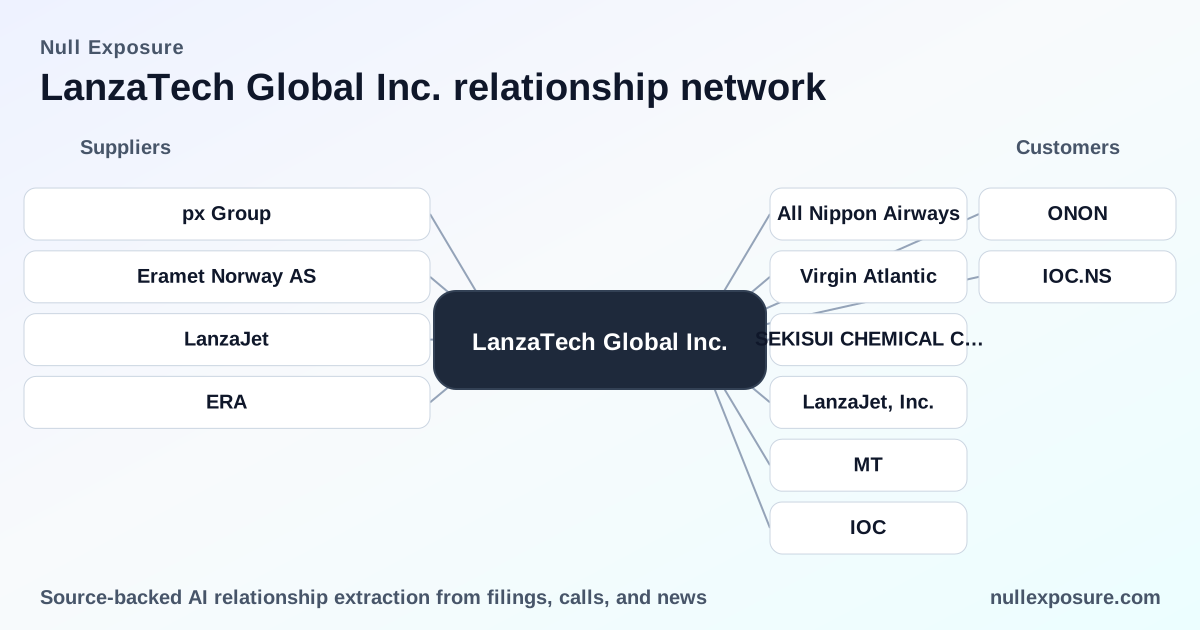
LanzaTech (LNZA): Commercial partners validate a licensing-first growth model with services revenue attached
LanzaTech operates as a technology licensor and industrial services provider that converts industrial carbon streams into ethanol and downstream products, monetizing through running royalties on licensed plants, fixed license fees, and engineering/R&D services. The company’s commercial traction is visible across airlines, steelmakers, chemical and energy majors, and specialty manufacturers — a partner mix that supports scale-up but concentrates revenue risk in a handful of large counterparties. For deeper partner-level exposure and signal tracking visit https://nullexposure.com/.
How LanzaTech’s contracts and footprint drive revenue and risk
LanzaTech’s operating model is license-centric with services attached. The company licenses intellectual property to facility owners and collects running royalties or fixed consideration, while also supplying feasibility studies, basic engineering, biocatalysts and R&D services that generate nearer-term revenue. This combined posture creates a two-track monetization profile: long-duration, recurring royalty upside as plants commercialize, plus earlier cash from services and supplies.
Geographically, LanzaTech runs a global rollout across North America, EMEA and APAC. That distribution supports diversified project pipelines but also implies complex execution risk across jurisdictions. The company reports material counterparties that represent 10% or more of revenue, signaling revenue concentration that investors must monitor as licenses convert to stable royalty streams. Government-sponsored R&D engagements are part of the mix, introducing contracting diversity (private industrial partners and public agencies) that both stabilizes and complicates cashflow timing.
Key operating characteristics:
- Contracting posture: Licensing as core revenue driver, supported by engineering and R&D services.
- Commercial maturity: Mix of pilot, demonstration and early commercial operations — projects are advancing but revenue recognition shifts as plants move to owner-operated commercial scale.
- Counterparty mix: Industrial majors, airlines, specialty manufacturers and government R&D customers — concentration risk is non-trivial given largest customers exceed 10% of revenue.
- Geographic reach: North America, EMEA and APAC with global reporting and operations, which increases addressable market and execution complexity.
For additional company-level intelligence and relationship monitoring, see https://nullexposure.com/.
Relationship snapshot — who LanzaTech is working with today
Below are concise, investor-facing summaries of every customer relationship detected in recent public sources.
-
All Nippon Airways — LanzaTech’s technology underpins LanzaJet’s SAF development that supported early commercial sustainable aviation fuel flights with major carriers, including All Nippon Airways in 2018–2019. Source: QuiverQuant coverage celebrating LanzaJet’s SAF production, March 10, 2026.
-
Virgin Atlantic — LanzaTech’s alcohol-to-jet pathway enabled early commercial SAF flights with Virgin Atlantic, demonstrating the technology’s route to aviation customers and brand partner validation. Source: QuiverQuant coverage on LanzaJet’s historic ethanol-based jet fuel production, March 10, 2026.
-
SEKISUI CHEMICAL CO., LTD. — A longstanding partner, SEKISUI operates an MSW-to-ethanol pilot in Kuji City, Iwate, with LanzaTech reporting successful operational results from that plant as of January 2026. This confirms real-world pilot performance in APAC and partner-operated deployments. Source: GlobeNewswire press release covered by Yahoo Finance, January 7, 2026.
-
LanzaJet, Inc. — LanzaTech is a strategic technology provider and shareholder of LanzaJet, supplying Alcohol-to-Jet conversion know-how and greater ownership as the JV moves toward commercial SAF output; corporate filings and press releases in 2025–2026 describe amended investment agreements and an increased stake. Source: QuiverQuant reports on LanzaTech increasing its LanzaJet stake and amending investment agreements, March 2026.
-
Eramet Norway — LanzaTech’s second-generation bioreactor is slated for deployment at Eramet Norway’s manganese smelter to convert greenhouse gases into ethanol, signaling industrial capture applications in extractive metals operations. Source: Investing.com SEC-filing coverage referencing the project, May 3, 2026.
-
ArcelorMittal (MT) — ArcelorMittal is cited as a global commercial partner with projects in Belgium; the relationship positions LanzaTech inside steelmaking value chains where off-gas conversion yields both emissions mitigation and ethanol feedstock. Source: QuiverQuant and ManilaTimes coverage of LanzaTech project announcements, March and January 2026.
-
IndianOil Company (IOC) — IndianOil is referenced as a regional partner in India, aligning LanzaTech’s technology with major national refinery/chemical operations and SAF project planning such as Dragon II in the U.K., indicating cross-border commercial linkages and off-take relevance. Source: QuiverQuant and ManilaTimes reporting on LanzaTech initiatives and SAF projects, January–March 2026.
-
On (ONON) — The athletic brand On partnered with LanzaTech and Borealis on CleanCloud, a program to convert carbon emissions into materials used in footwear, illustrating an application of LanzaTech’s ethanol-derived intermediates in consumer supply chains. Source: PR Newswire announcement originally published in 2021 and referenced in subsequent reporting.
What these relationships imply for investors
These partners validate LanzaTech’s licensing-first strategy and establish multiple commercial pathways — SAF for airlines, ethanol feedstock for chemicals and consumer materials, and direct industrial decarbonization for metals and steelmakers. Pilot-to-commercial transitions (SEKISUI, LanzaJet and ArcelorMittal-linked projects) are the critical inflection points where license economics convert into recurring royalties.
Key investor implications:
- Upside: Royalty economics scale asymmetrically as multiple plants reach commercial operations; strategic stakes in downstream entities like LanzaJet accelerate capture of higher-margin SAF value.
- Execution risk: Global projects increase schedule and permitting complexity; services revenue cushions near-term results but is lower-margin than royalties.
- Concentration risk: Largest contracting entities represent material shares of revenue; a small set of partners materially influences short-term performance.
Bottom line — invest with a project lens
LanzaTech’s partner roster demonstrates real commercial traction across aviation, heavy industry, and consumer applications, anchored by a licensing model that promises recurring upside as facilities scale. Investors should underwrite revenue trajectories on a project-by-project basis: count near-term services but price the stock for successful conversion of pilots and demonstrations into operating, royalty-generating plants. For ongoing partner monitoring and deeper relationship signals consult https://nullexposure.com/.
Bold, partner-validated technology plus concentrated counterparties equals asymmetric upside paired with execution-dependent risk; diligence should focus on project delivery milestones, royalty start dates, and any single-customer revenue concentration that could influence quarterly results.