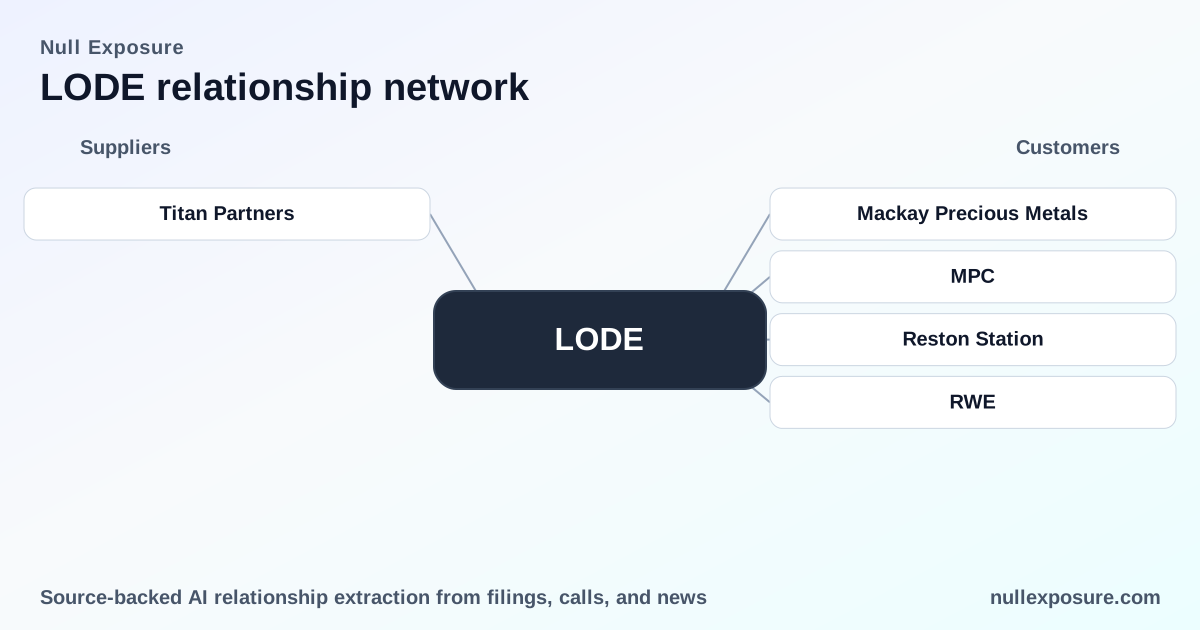
Comstock Mining (LODE): Transitioning from legacy mineral assets to fee-based services and licenses
Comstock Mining operates as a small-cap precious metals explorer and producer that is actively diversifying into recycling services and licensing of advanced fuels technology. The company monetizes through three distinct channels: traditional mineral production and royalties (including recent NSR sales), service revenues from a demonstration-scale solar panel recycling operation, and licensing/engineering agreements under its Comstock Fuels platform—with early commercial activity concentrated in FY2024–FY2026. For investors, the investment case is defined by revenue diversification potential and material counterparty concentration risk; detailed customer and partner relationships inform where recurring cash flow can realistically emerge. Learn more at https://nullexposure.com/.
Executive snapshot: what drives revenue and where the leverage sits
Comstock’s reported financials show modest revenue (Revenue TTM ~$1.55M) and negative operating margins, while the company carries a market capitalization that reflects optionality more than current cash generation. The near-term revenue mix is skewed toward service fees and one-off transactions: NSR royalty sales and recycling service fees produced measurable receipts in FY2024–FY2026, while the fuels business is positioned to generate licensing and engineering income in APAC markets. Key value drivers are successful conversion of pilot recycling into scale, repeatable licensing in international markets, and the translation of utility/industrial agreements into recurring volumes; key risks are customer concentration and early-stage commercial maturity.
Operating model signals investors should weigh
- Contracting posture — hybrid fee and license model. Company disclosures note both service-fee models for recycling (decommissioning and tipping fees, offtake sales) and licensing/engineering agreements for the Fuels segment, indicating Comstock sells both services and intellectual property to third parties rather than relying solely on commodity extraction revenues.
- Geographic expansion — APAC is a target market. Management commentary points to anticipated licensing and engineering work in Australia, New Zealand, Malaysia, Vietnam, and Pakistan, signaling a growth posture that emphasizes international engineering contracts.
- Concentration — single-customer materiality. The company reports that Mackay Precious Metals accounted for over 10% of revenues and receivables as of year‑end 2024, which is a meaningful concentration that elevates counterparty risk for near-term cash flows.
- Role profile — both seller and service provider. Comstock acts as a direct seller of recycled materials and as a service provider for panel decommissioning and processing, a combination that diversifies revenue types but keeps cash generation tied to industrial-scale throughput.
- Maturity — demonstration scale and early commercial revenue. The Metals recycling business is still at demonstration scale with initial revenue recognized; Fuels revenue is expected as licensing deals convert to execution, indicating early commercial stage rather than established recurring revenue.
- Criticality — limited but strategically relevant. Recycling and fuels licensing are strategically valuable and potentially higher-margin downstream activities, but current revenues are modest and therefore not yet critical drivers of consolidated profitability.
Customer and partner map: each relationship explained
Below are the customer and partner relationships surfaced in public reports, each in plain language with a concise source reference.
Mackay Precious Metals — material counterparty and NSR counterparty
Comstock completed a $1.1 million NSR royalty sale to Mackay Precious Metals in January 2026, and Mackay was disclosed as a customer representing over 10% of revenues and receivables at year‑end 2024, making this relationship material to near-term cash flows. (TradingView report on the NSR sale, Jan 21, 2026; company disclosure cited in FY2024/FY2023 notes.)
NextEra — target utility customer for energy-related services
Management cited NextEra among a list of major utilities the company has successfully engaged with, indicating active commercial conversations with large utility buyers that could underpin scale for energy‑adjacent projects. (Earnings call transcript coverage, Q4 2025 earnings discussion as reported by InsiderMonkey, FY2026 commentary.)
Reston Station — local services agreement for operational support
Comstock announced an agreement to provide services to Reston Station, intended to enhance operational capabilities at that site—this reflects the company’s service-provider activity beyond raw-mining operations. (Intellectia news coverage of a financial webinar and service announcement, reported March 2026.)
RWE — commercial contract cited as illustrative of recurring volume potential
RWE was referenced as one of the major utility names in management commentary, with external analysis highlighting the potential for RWE-style contracts to convert into recurring volumes for Comstock’s services. (SimplyWallSt profile on Comstock’s solar and utility contracts, FY2026 reporting; InsiderMonkey earnings call transcript, FY2026.)
Marathon Petroleum (MPC) — strategic investment in fuel-related operations
Marathon Petroleum made an investment in Comstock’s fuel subsidiary in March 2025, a transaction management described as a significant milestone for the fuel segment and its ability to commercialize feedstock/refining solutions. (Company earnings call transcript, Q3 2025 corporate update.)
Amentum (AMTM) — partner arrival and operational collaboration at Reston Station
Amentum’s presence at Reston Station was announced in conjunction with Comstock’s service activity there, suggesting third-party operational collaboration on site work or broader facilities support. (Intellectia news item, March 2026.)
Florida Light and Power — named utility prospect in management remarks
Florida Light and Power was listed by management among utilities they have engaged successfully, signifying prospective commercial relationships in the utility channel that could support offtake or services. (Earnings call transcript coverage on InsiderMonkey, FY2026.)
Nevada Energy — utility prospect named among strategic customers
Nevada Energy was cited by management as a signed or engaged utility partner, consistent with efforts to commercialize services and supply chain solutions with regional utilities. (Earnings call transcript coverage reported in FY2026.)
Edison — European utility listed in management commentary
Edison was included in the list of large utilities management referenced when describing their commercial progress, indicating global utility engagement for energy/renewables-related services. (InsiderMonkey earnings call coverage, FY2026.)
Brookfield — institutional partner referenced in utility engagement context
Brookfield was named alongside other major energy firms in management remarks about successfully signing large utility and infrastructure partners, pointing to institutional-level engagement potential. (Earnings call transcript reporting via InsiderMonkey, FY2026.)
What this map means for investors: distilled takeaways
- Concentration risk is real and measurable: Mackay’s >10% share of revenue and receivables is an explicit vulnerability for near-term cash flow.
- Revenue diversification is nascent but directional: Recycling service fees and licensing show a credible path to recurring margins, but both are still at demonstration or early-contract stages.
- Commercial validation exists at the enterprise level: Management cites major utilities and strategic partners (NextEra, RWE, Marathon, Brookfield) as engaged counterparties—these names enhance the credibility of pipeline conversion risk but do not eliminate execution risk.
- International upside via licensing: Targeted APAC licensing agreements for the Fuels segment represent a potentially higher-margin growth vector if the company can scale engineering delivery and local partnerships.
If you want a structured, investor-grade brief or relationship heatmap that prioritizes counterparties by revenue exposure and strategic importance, Null Exposure provides that analysis and data-backed monitoring at https://nullexposure.com/.
Investors should treat Comstock as an early-stage commercializer: actively diversifying away from pure exploration into service and licensing revenue, but still subject to concentrated counterparties and the execution hurdles of moving pilot operations into scalable contracts.