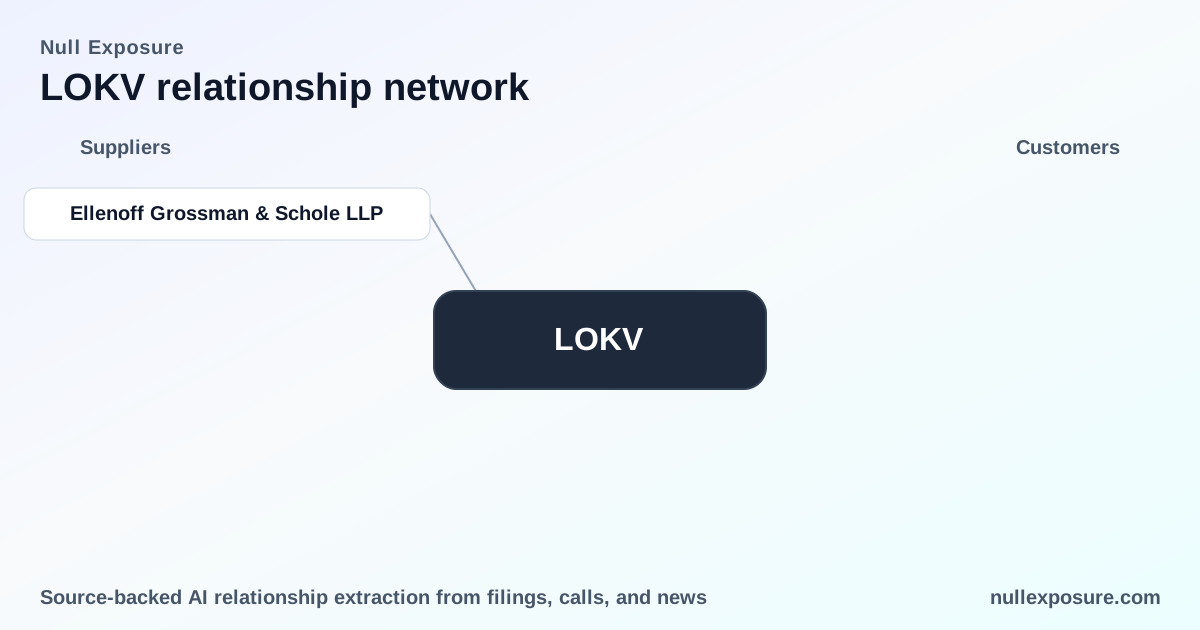
Live Oak Acquisition Corp. V (LOKV): Sponsor financing and what it means for investors
Live Oak Acquisition Corp. V operates as a traditional SPAC that raises capital through an IPO and sponsor contributions, then seeks a merger target to convert that capital into operating value. LOKV monetizes primarily through IPO proceeds, sponsor-purchased warrants, and the subsequent value creation (or return) delivered by a business combination; until a target is announced the vehicle’s economics are governed by trust cash, sponsor economics, and warrant structures. For investors evaluating the company’s customer/partner relationships, the most material active relationship in public reports is the sponsor financing tied to private placement warrants. For further company-level signal work and ongoing relationship monitoring, see NullExposure’s coverage. https://nullexposure.com/
Quick investor thesis: Sponsor-backed funding creates runway but concentrates upside and governance
LOKV’s near-term credit and liquidity profile is shaped by sponsor participation rather than operating revenues — the sponsor’s purchase of private placement warrants provides incremental cash and aligns incentives but also concentrates economic leverage with the sponsor. That configuration is normal for a SPAC, but it imposes specific dilution and governance dynamics that investors must price into the path to a successful business combination.
What the public relationship entries show, one by one
-
Live Oak Sponsor V, LLC purchased 4.5 million private placement warrants at $1 per warrant, generating $4.5 million in proceeds concurrent with the IPO. This is a standard sponsor financing mechanism that increases the SPAC’s liquidity while granting the sponsor additional upside through warrants. Investing.com reported this in the IPO coverage (May 2026): https://www.investing.com/news/sec-filings/live-oak-acquisition-corp-v-completes-230m-ipo-3916131
-
A separate SEC-filing summary that covered governance movement also noted the sale of the same 4.5 million private placement warrants to Live Oak Sponsor V, LLC at $1 per warrant and quantified the proceeds as $4.5 million. Multiple public notices emphasize that the sponsor purchased these warrants at IPO launch rather than post-IPO, reinforcing the sponsor’s early cash commitment and economic stake. The governance filing summary that included the warrant sale was reported by Investing.com in May 2026: https://www.investing.com/news/sec-filings/live-oak-acquisition-corp-v-announces-director-resignation-93CH-4084042
Operating model and contract posture — what the relationship data implies
LOKV’s relationship set reflects a classical SPAC contracting posture:
- Sponsor-centric capital structure. The sponsor’s purchase of private placement warrants is the clearest sign that liquidity and upside are concentrated with the sponsor entity rather than distributed across an operating customer base.
- High concentration of counterparty risk. With no operating customers and limited counterparties listed, counterparty concentration is intrinsic — the sponsor is economically critical to pre-combination funding and incentive alignment.
- Transactional maturity is early-stage. This vehicle is in the capital-formation phase, not post-merger operations; from an investor perspective the SPAC’s contracts and relationships remain pre-operational and governance-focused, with maturity tied to the timeline for sourcing a target.
- No explicit contractual constraints disclosed in the relationship payload. The dataset contains no separate constraints; that is a company-level signal that public filings reported the sponsor warrant sale but did not surface additional contract limitations in this extract.
Why these sponsor transactions matter for valuation and governance
- Dilution and economics. Private placement warrants expand the sponsor’s option-like position; investors should account for potential dilution if warrants are exercised or exert influence on negotiation economics at the business combination stage.
- Alignment and control. Sponsor cash injections through warrant purchases align sponsor incentives with deal completion, but they also concentrate voting and economic leverage that can affect deal terms and timing.
- Liquidity runway. The $4.5 million raised through the warrant sale is incremental to IPO trust proceeds and improves short-term funding flexibility; however, that amount is modest relative to the trust size commonly required to underwrite a mid-market acquisition.
Tactical implications for investors and operators
- Track warrant terms and exercise mechanics closely. Warrant strike, exercise window, and dilution assumptions are key inputs to modeling pro forma capitalization after a deal.
- Monitor redemption behavior at proxy and combination votes; high redemptions can force sponsor top-ups or change the transaction structure.
- Evaluate sponsor reputation and track record — in a sponsor-centric structure like this, management skill and capital commitment are the single largest operational levers before a target is announced.
- For operators evaluating partnership with LOKV as a prospective target, recognize that negotiations will hinge on sponsor economics and the sponsor’s desire for upside via warrants rather than immediate cash compensation.
Risks to price into any investment decision
- Concentration risk: Sponsor ownership of private placement warrants centralizes upside and can limit minority investor influence.
- Execution risk: The SPAC’s value depends entirely on finding an accretive target within the SPAC’s life; sponsor funding purchases provide runway but do not remove deal risk.
- Dilution: Warrants, if exercised or structurally equivalent, reduce per-share economics for public shareholders post-combination.
- Information asymmetry: Public filings highlight sponsor financing but provide limited detail on prospective deal targets, so the sponsor’s incentives drive the timetable and deal terms.
Bottom line and next steps for research-driven investors
LOKV is operating as a textbook sponsor-financed SPAC: the sponsor’s $4.5 million private placement warrant purchase is material for understanding near-term liquidity, dilution, and governance dynamics. Investors should prioritize analysis of warrant economics, sponsor track record, and redemption scenarios as they build valuation cases for any prospective combination. For ongoing monitoring and deeper relationship-level signals, review NullExposure’s updated coverage and transaction intelligence here: https://nullexposure.com/
If you need a custom briefing or a comparative read across Live Oak’s sponsor activities and peer SPACs, reach out through NullExposure for tailored research and model inputs.