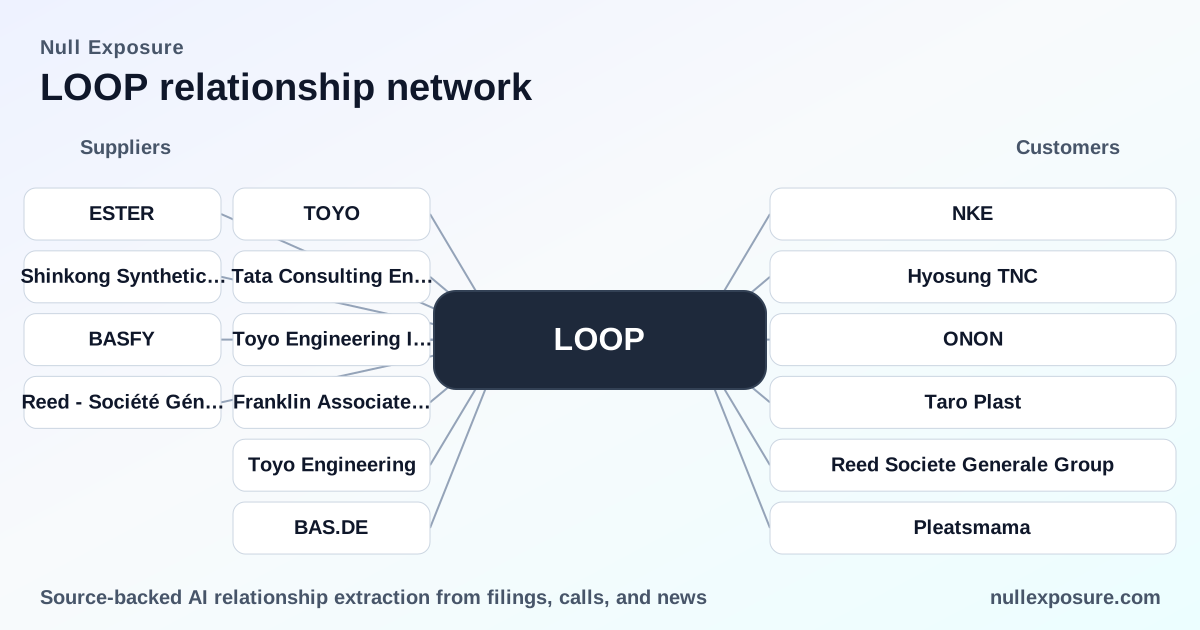
LOOP customer map: who pays for Loop Industries’ recycled polyester and why it matters to investors
Loop Industries converts waste PET and polyester fiber into virgin-quality building blocks and monetizes through long-term offtake sales of its Twist™ polyester resin, licensing of its depolymerization technology, and engineering/milestone fees for facility rollouts. The company’s commercial story in FY2025–FY2026 is anchored by a major retailer of scale plus a network of textile converters and strategic partners that extend market reach and distribution. For more structured coverage of customer relationships and commercial terms, see https://nullexposure.com/.
The anchor customer: Nike / NKE — scale, take‑or‑pay, and revenue visibility
Loop has executed a multi‑year offtake agreement with Nike (NKE) to supply Twist™ polyester from the Infinite Loop India facility, and the contract includes a guaranteed take‑or‑pay structure that fixes annual volume commitments and supports predictable near‑term revenue. (Multiple press releases and earnings transcripts, Mar–May 2026: https://intellectia.ai/news/stock/loop-industries-loop-secures-longterm-contract-with-nike-as-india-facility-construction-progresses-on-schedule; InsiderMonkey Q3 FY2026 transcript: https://www.insidermonkey.com/blog/loop-industries-inc-nasdaqloop-q3-2026-earnings-call-transcript-1675953/).
Why it matters: Nike functions as an anchor offtaker and provides a clear demand signal and pricing cadence under a long‑term contract — a structural revenue lever rather than one‑off sales.
Key industrial and converter customers
Taro Plast / Taro Plast S.p.A.
Loop announced a supply contract with Taro Plast, an Italian specialty polymer manufacturer, to buy DMT and related Loop products for conversion and resale. (Earnings call transcripts and press releases, FY2025–FY2026: https://www.investing.com/news/transcripts/earnings-call-transcript-loop-industries-q2-2025-sees-stock-dip-on-earnings-miss-93CH-4292821; TradingView SEC/10‑Q summary, May 2026: https://www.tradingview.com/news/tradingview:70d8c09bbec92:0-loop-industries-inc-sec-10-q-report/).
On (ON / ONON)
Loop supplied material used in On’s Circular Cyclon™ program so that an upper on a new shoe was made with Loop’s 100% recycled polyester fiber produced via Infinite Loop™ technology. (Press coverage, Mar 2026: https://sg.finance.yahoo.com/news/loop-industries-collaborates-unveils-launch-131500890.html).
Hyosung TNC / Hyosung
Loop partnered with Hyosung TNC to supply Twist™ polyester resin that Hyosung converts into regen™ high‑performance yarns for apparel and performance textiles. (Company release and industry coverage, FY2025: https://www.newswire.com/news/loop-industries-and-hyosung-tnc-launch-strategic-alliance-to-support-shift-by).
Pleatsmama
Loop’s collaboration with Pleatsmama produced pilot projects — including a handbag — demonstrating fiber‑to‑fiber circular applications for Loop’s recycled polyester. (Indian Textile Magazine coverage, FY2025: https://www.indiantextilemagazine.in/loop-industries-sets-stage-for-indias-circular-polyester-future-with-gujarat-plant-and-hyosung-partnership/).
Reed Societe Generale Group
Loop licensed its technology to Reed Societe Generale Group for a European plant; the arrangement includes engineering services revenue and milestone licensing payments to Loop. (Earnings call and press summary, FY2026: https://www.insidermonkey.com/blog/loop-industries-inc-nasdaqloop-q3-2026-earnings-call-transcript-1675953/; TradingView Q3 FY2026 report: https://www.tradingview.com/news/tradingview:c14fe2457f9b7:0-loop-industries-reports-third-quarter-fiscal-2026-results/).
Textile‑industry aggregation partners and regional converters
Loop’s commercialization strategy uses a network of converters and regional aggregators to scale distribution for Twist™ resin and fiber. Each of the following partners is referenced in company transcripts or releases as part of that network.
-
Shing Kong / Shinkong — described as an aggregator capable of bundling smaller buyers into larger volume purchases that can directly source Loop resin. (Earnings call transcript, FY2025: https://www.investing.com/news/transcripts/earnings-call-transcript-loop-industries-q2-2025-sees-stock-dip-on-earnings-miss-93CH-4292821).
-
Xingkong / Xinqong / Xingqong — referenced as Taiwan partners used to expand Twist™ reach through existing spun‑fiber customers. (Investor transcript and press coverage, FY2025: https://m.au.investing.com/news/transcripts/earnings-call-transcript-loop-industries-q2-2025-sees-stock-dip-on-earnings-miss-93CH-4065767?ampMode=1).
-
Xu Song — cited alongside other textile partners as a South Korea‑based collaborator to scale spun‑fiber adoption. (Earnings materials, FY2025: https://m.au.investing.com/news/transcripts/earnings-call-transcript-loop-industries-q2-2025-sees-stock-dip-on-earnings-miss-93CH-4065767?ampMode=1).
-
Yusong — identified as one of the largest spinning companies Loop partnered with to distribute Twist™ at scale. (Investor transcript, FY2025: https://www.investing.com/news/transcripts/earnings-call-transcript-loop-industries-q2-2025-sees-stock-dip-on-earnings-miss-93CH-4292821).
Each of these partners increases commercial reach beyond Loop’s direct customer base by offering Twist™ through their existing spun‑fiber channels.
Company‑level commercial constraints and what they signal to investors
Company disclosures and press materials collectively show a consistent commercial pattern that investors should treat as operational signals rather than isolated statements:
-
Long‑term contracting posture: Evidence points to multi‑year offtake agreements with guaranteed volume commitments and mechanisms (deposits credited against future sales) that extend revenue visibility across years. This underpins project financing potential for new facilities.
-
Licensing as strategic channel: Loop uses licensing agreements to monetize technology directly via partners building plants in regional markets; licensing yields milestone payments and engineering revenue rather than pure product sales.
-
Usage‑based pricing on delivered volume: Commercial terms for resin sales are structured as fixed rates per delivered volume with a single performance obligation — consistent with supplier economics tied to throughput.
-
Counterparty mix skewed toward large enterprises: Public messaging targets apparel and CPG customers and leverages major brands and global converters as anchors to accelerate adoption.
-
Seller role and product focus: Loop is a seller of Loop™ PET resin and Twist™ polyester (core product), supported by an operating track record at its Terrebonne depolymerization facility.
These constraints collectively describe a company that builds revenue visibility through anchor offtakes and scalable reach via licensing and converter partnerships, which supports capital planning for Infinite Loop™ facilities.
Investment implications — concentration, execution, and upside
-
Concentration risk exists but is mitigated by structure: Nike is a material anchor customer whose take‑or‑pay terms deliver near‑term revenue certainty; however, investor returns depend on Loop executing multiple facility ramp‑outs and diversifying offtake mix beyond a handful of large partners. (Multiple sources, Mar–May 2026: company releases and earnings transcripts referenced above.)
-
Execution and financing are now the primary value drivers: Licensing revenue, milestone payments, and engineered facility rollouts (India and Europe) transform Loop from a technology developer into a manufacturing‑backed supplier; successful project financing and on‑time ramp of Infinite Loop plants are critical to realize modelled cash flows. (Company press releases and investor presentations, FY2025–FY2026.)
-
Channel strategy reduces GTM friction: Partnerships with global spinners and converters (Hyosung, Shinkong, Yusong, etc.) create scalable distribution for Twist™, converting technical capability into product adoption in textile supply chains.
Bottom line and next steps
Loop has transitioned from proof‑of‑concept to commercialization with a clear mix of anchor offtake contracts, converter partnerships, and licensing deals that create differentiated revenue streams. The valuation case now hinges on facility execution, financing, and expanding the offtake base beyond current anchors.
For a concise, analyst‑grade summary of customer contracts, partner roles, and milestones that impact Loop’s near‑term cash flow outlook, visit https://nullexposure.com/.
If you want a focused briefing that maps contract terms, revenue timing, and counterparty concentration into scenario P&Ls, we can prepare a tailored investor memo.