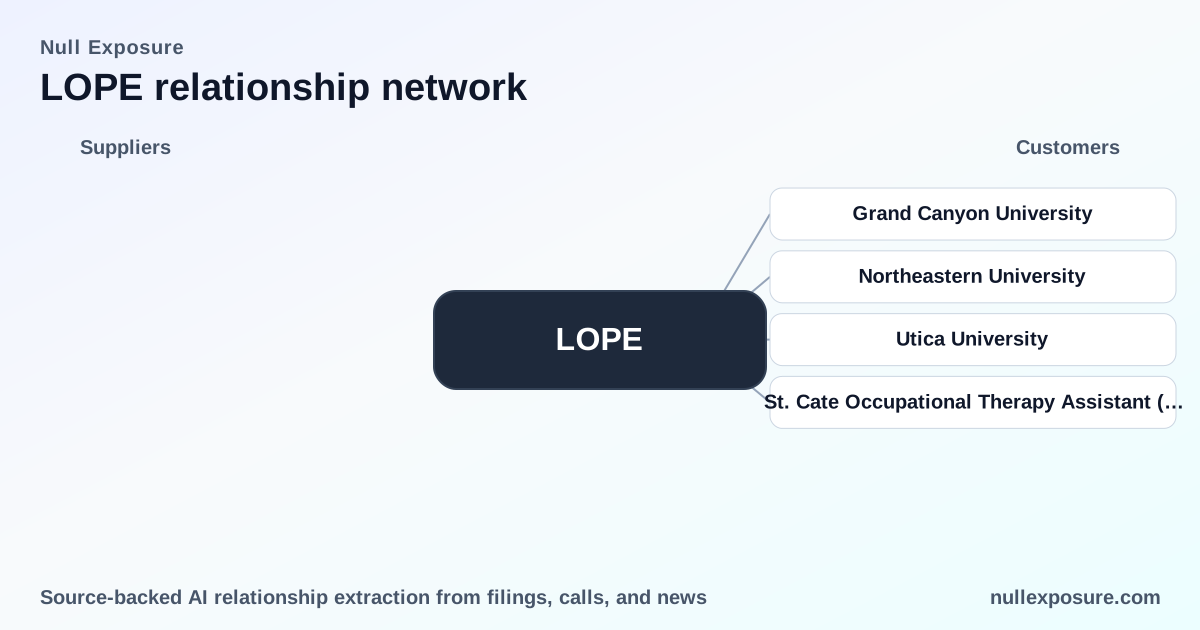
Grand Canyon Education (LOPE): Customer relationships that define the business model
Grand Canyon Education (LOPE) underwrites a services business that operates and monetizes college-level instruction and campus services by contracting with universities and colleges to provide integrated academic, marketing, technology and back-office functions in return for a percentage of tuition and fee revenue. The company’s economics are driven by long-term service agreements, high revenue share capture on partner tuition, and concentrated exposure to a primary university relationship that dominates service revenue. For investors evaluating partner risk and revenue durability, the most important facts are contract length, revenue concentration, and the pipeline of hybrid/partner programs GCE runs with other institutions. Learn more at https://nullexposure.com/.
H2: Why the customer map matters to valuation
Grand Canyon Education is not a software vendor or a marketplace; it is a service operator whose cash flows are tightly linked to student enrollment and tuition flows at partner institutions. That structure produces recurring revenue with embedded operational leverage, but it also creates single-customer concentration risk and legal/regulatory sensitivity. Investors should therefore price LOPE like a revenue-share operator with long-lived customer contracts and high customer criticality rather than a diversified SaaS business.
H2: What the public record lists — each customer mention, explained
Below I walk through every customer-related mention surfaced in the public record. Each item is a concise, plain-English takeaway followed by the reporting source.
-
Grand Canyon University — MarketBeat filing, April 26, 2026: MarketBeat flagged a securities filing while noting that GCE provides a “suite of higher-education services” to Grand Canyon University under a long-term agreement, confirming the ongoing operating relationship. (https://www.marketbeat.com/instant-alerts/filing-teacher-retirement-system-of-texas-acquires-36105-shares-of-grand-canyon-education-inc-lope-2026-04-26/)
-
Grand Canyon University — MarketBeat report on analyst action, April 16, 2026: An analyst note reiterated that GCE’s core business is delivering services to GCU under a long-term contract, underscoring how analyst coverage frames the company as the university’s service operator. (https://www.marketbeat.com/instant-alerts/barrington-research-reaffirms-outperform-rating-for-grand-canyon-education-nasdaqlope-2026-04-16/)
-
Grand Canyon University (GCU) — MarketBeat earnings alert, April 23, 2026: Routine earnings calendar coverage again ties LOPE’s results to its contracted operations for GCU, highlighting the recurring nature of the revenue stream. (https://www.marketbeat.com/instant-alerts/grand-canyon-education-lope-expected-to-announce-quarterly-earnings-on-thursday-2026-04-23/)
-
Grand Canyon University — ad-hoc-news market write-up, March 10, 2026: Post‑earnings commentary framed GCE as the service provider “behind Grand Canyon University,” emphasizing operational performance in a volatile sector. (https://www.ad-hoc-news.de/boerse/ueberblick/grand-canyon-education-stock-after-earnings-smart-buy-or-value-trap/68627905)
-
Grand Canyon University — MarketBeat FY2026 guidance release, February 18, 2026: Coverage of the company’s Q2 guidance reiterates that service revenues are driven by contracted operations at partner institutions, principally GCU. (https://www.marketbeat.com/instant-alerts/grand-canyon-education-nasdaqlope-releases-q2-2026-earnings-guidance-2026-02-18/)
-
Grand Canyon University — InsiderMonkey Q4 2025 earnings call transcript, March 2026: Management described dozens of AI-enabled products and development initiatives deployed across GCE/GCU’s colleges, signaling technology-led program expansion within the operating partnership. (https://www.insidermonkey.com/blog/grand-canyon-education-inc-nasdaqlope-q4-2025-earnings-call-transcript-1699610/)
-
Grand Canyon University — MarketBeat earnings projection, February 11, 2026: Pre-announcement coverage again linked LOPE’s quarterly performance to its contractual operations for GCU, reinforcing the earnings correlation. (https://www.marketbeat.com/instant-alerts/grand-canyon-education-lope-projected-to-post-quarterly-earnings-on-wednesday-2026-02-11/)
-
Grand Canyon University — ChristianDaily reporting on Department of Education action, March 2026: Coverage of the Education Department’s decision noted regulatory scrutiny over the relationship between GCU and its former public owner, underscoring legal and status risks that can flow from close operator-partner ties. (https://www.christiandaily.com/news/dept-of-education-affirms-grand-canyon-university-s-nonprofit-status-after-years-long-battle)
-
Grand Canyon University — MarketBeat FY2026 guidance update, April 30, 2026: An earnings guidance update reiterated the revenue linkage and the sensitivity of guidance to partner performance. (https://www.marketbeat.com/instant-alerts/grand-canyon-education-nasdaqlope-updates-fy-2026-earnings-guidance-2026-04-30/)
-
Utica University — InsiderMonkey earnings transcript note, March 2026: Management highlighted a joint online health science degree launched with Utica University, demonstrating GCE’s use of partner channels to expand program reach beyond its core campus operations. (https://www.insidermonkey.com/blog/grand-canyon-education-inc-nasdaqlope-q4-2025-earnings-call-transcript-1699610/)
-
Grand Canyon University (company profile) — StockStory LOPE profile, May 2026: Secondary market summaries continue to describe GCE’s primary service as operating GCU, a concise reminder of the business’s core customer relationship. (https://stockstory.org/us/stocks/nasdaq/lope)
-
Northeastern University — InsiderMonkey transcript excerpt, March 2026: GCE reported a hybrid partnership adding a graduate nursing program with Northeastern University, signaling an extension of GCE’s hybrid program model with established universities. (https://www.insidermonkey.com/blog/grand-canyon-education-inc-nasdaqlope-q4-2025-earnings-call-transcript-1699610/)
-
Grand Canyon University — MarketBeat filing, April 24, 2026: MarketBeat flagged institutional trades in LOPE stock while reiterating that the company’s revenue derives from long-term services agreements with university partners, notably GCU. (https://www.marketbeat.com/instant-alerts/filing-mt-bank-corp-purchases-135385-shares-of-grand-canyon-education-inc-lope-2026-04-24/)
-
Grand Canyon University — Finviz earnings summary, March 2026: Market summaries again positioned GCE as the operator of GCU, providing a cross-check of the company’s market narrative. (https://finviz.com/news/314970/grand-canyon-education-nasdaq-lope-posts-q4-cy2025-sales-in-line-with-estimates)
-
St. Cate Occupational Therapy Assistant (St. Cate) — InsiderMonkey transcript, March 2026: Management noted a hybrid occupational therapy bridge program tied to the St. Cate OTA program, illustrating GCE’s role in creating program ladders and hybrid offerings with niche partners. (https://www.insidermonkey.com/blog/grand-canyon-education-inc-nasdaqlope-q4-2025-earnings-call-transcript-1699610/)
H2: Constraints and what they tell investors about LOPE’s operating model
The public disclosures and extracted constraint signals collectively describe a company with these operating characteristics:
-
Long-term contracting posture. Services agreements typically carry initial terms in the 7–15 year range with renewal options, meaning revenue streams are durable but dependent on contractual performance measures.
-
North American geographic footprint. GCE provides services to university partners across the United States, positioning revenue and regulatory exposure primarily within U.S. higher-education policy regimes.
-
High customer concentration and criticality. GCE discloses dependence on its most significant university partner for a very large share of service revenue (historically cited at ~88.9%/87.8% for recent years), a signal that the business’s cash flow is critically concentrated and therefore sensitive to partner enrollment and regulatory outcomes.
-
Service-provider role and maturity. GCE generates all revenue from Services Agreements in which it delivers integrated academic, marketing, technology and back-office services and takes a percentage of tuition/fee revenue — a mature and clearly defined operating model distinct from licensing or software subscription businesses.
-
Active, expanding partner stage. The company reports active relationships with more than twenty partners and public evidence of program expansion and joint offerings, indicating an established but selectively growing partner network.
H3: Investment implications — what to watch next
- Valuation should price concentration risk. The company’s premium multiple reflects growth and margins; investors must weigh that against concentrated counterparty risk and regulatory sensitivity.
- Program expansion is de-risking but not diversifying enough. Hybrid and partner programs (Northeastern, Utica, St. Cate) demonstrate route-to-growth outside the core campus, but current disclosures indicate the business remains operationally concentrated.
- Contract tenure supports recurring cash flow — until it doesn’t. Long contract terms provide durability, but termination provisions and regulatory status of partners can cause abrupt re-rating.
For an organized view of LOPE’s partner exposures and ongoing signal updates, visit https://nullexposure.com/.
Bold, source-backed customer relationships and company-level constraints define the investment thesis for LOPE: durable but highly concentrated revenue, contractually entrenched operations, and programmatic expansion that reduces (but does not eliminate) counterparty risk. Monitor enrollment trends at partner institutions, regulatory developments, and the cadence of new hybrid partnerships as the primary risk and growth indicators.